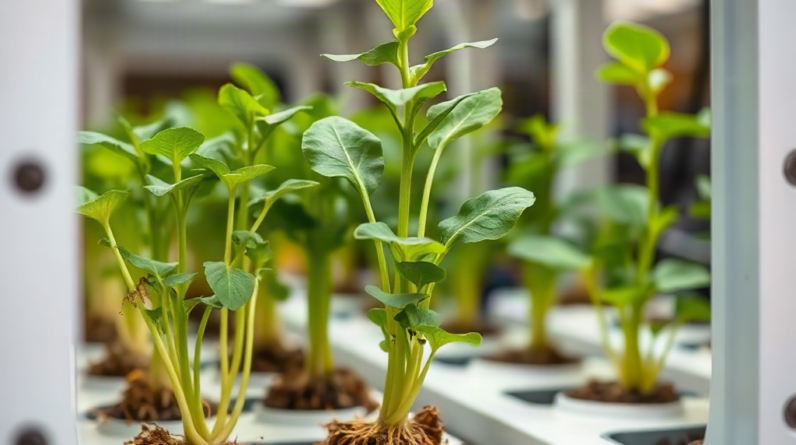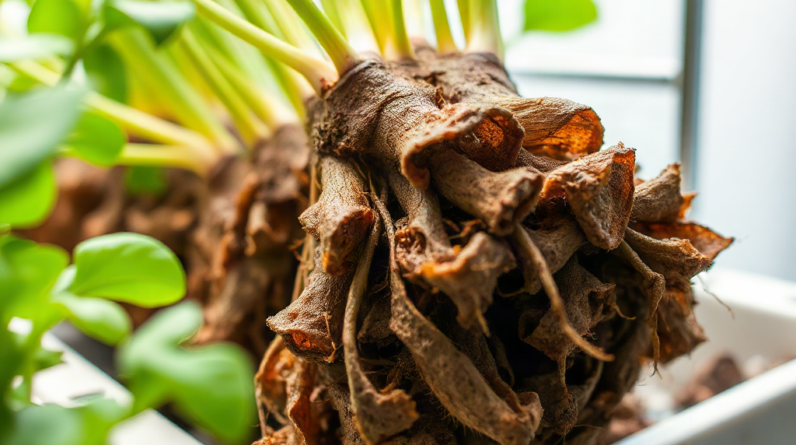
Hydroponic seedlings damping off before transplanting are usually being attacked by water-mold or fungal pathogens favored by saturated media, contaminated trays, weak airflow, and prolonged stem wetness. Typical symptoms include a pinched or water-soaked stem at the media line, sudden collapse, and roots that darken instead of expanding. Remove affected seedlings and isolate their cells because a collapsed stem will not recover. Save unaffected plants by reducing surface moisture, increasing gentle air movement, cleaning propagation equipment, and allowing plugs to drain between irrigations. Transplant only seedlings with firm stems, active roots, and no spreading lesions.
Recognizing Damping Off Rather Than Ordinary Seedling Stress
Damping off produces structural damage, not merely a temporary wilt. Affected seedlings commonly develop a narrow, soft, discolored section where the stem meets the propagation plug. The stem can appear water-soaked before it constricts, bends, and leaves the seedling lying across the tray. A plant in that condition has lost the tissue needed to support and supply its shoot; watering it more heavily does not restore that connection.
The timing and location of symptoms help separate damping off from other propagation problems. Pre-emergence infection may rot a seed or newly formed shoot before it breaks the surface, creating empty cells or patchy germination. Post-emergence damping off attacks visible seedlings. Collapse may begin in one persistently wet corner and spread into neighboring cells, especially where leaves touch or runoff moves between plugs.
Ordinary underwatering looks different. Several seedlings may droop together, but their stems remain firm and usually regain turgor after the plugs are rewetted. Excess fertilizer can burn young roots and leaf margins, while excessive light tends to bleach or curl exposed foliage. A stretched seedling caused by insufficient light has a long, thin stem, yet that stem is generally intact rather than pinched at the media surface. Root-zone disease becomes more likely when the plug smells sour, roots turn tan or translucent, and the stem lesion continues expanding after irrigation has been corrected.
Inspect plants under bright light and gently lift questionable plugs instead of judging only from above. Healthy young roots are usually light colored and extend through the plug without sloughing when handled. Seed coats, algae, and dark plug fibers can obscure the stem base, so move loose material aside without scraping the tissue. A hand lens can reveal the boundary between firm tissue and a soft lesion, although identifying the exact organism generally requires laboratory testing.
A collapsed seedling should be treated as nonrecoverable. A merely wilted plant with a sound stem deserves observation after moisture is corrected, but a plant with a girdled stem should be removed promptly. This distinction prevents growers from repeatedly soaking an infected tray in an attempt to revive dead tissue. For a focused visual diagnosis, compare symptoms against the checkpoints in Hydroponic seedlings damping off before transplanting before changing the entire propagation routine.
Why Propagation Conditions Favor Stem and Root Infection
Persistent moisture around immature stems creates the highest-risk environment. Organisms associated with damping off can survive on contaminated tools, trays, plant debris, seeds, or growing media and then exploit tender tissue under favorable conditions. Hydroponic propagation does not remove that risk. A seedling plug repeatedly saturated from below can retain a wet surface even though the eventual production system is clean and well aerated.
Watering frequency matters more than a simple rule about daily volume. A tray receiving a large irrigation and then draining may regain useful air space, while frequent small applications can keep the stem zone continuously wet. Domes intensify the problem after germination by trapping condensation and slowing evaporation. They are useful for retaining moisture before emergence, but leaving a sealed dome over established seedlings can keep stems and foliage damp for hours.
Air circulation also changes how quickly a plug surface dries. Stagnant air beneath shelving allows humidity to accumulate around a dense canopy. By contrast, a fan aimed directly at tiny seedlings may dehydrate plugs unevenly or bend stems. The better arrangement is gentle circulation across the propagation area, with leaves moving only slightly. Space trays so air can pass around them, and remove the dome gradually once most seeds have emerged.
Temperature can amplify moisture problems. Warm, saturated plugs accelerate biological activity and may place seedlings under low-oxygen stress, while cold media can slow root growth and leave plants vulnerable for longer. There is no universal temperature target for every crop: lettuce, basil, tomato, and pepper do not germinate or develop at identical rates. Follow the crop’s propagation range while avoiding large differences between a warm root zone and a cool, condensation-prone room.
Contamination often explains why one tray fails while another under similar lighting survives. Reusing a tray after rinsing away visible roots is not the same as cleaning and sanitizing it. Organic residue can protect pathogens from a sanitizer, so debris must be removed first and an appropriate product then used according to its label. Likewise, garden soil and unfinished compost are poor choices for a controlled hydroponic nursery because they introduce variable organisms and drainage behavior.
Do not assume nutrient strength is the primary cure. Seedlings need suitable nutrition after their stored seed reserves decline, but raising conductivity does not disinfect a wet plug and may add osmotic stress to damaged roots. Irrigation pattern, drainage, sanitation, airflow, crop temperature, and plug density should be reviewed together rather than chasing a single meter reading.
What to Do When Seedlings Begin Collapsing
Containment takes priority once stem collapse appears. Stop moving runoff, tools, or hands from the affected tray to healthy batches. Remove collapsed seedlings together with their plugs and discard them away from the growing area. If adjacent cells show discoloration, isolate the complete tray rather than transplanting apparently healthy plants directly beside established crops.
Use a short response sequence so corrective work does not create additional stress:
- Map the pattern: Note whether losses cluster under a drip point, beside a tray edge, beneath condensation, or across every cell.
- Check plug moisture: Lift several cells from wet and dry-looking areas; surface color alone can conceal saturation lower in the plug.
- Restore drainage: Empty standing water and confirm that inserts, channels, and drain openings are unobstructed.
- Adjust the environment: Remove or vent humidity covers after emergence and introduce mild, indirect air circulation.
- Separate viable plants: Keep only seedlings with firm stem bases and active, intact roots under observation.
Changing irrigation should be measured rather than abrupt. Severely drying a previously saturated tray can kill shallow roots and make the surviving plants look worse for a different reason. Allow plugs to move from evenly moist toward slightly lighter between applications, then irrigate thoroughly enough to wet the root zone and permit drainage. Check by plug weight and feel rather than following the same clock schedule through changes in canopy size, room humidity, and temperature.
For example, if collapse is concentrated in the back row of a flood tray, place an empty tray on the bench and test how water enters and exits. A slightly tilted bench or blocked outlet may leave that row submerged after the pump stops. Shortening the flood without correcting the trapped water may protect the front cells while leaving the original wet pocket unchanged. The physical distribution of moisture is often more revealing than the controller setting.
Clean exposed surfaces and equipment after removing losses. First wash away media particles and root residue; then apply a sanitizer approved for the relevant horticultural surface, concentration, and contact time. Never mix cleaning products unless their labels explicitly allow it. Seedlings should not be sprayed indiscriminately with household disinfectants, and a pesticide or fungicide should not be improvised from internet recipes. Product availability, crop labeling, production setting, and local rules differ, so any disease-control product must be selected and used according to its current label.
Recovery is demonstrated by stable stems, fresh root extension, and no new collapse over subsequent observations. New losses, expanding stem lesions, or continued sour-smelling media indicate that conditions remain favorable or contamination is still moving through the tray. The response sequence in Hydroponic seedlings damping off before transplanting is most useful when paired with daily records of irrigation, drainage, and affected cells.
Preparing the Next Batch for a Clean Transplant
Prevention begins before seeds enter the tray. Use clean propagation inserts, a fresh or appropriately stored soilless medium, clean water, and seed from a reliable source. Wash reusable solid surfaces to remove organic matter before sanitizing them. Porous items that cannot be cleaned adequately may cost more to rehabilitate than to replace, particularly after a severe outbreak.
Match the plug to the crop and watering method. A very small cell dries quickly but can remain saturated when it sits continuously in a deep nutrient film. A larger plug offers more moisture reserve, yet it also takes longer to dry if compressed or poorly drained. Fill cells consistently and avoid pressing media tightly around the seed; uneven packing creates wet and dry zones within the same tray.
After sowing, maintain the moisture needed for germination without leaving free water over the seed. Once seedlings emerge, vent or remove the humidity cover according to crop development rather than a fixed calendar date. Thin crowded cells early because overlapping seedlings slow surface drying and make individual stem bases difficult to inspect. Clean up dropped seed coats and dead plant material instead of allowing them to remain against stems.
A transplant-readiness check should consider plant structure and root condition, not just age:
- The stem base is firm, upright, and free of translucent or constricted tissue.
- Roots are actively reaching the plug edge without widespread browning or softness.
- The plug holds together when lifted but is not dripping or sour smelling.
- New leaves are developing normally for the crop, without unexplained collapse nearby.
- The production system is clean, operating correctly, and ready to receive plants immediately.
Moving questionable seedlings early is not a rescue strategy. Transplanting can conceal the original wet plug inside a net cup while introducing contamination to shared channels or a common reservoir. If only a few plants are doubtful, discarding them is usually less disruptive than exposing an established crop. If most seedlings appear weak, investigate the propagation process before filling the main system; plant age alone does not make a compromised batch ready.
Keep simple batch records for seed lot, sowing date, emergence, dome removal, irrigation frequency, room conditions, and losses by tray position. Records reveal repeatable patterns that memory misses. If the same cultivar repeatedly fails while neighboring cultivars remain healthy, examine seed quality and crop-specific conditions. If different crops fail in the same bench corner, drainage, condensation, or sanitation is the stronger suspect. The preventive checklist for Hydroponic seedlings damping off before transplanting should therefore be adapted to the tray pattern and crop rather than applied as a rigid watering formula.
Frequently Asked Questions
Can a hydroponic seedling recover after damping off?
A seedling with a constricted, collapsed stem will not recover. Remove it with its plug. A wilted seedling may recover only if the stem remains firm and the cause is temporary moisture stress rather than infected tissue.
Should I transplant the healthy-looking seedlings from an affected tray?
Isolate and observe them first. Transplant only plants with firm stem bases, clean active roots, and no new symptoms after moisture and airflow have been corrected; avoid moving questionable plugs into a shared system.
Does hydrogen peroxide cure damping off in seedling plugs?
It should not be treated as a universal cure. Concentration, formulation, crop sensitivity, organic residue, and contact time affect results. Remove diseased plants and correct saturation and sanitation failures rather than relying on an improvised drench.
How often should hydroponic seedlings be watered?
Water according to plug moisture, crop size, airflow, temperature, and drainage rather than a fixed daily count. Plugs should remain evenly moist during establishment but regain air space instead of staying continuously saturated.
Can damping off spread through a hydroponic reservoir?
Contaminated water, runoff, tools, hands, plugs, and shared equipment can move disease-associated organisms. Keep affected propagation trays separate and do not introduce suspect seedlings or their runoff into the production reservoir.
Further Reading
Authoritative Sources
- How to Prevent Seedling Damping Off
extension.umn.eduUniversity of Minnesota Extension explains characteristic symptoms, moisture-related risk, sanitation, and seedling management
- Damping-Off Diseases in the Garden
ipm.ucanr.eduUniversity of California’s integrated pest management resource describes pre-emergence and post-emergence disease and practical cultural controls
Conclusion
Successful intervention depends on distinguishing irreversible stem collapse from correctable wilting, then containing affected plugs before handling healthy trays. Inspect the stem at the media line, examine roots, and look for patterns tied to standing water, condensation, blocked drainage, or reused equipment. Correct moisture gradually, provide gentle circulation, and clean surfaces before sanitizing them.
The next transplant batch should be accepted on evidence of firm stems, new root growth, sound plugs, and stable conditions—not simply because the plants have reached a scheduled age. Record where losses occur and how trays were irrigated. Those observations will show whether the recurring pressure comes from tray design, propagation practices, seed quality, or one environmental pocket, allowing the next correction to address the source rather than the visible aftermath.