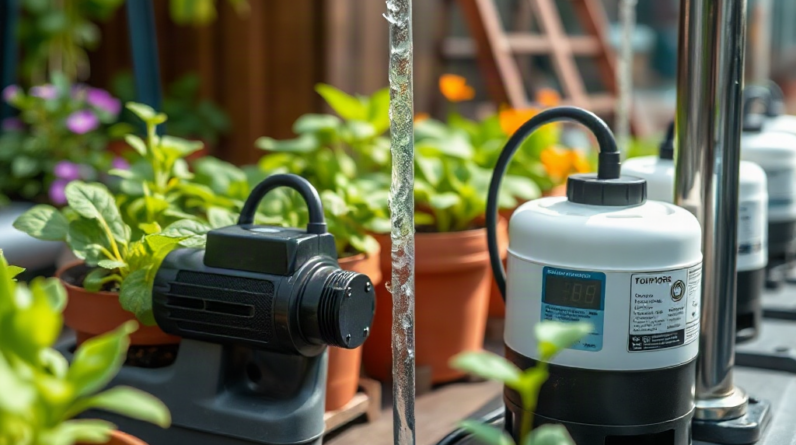
Pump sizing for hydroponic container gardens should be based on the required flow at the system’s actual head height, not the pump’s unrestricted gallons-per-hour rating. Add the flow needed by all drip emitters, channels, or return lines, then check the manufacturer’s pump curve at the vertical lift from the reservoir surface to the highest outlet. Allow modest capacity for tubing friction, filters, fittings, and gradual root or mineral restriction, but control excess flow with a bypass rather than severely throttling the discharge. Deep-water-culture containers need separately sized aeration because nutrient circulation cannot replace adequate air delivery to each root zone.
Identify the Flow the Container Layout Requires
A useful pump estimate begins at the plant containers, where the nutrient solution must arrive in a specific quantity and pattern. Reservoir volume alone does not reveal how much flow the delivery network needs. A 20-gallon reservoir supplying four drip-fed buckets may require less instantaneous flow than a smaller reservoir feeding numerous emitters, even though the larger tank holds more solution.
For a drip layout, total the rated output of every emitter that can run at the same time. Eight emitters rated at 2 gallons per hour represent a nominal demand of 16 gallons per hour. That figure is only the outlet requirement; the selected pump must produce it after overcoming lift, tubing resistance, and any inline filter. Emitters may also need a minimum operating pressure to deliver evenly, so a low-pressure aquarium pump with an attractive flow rating may still perform poorly at the farthest containers.
A recirculating arrangement introduces a second constraint: the return path must accept the delivered water without flooding a container. Pump output that exceeds the drainage capacity can raise the solution above the intended root-zone level. Before buying a larger pump, inspect the diameter and slope of return tubes, the number of elbows, and the possibility that roots could reach a drain. Increasing supply flow without improving drainage transfers the bottleneck rather than solving it.
Reservoir turnover can serve as a reasonableness check, but it should not replace outlet calculations. A commonly used starting point for small recirculating gardens is enough delivered flow to move roughly the reservoir volume once or twice per hour. The correct rate can be higher or lower depending on whether flow is continuous, intermittent, divided among containers, or responsible for surface agitation. A timer-operated flood or drip cycle requires adequate volume during the short pumping window, not merely a favorable hourly turnover number.
Build the initial requirement in this order:
- Total simultaneous outlet demand: Add all emitters, channels, spray points, or container inlets that operate together.
- Confirm drainage capacity: Check that return fittings can carry that flow when roots and residue reduce their open area.
- Compare reservoir turnover: Use turnover as a cross-check rather than the sole sizing formula.
- Add a measured allowance: Reserve some output for filter loading, tubing friction, and adjustment rather than automatically doubling the pump size.
This outlet-first approach makes Hydroponic system pump sizing for container gardens responsive to the actual plumbing. The common mistake is selecting a pump from reservoir gallons alone, which ignores how many destinations must receive solution and how quickly containers can drain it.
Calculate Head Height and Read the Pump Curve
Head height is the vertical distance the pump must lift solution, measured from the operating water surface in the reservoir to the highest discharge point. Measuring from the bottom of the reservoir understates neither every setup nor every condition consistently; the water surface is the practical reference because its level changes as plants consume solution. Use the lowest normal operating level when calculating the demanding condition.
Suppose a submersible pump sits in a floor-level reservoir and the highest drip manifold is 4 feet above the reservoir’s minimum water line. The static head is approximately 4 feet, regardless of whether the tubing travels 5 feet or 15 feet horizontally. Horizontal tubing still matters, but mainly through friction. Narrow hose, long runs, elbows, tees, valves, filters, and small emitters all add resistance that reduces delivered flow.
The flow printed prominently on a pump package is usually the maximum at little or no lift. It is not the flow available at a raised manifold. Consult the manufacturer’s performance curve or table and find the expected output at the calculated head. If a pump is rated for 400 gallons per hour at zero head but supplies only 210 gallons per hour at 4 feet, 210 is the more relevant starting figure. A pump whose maximum head is 5 feet would have little usable capacity at a 4-foot lift because output approaches zero near maximum head.
Exact friction-loss engineering is rarely necessary for a compact container garden, but ignoring resistance entirely produces weak delivery at distant outlets. Choose a model that exceeds the calculated outlet demand by a moderate amount at operating head, then install a bypass line or accessible flow-control valve if adjustment is needed. A bypass sends surplus solution back to the reservoir and can add useful circulation. It is often preferable to forcing a substantially oversized pump to work against a nearly closed discharge valve.
Do not restrict the pump’s intake to reduce flow. Intake restriction encourages poor cooling, debris accumulation, and unstable output. Keep the intake clear, use the manufacturer’s prefilter where appropriate, and regulate the discharge side within the pump maker’s instructions. If the model lacks a published pump curve, the buyer cannot reliably predict performance at the garden’s lift. Choosing a documented pump is more useful than choosing the largest zero-head number within budget.
A sound head calculation also accounts for future layout changes. Raising containers onto a stand or moving the reservoir lower increases lift and may move the operating point into a weak part of the curve. Recalculate before altering elevation; extra horizontal distance is usually less consequential than even a modest increase in vertical rise.
Match Pump Capacity to the Hydroponic Method
Different container-based methods ask the pump to perform different jobs. A recirculating drip garden needs consistent delivery across emitters, while an ebb-and-flow tray needs enough short-duration volume to fill before the cycle ends. A nutrient-film channel depends on a shallow, continuous stream, and a deep-water-culture container may use no nutrient pump at all if each vessel is independently aerated.
Recirculating Drip Containers
Size a drip pump from the combined emitter demand at the required pressure and head. Flow equality matters more than raw volume: the first bucket should not receive a strong stream while the last receives occasional drops. A looped manifold, equal-length branch tubes, cleanable filters, and pressure-compatible emitters can improve distribution. Test with collection cups rather than assuming identical labels produce identical delivery under the installed pressure.
Ebb-and-Flow Containers or Trays
For flood-and-drain operation, calculate the volume required to reach the chosen flood depth and divide it by the desired fill time. The pump must deliver that rate at the tray’s elevation while the overflow safely returns excess solution. Media displacement means the tray’s geometric volume overstates how much nutrient solution it actually takes, so a timed bucket test after assembly is more reliable than dimensions alone. An undersized pump may take so long to fill that early containers remain wet much longer than distant ones; an oversized unit can outrun drains or disturb lightweight media.
Channels and Recirculating Buckets
Channel flow should remain even from inlet to outlet without creating deep pooling around roots. Instead of applying a single universal rate, follow the channel manufacturer’s operating range and confirm it with the installed slope, root mass, and plant spacing. Recirculating buckets require enough movement to prevent isolated stagnant zones, but aggressive inflow can alter the designed solution level or pull roots toward return fittings.
Deep-Water-Culture Containers
Water movement and aeration must not be treated as interchangeable specifications. A water pump can circulate nutrient solution between connected vessels, but root oxygenation usually depends on an air pump, distribution manifold, airline resistance, water depth, and diffusers. Air pumps are selected by delivered air volume and pressure capability, not by water-pump gallons per hour. If bubbles weaken noticeably at the most distant container, rebalance the manifold, check valves and stones for restriction, or use separate air circuits.
The central decision is to size for the task that controls plant-container conditions. A pump that looks adequate under a turnover formula may fail to pressurize emitters, fill a tray on schedule, or overcome a raised channel. Conversely, a high-capacity pump can add heat, noise, power use, and drainage risk without improving root-zone conditions. Use the method-specific calculation alongside the broader Hydroponic system pump sizing for container gardens assessment.
Verify Performance After Installation
Installed flow should be measured because pump curves describe controlled conditions, not a garden with its exact hose, fittings, nutrient residue, and elevation. Place a measured container under the return or a representative outlet, collect flow for a timed interval, and convert the result to gallons or liters per hour. For example, collecting 1 gallon in 30 seconds indicates an unrestricted measured rate of about 120 gallons per hour at that point. Repeat the test at individual drip outlets when uniformity matters.
Test at the reservoir’s minimum planned operating level and with the complete filter, manifold, valves, and return plumbing installed. A test performed with a full reservoir and open hose can conceal marginal performance. Check both the nearest and farthest containers. Similar collection volumes indicate balanced distribution; a widening difference usually points to inadequate pressure, restrictive branches, a poor manifold layout, or partial blockage rather than an automatic need for a larger pump.
Signs of a suitable setup include predictable fill times, stable container levels, steady return flow, and comparable output among matching emitters. Warning signs include a pump that repeatedly runs dry, intermittent far-end flow, overflowing containers, severe vibration, excessive heat transfer, or a sharp flow decline between cleanings. Noise alone does not prove incorrect sizing, but rattling or surging can indicate trapped air, intake obstruction, low reservoir level, or operation too close to the pump’s maximum lift.
Recheck output after roots mature and after nutrient deposits have had time to form. A new system may drain freely, while an established one has reduced return capacity and partially restricted filters. Cleaning can restore lost performance; replacing the pump before checking the intake screen, impeller, tubing kinks, filter, and root intrusion wastes money and may make flooding worse.
A practical commissioning sequence is to run plain water first, observe every connection, measure outlet delivery, and adjust the bypass or discharge valve. Mark the reservoir’s minimum safe level only after confirming that the pump remains submerged and stable there. Then document the measured flow and fill time. Those baseline values make later troubleshooting objective: a substantial change signals restriction, wear, altered plumbing, or an unexpected water-level condition.
Electrical safety remains part of installation quality. Use equipment intended for the operating environment, keep plugs and connections away from splashes, form drip loops, and follow the pump manufacturer’s placement and maintenance instructions. Pumps should not be lifted by their cords or allowed to run dry unless specifically designed for it. The most effective sizing decision is one that remains controllable, serviceable, and safe after the garden is fully planted.
Frequently Asked Questions
How many gallons per hour should a hydroponic pump provide?
Calculate the simultaneous demand of the outlets, then select a pump that supplies that flow at the actual head height. Reservoir turnover is a useful cross-check, but it cannot account for emitter pressure, short flood cycles, or plumbing restrictions.
Should I buy a pump larger than the calculated requirement?
A moderate margin can accommodate filters, fittings, and gradual restriction. Avoid extreme oversizing; excess flow can overwhelm drains, add heat, and require heavy throttling. A bypass return offers more flexible control.
Does horizontal tubing count as head height?
Horizontal distance is not added directly to vertical head, but it creates friction, especially in narrow tubing with many fittings. Use the actual vertical lift, then allow for plumbing resistance when reading the pump curve.
Can one pump run several hydroponic containers?
Yes, if its delivered flow and pressure cover all simultaneous outlets and the manifold distributes solution evenly. Measure the nearest and farthest outlets because an unbalanced network can leave remote containers underfed.
Can a water pump replace an air pump in deep-water culture?
Not automatically. Water circulation may agitate the surface, but deep-water-culture aeration is normally evaluated separately through air volume, water depth, airline resistance, and diffuser performance at each container.
Conclusion
Begin with the job performed at the containers, then work backward through the plumbing to the reservoir. Total the simultaneous outlet demand, measure vertical lift from the minimum operating water level, and compare that operating point with the manufacturer’s pump curve. Confirm that drains can return the delivered volume before adding capacity.
After assembly, treat measured flow as the final test. Record outlet volumes or flood times, inspect the farthest container, and retest after filters and roots begin restricting the circuit. A modest performance margin and an adjustable bypass usually provide better control than an oversized pump forced against a closed valve. Keep aeration calculations separate where roots remain submerged, and resolve weak delivery by checking blockage, balance, and head before replacing equipment.
Related Content
- How to Manage Plant Diseases in Hydroponics: Effective Methods and Common Mistakes
- How to Choose the Right Hydroponic Nutrient Solution
- 10 Effective Strategies for the Best general hydroponics flora series in 2025
- How to Choose the Best Hydroponic Setup for Vegetables: Key Factors and Essential Equipment
- Aquaponics and Hydroponics: Methods for Sustainable Food Production