Hydroponic barley fodder for small livestock is a fresh supplemental feed produced by sprouting barley grain in shallow trays, usually without soil, until roots and green shoots form. Its high moisture content can improve feed palatability and provide animals with fresh forage, but the harvested mat contains less dry matter than its weight suggests. Clean seed, drainage, airflow, and daily inspection are critical because dense, wet roots can develop mold or bacterial spoilage. Introduce fodder gradually, weigh rations on a dry-matter basis, and retain suitable hay, pasture, minerals, and species-appropriate concentrates rather than treating sprouted barley as a complete diet.
What Barley Fodder Contributes to a Small-Livestock Diet
Sprouted barley is best understood as barley grain transformed into a moist root-and-shoot mat, not as newly created feed. Germination uses part of the seed’s stored carbohydrate to power root and leaf growth. The harvested material may look far more abundant than the original grain because it has absorbed substantial water, yet its dry-matter yield may stay similar or decline during sprouting.
That distinction affects every feeding decision. A kilogram of fresh fodder cannot be compared directly with a kilogram of dry hay or grain. Fresh mats commonly contain a large proportion of water, while hay is predominantly dry matter. Replacing dry feed by equal fresh weight can therefore leave sheep, goats, rabbits, or other small livestock short of energy, fiber, or both. Producers should compare feeds using dry matter and, where possible, a laboratory forage analysis rather than appearance alone.
The practical benefits are freshness, palatability, compact production, and predictable availability when pasture is dormant or growing space is limited. Some animals readily consume the green shoots and softened grain. The system can also turn stored barley into a forage-like feed without a field or long growing season. Those advantages make Hydroponic barley fodder for small livestock most useful as one component of a ration, especially where dependable fresh forage has operational value.
Sprouting does not make the mat nutritionally complete. Ruminants still need enough effective fiber to support chewing and normal rumen function, while rabbits require a consistently fiber-rich diet centered on appropriate hay or forage. Minerals, salt, clean water, and any needed protein or energy sources must be considered separately. A soft mat cannot be assumed to replace long-stem forage merely because it is green.
A sensible first trial is small enough to observe intake without disturbing the established ration. Offer a clean portion alongside the animal’s normal feed, record how much is actually eaten, and watch manure consistency, appetite, cud chewing in ruminants, and body condition over time. Refusal, sorting, loose manure, or declining hay consumption indicates that the inclusion rate, fodder quality, or ration balance needs review. A livestock veterinarian or qualified animal nutrition professional should assess substantial ration changes, particularly for pregnant, lactating, growing, or medically vulnerable animals.
A Reliable Tray-to-Feeder Production Method
Consistent fodder begins with sound barley intended for feed use and free from visible damage, musty odor, insects, or chemical treatment that would make it unsuitable for livestock. Germination quality matters more than bargain pricing: a batch with weak or uneven sprouting leaves unsprouted kernels in a wet tray, creating ideal pockets for spoilage. Testing a small sample before committing the entire bag can expose poor germination early.
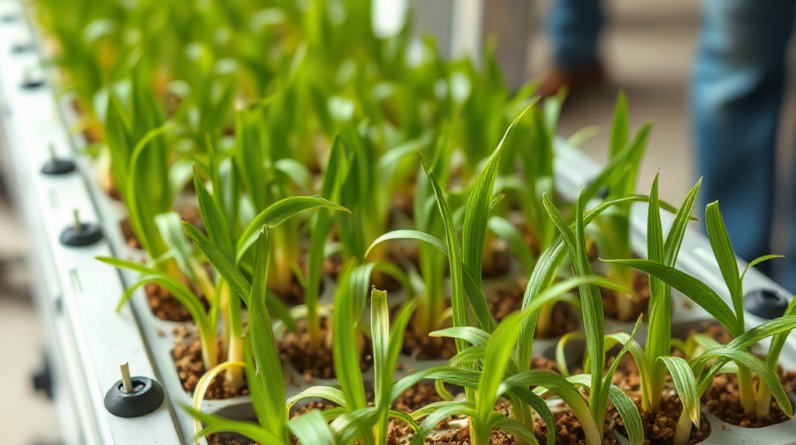
Start by removing foreign material and rinsing the grain with clean water. Soak only long enough to hydrate the kernels, then drain thoroughly; prolonged immersion deprives seed of oxygen and encourages sour fermentation. Spread the swollen grain in a shallow, even layer inside clean, food-safe trays with open drainage holes. Thick layers hold heat and moisture in the center, so adding more seed to increase output often produces a poorer, less uniform mat.
During growth, apply enough clean water to keep the seed moist while allowing excess water to leave immediately. Irrigation frequency depends on temperature, humidity, tray depth, and airflow, so a fixed schedule is less useful than inspecting the tray. Kernels should remain moist without sitting in pooled water. Shelving should allow air to move across and between trays, and drainage water should not drip from an older tray onto a younger one.
A compact daily workflow keeps sanitation and harvest timing under control:
- Inspect before watering: smell the tray and check roots, grain, and drainage channels.
- Water evenly: wet dry edges without flooding the dense center.
- Drain fully: clear blocked holes and remove standing runoff.
- Rotate trays: correct uneven light, airflow, or irrigation exposure.
- Harvest promptly: feed the mat while it is fresh rather than holding it wet for extra height.
- Wash immediately: remove roots and grain residue before reloading a tray.
Fodder is often harvested once the mat holds together and has produced a useful shoot, but calendar age should not override condition. Growth speed shifts with the room environment and seed lot. A shorter, clean mat is preferable to taller fodder that smells fermented or shows suspicious growth. Weighing the dry seed loaded and fresh fodder removed from several trays will establish realistic output for the actual setup rather than relying on advertised conversion ratios.
Moisture, Mold, and Other Failure Points
Sanitation failures usually begin with excessive retained moisture, contaminated equipment, weak seed, or inadequate airflow. Barley releases organic material as it soaks and germinates, and dense root mats trap moisture and heat. A tray may appear healthy on top while spoiled kernels develop underneath, which is why inspection must include the base and center rather than only the green shoots.
White root hairs are frequently mistaken for mold. Root hairs tend to appear evenly around actively growing roots and become less visible when wetted. Mold is more likely to form irregular patches, bridge between kernels, produce colored growth, or accompany a musty, sour, or rotten odor. Visual identification is not always reliable, however. If a tray has an abnormal smell, slimy grain, unusual discoloration, or uncertain fungal growth, discard it rather than feeding around the affected area.
Washing a questionable mat does not restore safe feed, and removing the visible patch may leave contamination elsewhere. Likewise, adding sanitizing chemicals to routine irrigation can create residue or dosing concerns and does not correct thick seeding, blocked drainage, or dirty trays. Any seed-treatment or cleaning product used around livestock feed must be specifically appropriate for that use and applied according to its label. Plain operational controls—clean surfaces, potable water, full drainage, moderate seed depth, and prompt harvest—should carry most of the preventive load.
Room conditions need active management. Warm, humid spaces accelerate germination but also favor microbial growth; cold rooms slow production and may leave kernels wet for longer. Fans can improve air exchange, although strong airflow may dry tray edges while the center remains saturated. Look for an even root mat, neutral fresh-grain smell, freely draining water, and repeatable growth across shelves. Condensation, persistent puddles, warm tray centers, uneven germination, or rising discard rates signal that production has exceeded the room’s ventilation or sanitation capacity.
Keep a simple batch record with seed source, soak timing, tray position, harvest date, yield, and any discarded trays. Repeated problems on one shelf point toward irrigation or airflow; problems across an entire seed lot suggest seed quality or storage. This record-based approach makes Hydroponic barley fodder for small livestock safer and more predictable than reacting only after obvious mold appears.
Feeding Amounts and Species-Specific Decisions
Introduction should be gradual because sprouted barley changes ration moisture, texture, and fermentable carbohydrate intake. Begin with a modest portion and increase only while normal appetite, manure, rumination, and hay consumption remain stable. Weigh both the fodder and the feeds it is intended to replace; guessing by tray fraction can produce inconsistent meals because mats vary in thickness and water content.
For sheep and goats, the mat may function as a palatable supplemental feed, but it should not displace all long-stem forage. Hay or suitable pasture supplies physical fiber that promotes chewing and supports a stable rumen environment. Sudden large servings of grain-rich fodder may disrupt digestion, especially when animals are not adapted to barley. Animals competing in a group feeder may also consume very different amounts, so provide enough feeding space and observe timid as well as dominant individuals.
Rabbits present a different constraint. Their digestive health relies on a high-fiber ration, and moist barley sprouts should not be treated as a substitute for appropriate grass hay. Introduce a small portion cautiously and stop if appetite or droppings change. Other species—including poultry, pigs, and camelids—have distinct nutrient requirements and tolerances; the presence of green shoots does not make one feeding rate suitable across species.
Dry-matter comparison provides a more defensible starting point. Obtain the fodder’s dry-matter percentage through feed testing when it will form a meaningful ration share. Multiply the fresh weight by the dry-matter fraction to estimate the nutrients actually delivered without water. For example, two trays with equal fresh weight can supply different amounts of feed if one was harvested wetter. Laboratory analysis can also reveal crude protein, fiber, energy-related measures, and mineral composition, allowing a nutrition professional to balance the whole ration.
Signs the program is working include eager but controlled intake, stable manure, continued consumption of necessary forage, steady body condition, and repeatable tray quality. Weight loss, reduced cud chewing, persistent loose manure, bloating, feed refusal, or falling production are reasons to stop increasing the allowance and seek professional advice. The central mistake is evaluating success by how much green material animals eat rather than by health, dry-matter intake, and the balance of the complete diet.
Calculating Whether a Fodder System Is Worth Running
Economic value depends on the entire production process, not merely the price of barley. Count seed, water, electricity, trays, shelving, pumps or timers, climate control, cleaning supplies, labor, and discarded batches. Equipment depreciation and daily washing are easy to omit, yet they can determine whether a small installation saves money or simply converts inexpensive grain into expensive wet feed.
Track output by dry seed input, harvested fresh weight, estimated dry matter, and the amount livestock actually consume. Water gain should not be booked as feed gain. If animals leave the root mat or sort out portions, calculate cost using consumed dry matter rather than tray weight. Compare that figure with locally available hay, pasture, commercial feed, and unsprouted barley while accounting for the different nutritional roles of those feeds.
A household-scale rack may still be worthwhile when its main purpose is dependable fresh material during winter, drought restrictions, or limited land access. It may be less attractive where quality forage is inexpensive, labor is scarce, humidity control is costly, or livestock numbers are too low to use each harvest promptly. Feeding soaked or conventionally processed grain alongside sound hay is a simpler alternative when fresh shoots offer little operational advantage.
Run a measured pilot before expanding. Record at least several complete tray cycles, including failures and cleaning time, then compare animal intake and feed replacement on a dry-matter basis. Expansion makes sense only when clean trays can be produced repeatedly, livestock consume the fodder without ration problems, and the full cost fits the farm’s objective. A system that works for four goats may become unstable when multiplied rapidly because drainage, room humidity, harvest labor, and refrigerator or feeder capacity do not scale automatically.
Review the objective explicitly: lower purchased-feed cost, fresh-feed availability, use of limited space, or resilience during seasonal shortages. Each goal produces a different verdict. Readers considering Hydroponic barley fodder for small livestock should prioritize reliable hygiene and measured nutritional value over maximum tray yield. Dense, fast-looking production has little value if spoilage rises or the resulting ration no longer meets the animals’ needs.
Frequently Asked Questions
Can hydroponic barley fodder replace hay?
Usually not. Its high moisture and short, soft structure do not provide the same dry matter or effective fiber as suitable hay, especially for ruminants and rabbits.
How can root hairs be distinguished from mold?
Root hairs usually form evenly along healthy roots and recede visually when wet. Irregular webbing, colored patches, slime, or musty and sour odors justify discarding the tray.
Should nutrients be added to the irrigation water?
Short-cycle barley fodder relies mainly on reserves stored in the seed. Added fertilizer is generally unnecessary and can complicate sanitation and livestock-feed safety.
Can treated barley seed be used for fodder?
Do not use chemically treated planting seed unless its labeling explicitly permits the intended livestock-feed use. Choose clean barley suitable for animal feeding.
Why is dry matter more useful than fresh tray weight?
Fresh weight includes absorbed water. Dry matter shows how much actual feed remains after water is excluded, making comparisons with hay, grain, and other ration ingredients more meaningful.
Conclusion
A productive barley-fodder routine is built around clean germinating seed, shallow loading, unrestricted drainage, steady airflow, and refusal to feed questionable trays. Nutritional decisions should follow dry-matter intake and whole-ration balance rather than the impressive fresh weight of a green mat. Keep appropriate hay or pasture in the program, introduce sprouts slowly, and monitor manure, appetite, rumination, body condition, and actual consumption.
Before enlarging the rack, complete a small recorded trial that includes labor, utilities, rejected batches, and feed analysis when fodder will make up a meaningful ration share. The next practical move is to test one seed lot, standardize a cleaning and tray schedule, and review the proposed ration with a livestock veterinarian or qualified nutrition professional. Scale only after both tray quality and animal response remain consistent.