Improve air circulation in hydroponic setups by creating a gentle, continuous air path above, through, and beneath the plant canopy rather than directing one powerful fan at the leaves. Use an intake or room-air opening, an exhaust fan where heat and humidity collect, and oscillating or circulation fans positioned to remove stagnant pockets without causing leaf curl. Thin crowded foliage, leave space around reservoirs and equipment, and verify airflow at canopy edges and lower stems. The system is working when leaves move slightly, temperatures remain even, and condensation disappears; rigidly fluttering leaves, dry margins, and rapid reservoir evaporation indicate excessive airflow.
Build a Complete Air Path Through the Growing Area
Effective circulation begins with a defined route for air to enter, cross the growing area, and leave. A fan that merely stirs the same warm, humid air inside an enclosed tent or room does not provide the same control as coordinated intake, circulation, and exhaust. Transpiring leaves release water vapor, lamps and pumps add heat, and dense foliage slows mixing. Without an exit path, those loads accumulate even when leaves appear to be moving.
Place the exhaust near the upper part of the enclosure because warm air commonly gathers there. Fresh or conditioned air should enter from a lower point on the opposite side when the layout permits. The diagonal separation encourages air to cross more of the growing area before it exits. In a small tent, passive intake vents may supply enough replacement air for a modest exhaust fan. A larger room, restrictive ductwork, or a filtered intake may require an active intake fan, but it should not overpower the exhaust and push moist air through uncontrolled gaps.
Air exchange and internal circulation solve related but distinct problems. Exhaust removes accumulated heat and moisture; circulation fans mix the remaining air around stems and leaves. Increasing exhaust alone can waste conditioned air while leaving a sheltered pocket behind a reservoir or dense row. Adding more circulation fans without exchanging air can spread excess humidity uniformly rather than removing it. A balanced layout uses both functions at the lowest effective settings.
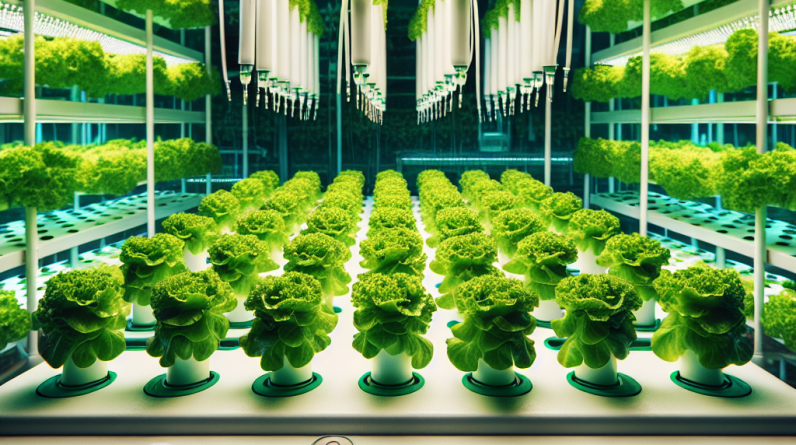
For example, consider a shelving unit holding leafy greens beneath LED fixtures. An exhaust above the top shelf may remove ceiling heat while doing little for the still air under the lower shelf. A small circulation fan aimed along that lower aisle completes the route. Conversely, placing intake and exhaust beside each other creates a short circuit: incoming air leaves before crossing the canopy. Smoke-producing tests are inappropriate around edible plants and electrical equipment; a light strip of tissue held safely away from fan blades can reveal the direction of movement.
When applying how to improve air circulation in hydroponic setups to a particular room, map the air path before buying additional equipment. Identify the inlet, outlet, hottest point, most humid point, canopy center, and any enclosed space below the plants. Correcting a blocked vent or poor exhaust location may accomplish more than installing a stronger fan.
Place Fans for Canopy and Lower-Level Coverage
Circulation fans should produce mild leaf movement across the whole crop, not a concentrated blast on the nearest plant. A fan positioned too close creates a narrow high-speed zone while distant leaves remain still. The exposed plants may develop curled edges, uneven drying, or mechanical damage, yet the center of the canopy can retain humid air. Greater fan power does not correct poor placement.
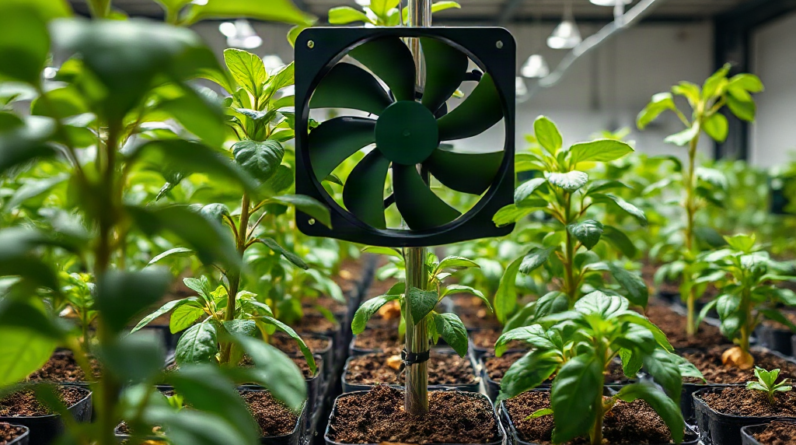
Start with one oscillating fan set above or beside the canopy so its sweep travels across the growing surface rather than directly downward into one plant. A second, smaller fan can move air below the foliage where lower stems, net pots, channels, and reservoir lids interrupt the air path. Fans mounted at opposing corners often distribute air more evenly than two units pointing in the same direction. They should complement the exhaust route instead of producing a closed circular current that never reaches the outlet.
Use this six-point placement check after plants and equipment are in their operating positions:
- Inlet: Confirm that foliage, storage containers, and wall liners do not cover the incoming-air opening.
- Outlet: Locate extraction where heat and moisture gather, with ducting kept as direct as the installation allows.
- Canopy top: Look for slight movement across outer and central leaves, not constant snapping or folding.
- Canopy interior: Check between mature plants, where overlapping leaves create sheltered pockets.
- Lower zone: Verify movement around stems, channels, buckets, and the space beneath benches.
- Return path: Make sure circulated air can reach the exhaust rather than stopping against a wall or solid rack.
Fan type affects the result. Oscillating units spread movement across a broad area but can leave gaps at the ends of their sweep. Fixed clip fans are useful for targeted dead zones, though their narrow stream requires careful aiming. Inline duct fans are designed primarily for air exchange and overcoming duct resistance, not for bathing the canopy in direct airflow. A large floor fan may suit an open room but is often too forceful and bulky for a compact tent.
Seedlings and newly transplanted crops need a gentler setting than mature tomatoes or cucumbers. Their small root systems and tender leaves can lose moisture quickly under direct air. Begin at a low speed, increase distance if leaves vibrate sharply, and reassess as the canopy expands. The correct setting is determined at plant level, not by the fan’s advertised room coverage.
Remove Plant and Equipment Airflow Obstructions
Plant spacing and canopy management often determine whether fan air reaches the locations that need it. A circulation system that worked during early growth may become ineffective after neighboring leaves overlap. Broad leaves form layers that trap humid air around inner stems, while tightly packed buckets and channels block movement below. Treat airflow as a changing property of the crop rather than a one-time equipment setting.
Leave practical gaps between plants based on their mature width, training method, and access needs. Lettuce planted for baby-leaf harvest can form a uniform low canopy, whereas mature fruiting crops create tall, irregular barriers. For trellised tomatoes, removing selected old or damaged lower leaves can open a path beneath the productive canopy. Avoid aggressive pruning solely to increase air movement: excessive leaf removal reduces photosynthetic area and can expose fruit or tender growth to stronger light and drying.
Equipment placement deserves the same attention. Solid reservoir lids, stacked supplies, reflective curtains, and closely spaced shelves can divide a room into isolated compartments. Keep electrical cords secured and dry, maintain safe clearance around fan blades, and never place a household fan where splashes or leaks could reach it. Any fan used near nutrient solution should be appropriate for the environment and connected according to its manufacturer’s instructions. Air circulation does not replace electrical protection, leak control, or sanitation.
A common scenario is a deep-water culture row with healthy upper leaves but condensation beneath a nearby shelf. Increasing the upper fan speed may stress exposed foliage without drying the lower surface. Moving stored containers, opening clearance beside the buckets, and adding a low-speed fan across the aisle addresses the obstruction instead. This targeted correction also avoids unnecessarily accelerating evaporation from uncovered openings.
Reservoirs should remain covered for light exclusion and contamination control, so improving circulation does not mean blowing air directly across exposed nutrient solution. High air velocity can increase water loss and may cause solution temperature to track room conditions more quickly. Root-zone oxygenation is a separate function supplied by suitable aeration or solution movement; a canopy fan does not replace an air pump and air stone in a system that requires them.
Revisit spacing whenever the crop is trained, harvested, or moved. Readers planning how to improve air circulation in hydroponic setups should reserve access lanes and fan clearance in the original layout. Recovering those spaces after a mature crop fills the room is harder and may require disruptive pruning.
Test, Adjust, and Maintain the Airflow Pattern
Airflow should be judged by conditions across the growing area rather than by noise, fan speed, or movement at a single leaf. Check the upper canopy, center rows, corners, lower stems, and space beneath racks. Slight leaf motion suggests that air is reaching the plant, but it does not prove that humidity and temperature are even. Measurements taken at several locations provide a clearer picture than one sensor mounted beside the exhaust.
Place temperature and humidity sensors at representative canopy height, away from direct fan streams, lamp heat, humidifier mist, and the incoming-air vent. A sensor in a strong stream may report the supply-air condition while the canopy interior remains warmer or damper. If possible, compare readings at the center and edge of the crop during both lit and dark periods. Transpiration, cooling equipment, and lamp output change over the cycle, so a layout that appears adequate during inspection may develop stagnant conditions later.
Physical clues add useful context. Persistent condensation on walls or equipment, a damp canopy interior, large temperature differences between shelves, and leaves that remain motionless indicate weak distribution or insufficient exchange. Leaves held sideways, crisp margins near one fan, unusually fast drying of young plants, and excessive reservoir top-off demand can point to too much direct air or overly aggressive exhaust. These symptoms can have other causes, so compare affected plants with their position in the room before changing the nutrient formula or irrigation schedule.
Adjust one variable at a time. First clear obvious blockages and confirm that intake and exhaust paths are open. Next change fan angle or distance; then alter speed. Add another fan only when repositioning cannot reach a documented dead zone. This order is less expensive and makes the effect of each correction visible. After an adjustment, observe a full light and dark cycle when practical rather than judging the result within a few minutes.
Maintenance preserves the designed airflow. Dust on guards and blades reduces output and can spread debris when disturbed. Clean fans with power disconnected, following the manufacturer’s directions, and inspect mounts for loosening or vibration. Check filters, ducts, intake screens, and oscillation mechanisms on a regular schedule. As plants gain height or fill a trellis, repeat the six-point check instead of assuming the original angles still work.
A successful pattern produces modest, distributed leaf movement, fewer sheltered pockets, and more consistent readings across the crop. If stronger airflow merely shifts the hot or humid zone to another corner, the route remains incomplete. The next step is to change where air enters or exits, not to continue raising every fan to maximum speed.
Frequently Asked Questions
Should hydroponic fans run all the time?
Gentle circulation is commonly maintained continuously, while exhaust operation may be controlled by temperature and humidity. Confirm conditions during dark periods, when moisture can accumulate even though lamp heat has fallen.
How much should hydroponic leaves move?
Leaves should tremble or sway slightly across most of the canopy. Persistent folding, sharp fluttering, curled edges, or damage concentrated near a fan indicates that the stream is too strong or too close.
Is one fan enough for a small grow tent?
One circulation fan may cover a young, open canopy, but it cannot necessarily provide exhaust or reach beneath dense foliage. Check corners and the lower zone before deciding that tent size alone makes one fan sufficient.
Does a reservoir air pump improve room circulation?
No. An air pump and air stone aerate nutrient solution in systems that use them; circulation fans move air around foliage. Each addresses a different environment and should not be treated as a substitute for the other.
Can too much airflow damage hydroponic plants?
Yes. Concentrated airflow can increase water loss, dry tender leaf margins, bend stems, and create uneven conditions between exposed and sheltered plants. Reduce speed, increase distance, or redirect the fan across the canopy.
Conclusion
Reliable circulation comes from completing the air route, not maximizing fan speed. Confirm that replacement air can enter, pass through the upper and lower crop zones, and reach an appropriately placed exhaust. Then remove obstructions, aim circulation fans across rather than directly into foliage, and preserve safe clearance from water and electrical equipment.
Begin with a map of the current layout and inspect all six points: inlet, outlet, canopy top, canopy interior, lower zone, and return path. Compare conditions at several canopy locations through light and dark periods. Repositioning a fan or clearing a blocked aisle should come before adding equipment. Repeat the inspection as foliage expands, because yesterday’s open route can become tomorrow’s stagnant pocket. Slight, widespread leaf movement and consistent environmental readings are more useful targets than a room full of fans running at maximum output.
Further Reading
Authoritative Sources
- Grow Room Airflow Guide | Fan Placement & Air Circulation
hydroponics.co.ukPositioning a fan around canopy height or slightly above it can help move warm air away from the upper foliage and mix air across the growing ...
- Indoor Garden Air Circulation and Fan Placement
risegardens.comThis guide covers fan types, placement strategies, scheduling, and common mistakes for hydroponic home growers.
- Ventilation & Airflow in Indoor Hydroponic Gardens
rootsandrouteshydro.comPosition fans to create gentle cross-currents, not high-speed blasts. Keep at canopy height for best air circulation across leaves. Rotate fans ...
- Greenhouse Fan Placement Guide That Works
greenhousetogrow.usUse this greenhouse fan placement guide to improve airflow, reduce hot spots, control humidity, and protect crops in any size greenhouse.