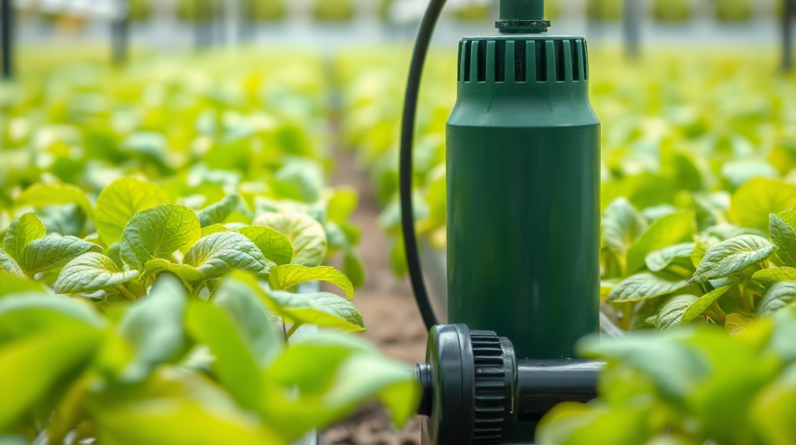
Matching pump flow to hydroponic plumbing means selecting a pump that delivers the required flow at the system’s actual vertical lift and pipe resistance, not at its zero-head rating. Calculate the target flow for the growing method, measure the height from reservoir water level to the highest outlet, and account for narrow tubing, elbows, filters, valves, and emitters. A pump that is too small produces dry channels or weak drippers, while an oversized model wastes power, increases splashing, and may disturb roots. Compare the system’s calculated operating point with the pump curve, then verify flow at the outlets after installation.
Define the Flow Your Hydroponic Layout Actually Needs
The correct pump flow begins with the irrigation method, number of outlets, and required delivery pattern. A deep-water culture system may need gentle circulation for mixing and oxygen distribution, while a nutrient film technique layout depends on a steady sheet moving through each channel. Drip systems are governed by emitter output and pressure, and an ebb-and-flow table needs enough delivery volume to fill the tray within the intended cycle without overwhelming the drain.
Count the active outlets and identify their specified flow rate. If a system has eight drippers rated at 2 liters per hour, the nominal demand is 16 liters per hour before plumbing losses. That figure is not automatically the pump size because the pump must deliver it at the required head. For a channel system, estimate the flow needed per channel and multiply by the number of channels, then allow enough capacity for balancing and minor changes in resistance.
Use the manufacturer’s flow specification as a starting point rather than a promise of installed performance. A label may state that a pump moves 1,200 liters per hour, but that number commonly describes operation with no lift and no connected plumbing. Once the pump pushes water upward through tubing, fittings, a filter, and outlets, the delivered rate falls.
A useful design distinction is between circulation demand and delivery demand. Circulation demand concerns mixing the reservoir and maintaining movement. Delivery demand concerns getting a predictable amount of solution to every plant site. A pump can circulate a reservoir vigorously while still failing to supply the far end of a long manifold. Conversely, an oversized circulation pump may create turbulence without improving root-zone delivery.
Before buying equipment, write down the outlet count, outlet rating, desired operating schedule, reservoir level range, and highest outlet. The internal planning link Matching pump flow to hydroponic plumbing can be used as a reference while comparing those figures. Prioritize uniform delivery over impressive free-flow numbers.
Calculate Head Height and Plumbing Resistance
Head is the resistance the pump must overcome, expressed as a height of water. Static head is the vertical distance from the reservoir’s operating water surface to the highest discharge point. Measure to the outlet, not merely to the top of the grow rack. If the reservoir surface is 45 centimeters below a top channel, that vertical lift already affects the pump’s output.
Friction adds to static head. Water loses energy as it travels through long tubing, narrow pipe, elbows, tees, unions, check valves, filters, and partially closed valves. Small tubing can be especially restrictive when several outlets share one supply line. A short, wide main line feeding smaller branch lines often produces more even distribution than running the entire system through one narrow tube.
Fittings should not be treated as negligible in a crowded hydroponic layout. A sharp elbow, clogged screen, or undersized bulkhead can create a noticeable pressure drop, particularly in a drip manifold. A gravity-fed return line has a different role: it must drain freely and should not be sized or routed as though it were a pressurized supply line.
Consider a rack with a reservoir below two tiers of channels. The pump may lift solution to the upper tier, pass it through a manifold, and feed several channels through small connectors. The lower tier may receive more flow simply because it has less lift and resistance. Installing a valve on the easier branch can balance the outlets, but closing it too far may shift excessive pressure toward leaks or weak fittings.
When the pump is selected, use the total operating resistance rather than only the vertical measurement. A conservative estimate can include the measured lift plus the manufacturer’s guidance for pipe friction and accessories. If the design includes a filter, nutrient mixer, UV unit, or injector, use that component’s pressure-loss information when available. Avoid adding an arbitrary percentage and assuming it replaces a real calculation; extra capacity is useful only when the pump curve shows what remains at the required head.
Plumbing geometry also affects maintenance. A pump that technically meets the demand may become inadequate after algae, roots, sediment, or biofilm narrow a screen. Leave access for cleaning and use unions where a pump or filter must be removed. The goal is a system that retains usable flow between cleanings, not one that works only immediately after assembly.
Match the Pump Curve to the Operating Point
A pump curve shows how much water a pump can deliver at different head heights. The operating point is where the pump’s available output meets the plumbing system’s resistance. Read the curve at the estimated total head and compare that flow with the calculated demand from the outlets. A free-flow rating at zero head is useful for comparison, but it is not the value that determines performance on a rack.
Suppose a pump is advertised at 1,000 liters per hour with no lift, but its curve shows only 600 liters per hour at the height of the top channel. If the layout requires 500 liters per hour, the margin may be workable when the plumbing is clean. If the demand is 600 liters per hour, there is no practical reserve for a dirty filter, changing water level, or slight tubing restriction. A model with a higher curve at the required head may be more suitable even if its free-flow label looks only modestly larger.
Do not select a pump by wattage alone. Two pumps with similar electrical consumption can have different impeller designs and pressure capabilities. An aquarium circulation pump may move a large volume at low head, whereas a pressure-oriented pump may maintain better output through a manifold. The appropriate choice depends on whether the system needs gentle bulk movement, lift, or controlled delivery through restrictive emitters.
Variable-speed pumps add control but do not remove the need for sizing. Reducing speed can quiet a system and limit splashing, yet the pump must still reach the highest outlet when the reservoir is at its lowest normal level. A controller should be used to tune a functioning design, not compensate for a pump that cannot overcome the plumbing.
Plan a modest operating margin, but do not confuse margin with excess flow. Extra capacity allows adjustment for routine resistance and lets a valve balance branches. Excessive capacity may shear solution into foam, erode media, disturb seedlings, or force constant throttling. Throttling a centrifugal pump on the discharge side is generally preferable to restricting its intake, because an obstructed intake can cause cavitation, noise, and premature wear.
For a new build, compare at least two pump curves at the same calculated head. Record the required flow, acceptable noise level, power use, outlet size, and replacement availability. A pump that is easy to clean and replace may be a better choice for a home system than a higher-output model with inaccessible parts.
Test, Balance, and Troubleshoot the Installed System
Installed flow should be measured at the outlets, because the assembled system—not the pump box—determines delivery. Fill the reservoir to the normal operating level, run the pump with the actual filter, tubing, valves, and emitters connected, and collect discharge from representative outlets for a timed interval. Convert the collected volume to a rate and compare the first, middle, and last branches.
Uneven output usually points to a distribution problem rather than a simple need for a larger pump. The nearest branch may take most of the flow because it has the shortest path. A kinked tube, clogged emitter, blocked screen, air pocket, or poorly sealed bulkhead can reduce a distant branch. If every outlet is weak, inspect the pump intake, water level, impeller, filter, and total lift before changing the manifold.
Use a simple commissioning checklist:
- Measure flow at the highest and farthest outlet.
- Check that the reservoir remains above the pump intake during the full operating cycle.
- Inspect every branch for kinks, leaks, trapped air, and loose fittings.
- Confirm that filters and emitters are clean before judging pump capacity.
- Observe the return path for pooling, overflow, or slow drainage.
A practical example is a four-channel NFT system that performs well with a full reservoir but loses flow overnight as the water level drops. The pump has not changed; the static head has increased because the source water surface is lower. Raising the minimum reservoir level, shortening the lift, or selecting a pump with more output at that head may solve the issue. Adding more pump capacity without checking the low-level condition can create excessive flow when the reservoir is full.
Balance branches gradually. Open all valves, identify the strongest branch, and reduce that branch slightly while checking the weaker outlets. Wait for the system to stabilize after each adjustment. A valve that is closed too aggressively can make a dripper appear defective when the actual problem is insufficient manifold pressure. In systems with pressure-compensating emitters, verify that the pump can reach their minimum pressure requirement; gravity circulation will not provide the same behavior.
Watch the plants and plumbing together. A channel that runs dry, a dripper that pulses, or a return that surges can reveal hydraulic instability before visible plant stress appears. Conversely, excessive splashing and persistent foam may indicate overdelivery or an air leak on the suction side rather than healthy oxygenation.
Avoid Oversizing, Undersizing, and Maintenance Traps
Undersizing causes familiar symptoms: weak delivery at high outlets, inconsistent drippers, dry sections of channels, and poor recovery after the reservoir level falls. Oversizing creates different problems, including noisy returns, nutrient solution splashing from channels, displaced media, unnecessary energy use, and valves that remain nearly closed. Neither condition is corrected by guessing from plant count alone.
Plant count can estimate outlet demand, but it does not describe the plumbing. Ten plants in a short drip line may require less pump pressure than six plants spread across a tall rack with a fine filter and narrow branches. Likewise, a large reservoir does not automatically need a large pump. Reservoir volume affects mixing and operating duration; pipe length, lift, and outlet design determine hydraulic resistance.
A common mistake is to increase pump size when a clogged intake is the real fault. Nutrient precipitate, roots, algae, and sediment can reduce flow at the pump screen. Clean the intake and filter on a schedule suited to the system, then retest before redesigning. Keep an inspection record with reservoir level, outlet flow, cleaning date, and unusual noise. Trends make gradual restriction easier to identify.
Prioritize changes in this order: confirm the water level, clean the intake and filter, inspect tubing and fittings, measure branch flow, adjust valves, and only then reconsider pump selection. This sequence prevents a working pump from being replaced because of a cheap blocked screen. It also separates a hydraulic fault from a biological or nutrient-management issue.
Long-term reliability may justify choosing a pump with replaceable impeller parts, a compatible hose connection, and protection against running dry where available. Keep the pump submerged to the manufacturer’s required depth and avoid operating it below the safe minimum level. Electrical connections should remain protected from splash and arranged so water cannot run along a cord into an outlet.
For future modifications, recalculate rather than assuming the existing pump has spare capacity. Adding another tier, longer tubing, a UV unit, or more restrictive emitters changes the operating point. A system that was balanced with four channels may distribute poorly after two more are added, even if the nominal total outlet flow seems modest. Documenting the original design makes those changes easier to evaluate.
Frequently Asked Questions
Should pump flow be based on the pump’s free-flow rating?
No. Use the pump curve to find output at the system’s actual lift and plumbing resistance, then compare that value with outlet demand.
How much extra pump capacity should a hydroponic system have?
A modest reserve is useful for dirty filters, lower reservoir levels, and balancing valves, but excessive capacity can cause turbulence, noise, and wasted power.
Why does the farthest hydroponic outlet receive less water?
The farthest branch may have greater friction, more fittings, higher lift, a kink, or a partially blocked emitter. Measure and inspect that branch before replacing the pump.
Can a valve reduce flow from an oversized pump?
A discharge-side valve can help balance a centrifugal pump, but it should not replace correct sizing. Never restrict the pump intake, and verify that all branches still receive adequate flow.
What should be checked when flow suddenly drops?
Check the reservoir level, pump intake, impeller, filter, tubing, air leaks, and emitter screens. Clean and retest the system before changing pump size.
Further Reading
Authoritative Sources
- Academy of Nutrition and Dietetics
eatright.orgProfessional nutrition guidance, healthy eating resources, and practical dietitian-reviewed advice.
- U.S. Department of Agriculture
usda.govOfficial food, nutrition, agriculture, and consumer guidance from the USDA.
- NIH Office of Dietary Supplements
ods.od.nih.govResearch-based fact sheets on nutrients, supplements, dietary intake, and safety considerations.
- International Society of Sports Nutrition
sportsnutritionsociety.orgEvidence-informed sports nutrition resources and position stands for active people and athletes.
Conclusion
Reliable hydroponic plumbing comes from matching delivered flow to the system’s actual operating conditions. Calculate outlet demand, measure vertical lift, account for restrictive fittings and filters, and read the pump curve at that combined resistance. Then test the assembled system at normal and low reservoir levels, comparing the strongest and weakest branches rather than trusting the label on the pump.
Prioritize uniform delivery and serviceability over maximum circulation. Clean the intake, protect the pump from running dry, balance branches with discharge-side valves, and investigate blockages before buying a larger model. When the layout changes, recalculate the operating point. Those steps keep channels wet, drippers consistent, and energy use aligned with what the plants actually require.