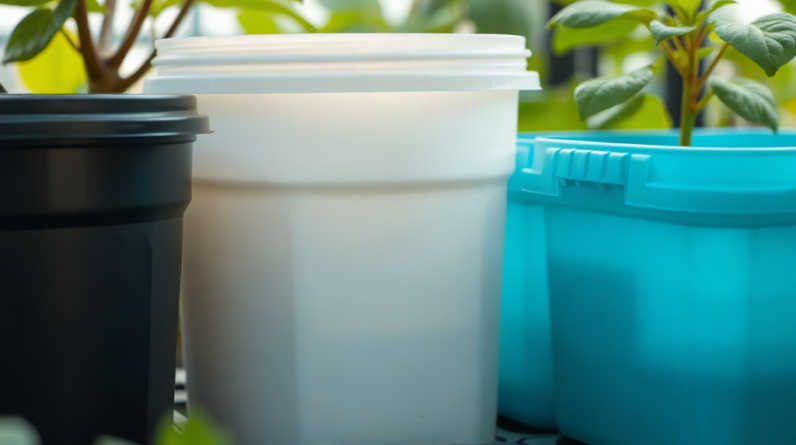
Choose food-safe containers for hydroponics by verifying documented food-contact use, selecting an appropriate material, and confirming the container has never held hazardous substances. HDPE and polypropylene are common practical choices, while opaque walls help keep light from reaching the nutrient solution and encouraging algae. A recycling symbol identifies the resin but does not, by itself, prove that a particular bucket or tote is food-safe. Inspect reused containers for odors, stains, deep scratches, cracks, and unknown prior contents, and reject questionable vessels rather than relying on cleaning to make them suitable.
What Food-Safe Really Means for a Hydroponic Container
A food-safe designation applies to a finished container intended for suitable food-contact conditions, not merely to the broad family of plastic from which it was made. Manufacturing additives, colorants, recycled content, intended temperature range, and the container’s previous use can all affect whether a particular product belongs near nutrient solution. The most dependable evidence is a manufacturer’s food-contact statement, product specification, or label describing the intended use.
Hydroponic reservoirs and plant sites create prolonged contact rather than the brief contact involved in carrying dry groceries. The container may hold water, dissolved mineral salts, and mild acids used for pH adjustment for days or weeks. It can also be exposed to warm grow-room temperatures, pumps, fittings, and repeated cleaning. A vessel marketed only as a general-purpose storage tote should not automatically be treated as equivalent to a container documented for food contact.
Recycling codes are useful for identifying the base resin, but they are frequently overinterpreted. A number such as 2 or 5 can indicate high-density polyethylene or polypropylene, respectively. It does not certify every product made from that resin for food use, nor does it reveal the container’s entire formulation or history. Conversely, the absence of an obvious molded code does not establish that a purpose-built reservoir is unsafe; its technical documentation may be more informative than the symbol.
The crop does not usually touch the reservoir wall, yet roots and recirculating solution do. That makes the reservoir, channels, net-pot supports, tubing, seals, and fittings part of the same contact pathway. A carefully selected tank loses much of its value if nutrient solution passes through an unsuitable repurposed hose or a corroding metal fitting before returning to the roots.
Do not confuse “food-safe” with sterile, algae-proof, structurally durable, or suitable for every chemical and temperature. Each is a separate requirement. A clear food-contact container may be acceptable from a material standpoint but poor at excluding light. A thin bucket may be correctly labeled yet deform around a bulkhead fitting. Effective Choosing food-safe containers for hydroponics therefore combines documented contact suitability with the physical demands of the installation.
Container Materials and Their Practical Tradeoffs
High-density polyethylene and polypropylene are widely used because they are lightweight, resist many common aqueous solutions, and are available in documented food-contact products. HDPE is common in buckets, drums, and molded tanks. Polypropylene often appears in bins, lids, and smaller vessels. Either can be a sensible option when the finished product is identified for the intended contact use and can tolerate the operating conditions specified by its manufacturer.
Material choice affects more than chemical compatibility. Flexible walls may bow when a large tote is filled, changing the load on plumbing connections. Brittle plastic can crack where holes are drilled, especially if a fitting is overtightened or the container is moved while full. Dark plastic blocks more light than a translucent wall, but color alone says nothing about food-contact status. A black construction bucket, for example, should not be preferred over a documented food-grade bucket solely because it is opaque.
Purpose-built plastic reservoirs cost more than some repurposed containers, but they may offer flat surfaces for fittings, compatible lids, known capacities, and shapes designed for cleaning. A certified food-handling bucket can be a practical lower-cost reservoir for a small deep-water culture setup. Large household storage totes may be tempting for multi-plant systems, yet their sidewalls and lids are often designed for dry storage rather than the continuous outward pressure of water.
Stainless steel can be durable and easy to clean when the alloy, welds, and fittings are suitable for the solution. It is usually heavier and more expensive, and mixed-metal plumbing can introduce avoidable corrosion concerns. Bare reactive metals are poor default choices around acidic nutrient solution. Galvanized containers, unknown metal drums, and vessels with deteriorating coatings deserve particular caution because visual cleanliness does not establish compatibility.
Glass is chemically resistant and easy to inspect, but its weight, breakage risk, and light transmission make it inconvenient for most reservoirs. It can suit a small demonstration or propagation vessel if protected from impact and light. Wood requires a liner and therefore shifts the food-contact question to that liner, its seams, and its adhesive. Flexible liners can solve unusual shape or size constraints, but only products documented for potable water, food contact, or an appropriately comparable use should be considered.
Choose the finished product rather than selecting by resin name alone. For a compact indoor unit, a sturdy opaque HDPE bucket with a fitted lid may outperform a larger, cheaper tote. For a permanent installation, a purpose-made tank may justify its cost through stronger walls and easier plumbing. The common mistake is optimizing for initial price while ignoring replacement risk, leakage, cleaning access, and uncertainty about the material.
How to Evaluate New and Reused Containers
A container should pass a documentation, history, condition, and cleaning review before it enters the growing area. New products are generally easier to evaluate because the label and manufacturer can identify their intended use. Ask the seller or manufacturer whether the exact model is intended for food contact or potable water and whether any use restrictions apply. A vague description such as “heavy duty” or “commercial grade” answers a durability question, not a food-safety question.
For reused containers, prior contents matter more than appearance. A bucket obtained from a bakery or commercial kitchen may be a reasonable candidate if its original food contents are known and the container remains sound. A drum from an unknown source should be rejected even when it looks clean. Containers that held pesticides, fuels, industrial cleaners, lubricants, solvents, or other hazardous materials should not be repurposed for hydroponics; washing does not provide reliable evidence that residues have been removed from seams, scratches, closures, or permeable surfaces.
Use this compact acceptance check before modifying a vessel:
- Confirm its identity: Find the manufacturer, model, label, or specification supporting the intended contact use.
- Verify its history: Accept reused vessels only when every previous content is known and compatible with reuse.
- Inspect its condition: Reject cracks, chalking, severe fading, deep scoring, persistent stains, warped lids, or unexplained odors.
- Test its structure: Fill it with plain water in a safe location and check wall deflection, seams, handles, and planned fitting positions.
- Clean and rinse it: Use a cleaning method compatible with the material, then rinse thoroughly before adding nutrient solution.
Odor is a rejection signal, not a problem to mask. Scrubbing may remove visible residue while leaving material trapped in scratches or absorbed into a damaged surface. Deep abrasions also create harder-to-clean areas where organic debris and biofilm can accumulate. A container that requires aggressive treatment to seem acceptable is rarely worth the uncertainty when a documented replacement is available.
Carry out the water test before drilling. Mark the intended operating level, fill to that point, and leave the container where a leak will not damage flooring. Check whether the lid still seats correctly and whether the base remains fully supported. A narrow shelf edge or uneven floor can concentrate stress once the vessel is full. Only after the container proves stable should holes be added with tools appropriate to the material.
Record the product source and former contents on the container or in a system log. That simple step prevents an unidentified spare bucket from being mixed into the setup months later. Readers comparing candidates through Choosing food-safe containers for hydroponics should treat missing history as a failed check rather than an invitation to guess.
Fit, Light Control, and Long-Term Maintenance
The safest material can still perform poorly if the container admits light, cannot support fittings, or is difficult to service. Reservoir capacity should accommodate the normal solution volume plus operating headroom. Filling a vessel to its rim leaves little margin for displaced water, return flow, plant access, or movement. Pumps must remain submerged at the expected low level, while roots and return plumbing must not obstruct the lid or force openings to remain uncovered.
Light reaching nutrient-rich water encourages algae growth. Algae competes for dissolved resources, creates deposits, complicates cleaning, and can contribute to unstable oxygen and pH conditions as growth accumulates and decomposes. Opaque walls and a close-fitting lid are more dependable than trying to correct the problem after the reservoir turns green. If a documented food-contact container is translucent, use a removable external light barrier that does not shed material into the solution. Paint should not be applied to contact surfaces, and coatings should not be assumed suitable without supporting product information.
Plumbing changes the structural demands. A round bucket wall may not give a gasket a flat sealing surface, while a thin tote can flex whenever tubing is moved. Position bulkhead fittings on a smooth, reinforced area, follow the fitting manufacturer’s hole-size instructions, and support connected pipe so its weight does not pull on the wall. Excessive tightening can distort a gasket or start a crack; a slow drip after filling signals that the installation needs correction, not another layer of improvised adhesive.
Cleaning access is equally practical. Narrow-neck drums may store solution efficiently but make it difficult to inspect corners and wipe away deposits. Removable lids provide better access, though they need openings sized closely around plant sites, cables, and hoses. Choose a shape that can be drained fully and reached by the cleaning tools you intend to use. Permanent residue, roughening, cracking around fittings, unexplained discoloration, or recurring leaks are signs that retirement may be safer than another repair.
Temperature also affects the decision. Sunlit balconies, hot rooms, and equipment that transfers heat to the solution can push a container beyond the conditions considered when it was purchased. External insulation or shading may reduce heat gain, but it must not hide leaks or trap contamination against the wall. Outdoor setups also need protection from rainwater, pests, debris, and ultraviolet exposure; food-contact suitability does not guarantee outdoor longevity.
A successful choice remains opaque, stable, odor-free, easy to inspect, and dry around seams and fittings during operation. Early failure signs include bulging walls, whitening around drilled holes, a lid that no longer fits, repeated algae at light leaks, or odors that return after cleaning. Inspect these points during every solution change. Container selection is not finished at purchase: ongoing observation determines whether the vessel continues to meet the standard set during Choosing food-safe containers for hydroponics.
Frequently Asked Questions
Does a recycling number prove that a container is food-safe?
No. The number identifies the general resin category, not the finished product's food-contact status, additives, manufacturing controls, or previous use. Check the label or manufacturer documentation for the exact container.
Can restaurant buckets be reused for hydroponics?
They may be suitable when their original food contents are known, the material remains undamaged, and they can be cleaned thoroughly. Reject buckets with persistent odors, deep scratches, cracks, or an uncertain history.
Are clear containers safe for nutrient solution?
A clear container may have acceptable food-contact documentation, but it allows light into the solution and can encourage algae. Add a removable opaque external barrier or choose an opaque documented container.
Can a container that held chemicals be cleaned for hydroponic use?
Do not reuse containers that held fuels, pesticides, solvents, lubricants, industrial cleaners, or unknown chemicals. Cleaning cannot reliably demonstrate that residues have left scratches, seals, or permeable material.
When should a hydroponic reservoir be replaced?
Replace it when cracks, severe warping, recurring leaks, surface breakdown, persistent odors, deep scoring, or damage around fittings prevents dependable cleaning or containment.
Conclusion
A dependable hydroponic container has three forms of evidence behind it: suitable product documentation, a known and acceptable history, and sound physical condition. After those checks, compare candidates by opacity, wall strength, fitting compatibility, capacity, drainage, and cleaning access. Do not let a recycling code, dark color, low price, or spotless appearance substitute for information about the finished product.
Before planting, verify the label or specification, perform a plain-water leak test, block light from the solution, and inspect every contact component rather than focusing only on the main reservoir. Keep a record of the container’s source and review seams, drilled openings, lids, and interior surfaces during solution changes. If its history is uncertain or its condition makes thorough inspection difficult, replacement is the clearer choice.
Related Content
- The Ultimate Guide to the 2025 Hydroponic Water System: 10 Effective Tips
- How to Manage Nutrient Delivery in Hydroponics: Methods for Optimal Growth and Efficiency
- Symptoms of Inadequate Nutrient Levels in Hydroponics: Identifying Key Indicators for Healthy Growth
- The Ultimate Guide to Hydroponic Farming at Home in 2025: 10 Effective Tips to Grow Like a Pro
- Year-Round Hydroponic Vegetable Growing Guide