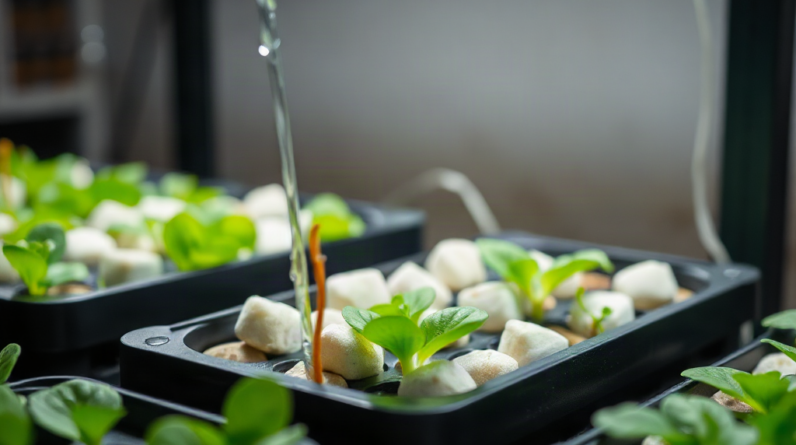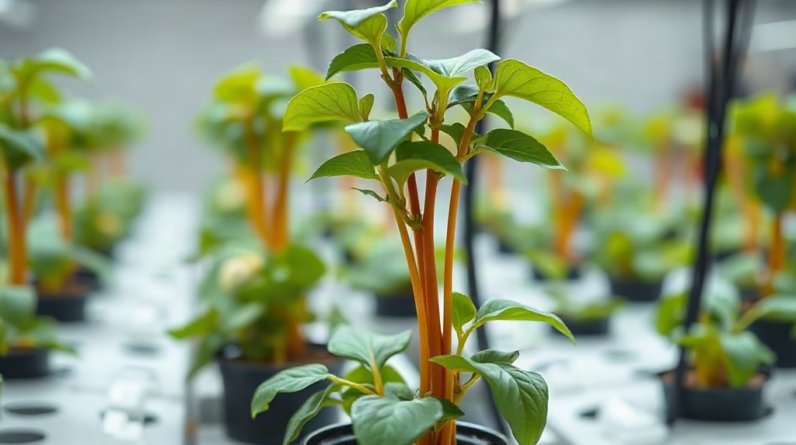
Strengthen weak stems in hydroponic plants by correcting excessive light distance, stagnant air, rapid growth, root-zone stress, and unbalanced nutrition before relying on physical supports. Place the light at a crop-appropriate intensity, create gentle stem movement with an oscillating fan, maintain steady root oxygenation, and verify nutrient concentration and pH with calibrated meters. Support leaning plants temporarily, but avoid tying stems so tightly that growth is restricted. New growth should become shorter, thicker, and better able to hold its leaves; continued stretching, soft tissue, discoloration, or a narrowing stem base indicates that the underlying problem remains.
Identify Why the Stems Are Weak
Stem weakness is a symptom rather than a single deficiency. A long, pale stem usually points toward insufficient light, while a short stem that bends under normal leaf weight may reflect weak air movement, overly fast growth, or root-zone trouble. A pinched, dark, or water-soaked area at the stem base requires different action because tissue damage or seedling disease may already be present.
Begin by examining where the weakness occurs. Uniformly thin stems across an entire tray suggest a shared environmental condition. If only the plants beneath the edge of a fixture are stretching, light distribution is the stronger suspect. A single collapsing plant among otherwise sturdy neighbors calls for an inspection of its collar, roots, net cup, and irrigation exposure rather than a room-wide nutrient adjustment.
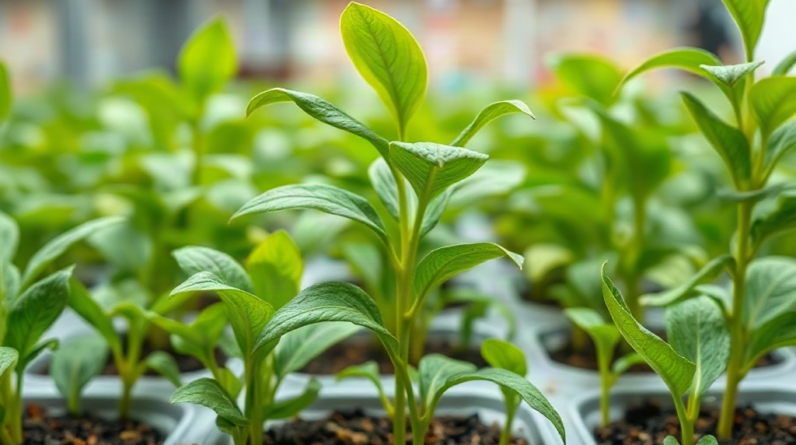
Plant age also changes the diagnosis. Seedlings naturally have delicate stems, but they should gradually develop thicker tissue as true leaves expand. Mature tomatoes, peppers, and cucumbers carry substantially more leaf and fruit mass, so a healthy stem can still lean when trellising is late. Lettuce may appear top-heavy when leaves expand rapidly, although its compact growth habit means pronounced stem elongation is still a warning sign.
Use a focused inspection before changing the reservoir:
- Growth pattern: Note long internodes, leaning toward the fixture, or unusually rapid vertical growth.
- Stem condition: Look for softness, constriction, cracks, discoloration, and damage where clips or net pots touch.
- Root condition: Healthy roots are generally firm and lack a foul odor; slime, browning, or easy breakage deserves prompt attention.
- System pattern: Compare plants by channel position, light coverage, cultivar, and planting date.
A common mistake is treating every weak stem as a calcium problem. Calcium participates in plant tissue development, but adding more cannot correct shade, stagnant air, damaged roots, or an unsuitable pH. Unnecessary supplementation can also disturb the nutrient balance. Record the visible pattern, pH, nutrient strength, solution temperature, and recent equipment changes first. That evidence makes Strengthen weak stems in hydroponic plants a targeted troubleshooting task rather than a sequence of guesses.
Correct Light, Airflow, and Room Conditions
Light should be assessed first when stems are abnormally long, narrow, and tilted. Plants extend toward a weak or distant light source because leaf placement becomes more valuable than compact structural growth. Lowering an adjustable fixture may reduce stretching, but the correct distance depends on the lamp, crop, growth stage, heat output, and manufacturer guidance. Distance alone is not a reliable measure of intensity.
Change light exposure gradually and watch the newest growth. Leaves that bleach, curl upward, develop dry margins, or become excessively warm may be receiving more light or heat than they can use. Conversely, continued elongation and widening gaps between leaves suggest inadequate intensity or poor fixture coverage. A light meter offers better decision support than visual brightness because human eyes adapt readily to indoor conditions.
Gentle air movement adds controlled mechanical stress that encourages sturdier growth. Use an oscillating fan to move leaves slightly rather than blasting one row continuously. In a seedling area, the correct airflow produces a mild flutter without folding leaves, drying small starter plugs rapidly, or pushing plants against adjacent surfaces. A stationary high-speed fan can cause wind injury on the exposed side while leaving sheltered plants untouched.
Consider a tray where seedlings nearest a wall have thin stems but those near an aisle are firmer. Raising fan speed may worsen drying at the aisle without reaching the stagnant boundary near the wall. Repositioning the fan or improving circulation around the tray is more effective because it addresses distribution rather than total airflow. The same principle applies to lighting: one powerful central fixture may produce stronger plants in the middle and stretched growth at the perimeter.
Temperature and humidity influence how rapidly plants use water and build new tissue. Very warm conditions combined with weak light can produce fast, soft growth because temperature-driven development outpaces available light energy. High humidity and limited circulation can further reduce transpiration and keep crowded foliage damp. Avoid making abrupt climate changes solely to harden stems; unstable conditions can stress roots and leaves without fixing the original imbalance.
The practical priority is uniformity. Check fixture coverage, rotate trays only if rotation can be performed consistently, separate taller crops from short seedlings, and remove obstructions that create still pockets. Do not expect old stretched sections to become short again. Success appears in the new growth: closer leaf spacing, thicker upper stems, upright leaves, and less dependence on a stake.
Check Roots, Irrigation, and Nutrient Balance
Strong shoots depend on roots that can obtain oxygen, water, and dissolved minerals without repeated stress. A plant may wilt and lose stem rigidity even when surrounded by nutrient solution if oxygen is limited or diseased roots cannot function normally. Inspect the root zone before increasing fertilizer strength, especially when weak stems occur with drooping leaves, slowed growth, odor, or discolored roots.
In deep-water culture, confirm that aeration is operating continuously, air stones are not clogged, and roots are not packed into a stagnant mass. In nutrient film systems, check that flow reaches every channel and that roots have not created a blockage. Drip systems require attention to individual emitters because one partially blocked line can weaken a single plant while reservoir readings remain normal. Starter plugs should remain moist enough for young roots but not continuously saturated above the intended solution level.
Measure pH and electrical conductivity with clean, calibrated instruments. A reservoir can contain adequate minerals while an unsuitable pH reduces their availability. Electrical conductivity indicates the overall concentration of dissolved ions, not whether each nutrient is present in the proper proportion. Follow the nutrient manufacturer’s crop and growth-stage range rather than chasing a universal number, and account for the starting water when mixing.
Reservoir trends provide useful clues. If water falls while conductivity rises, plants may be taking up proportionally more water than nutrients; repeatedly topping up with full-strength concentrate could make the solution harsher. If conductivity falls as water is used, nutrient uptake may be outpacing replenishment. Interpret both patterns alongside plant appearance and the system’s normal operating range rather than reacting to one reading.
More fertilizer does not produce a stronger stem on demand. Excessive nitrogen can encourage lush, soft growth, particularly when light is inadequate. Heavy correction with calcium or silica products may create new imbalances, alter pH, or raise total concentration. Silica is used by some growers as part of a planned nutrient program, but it is not a rescue treatment for a collapsing stem or failing root system. Confirm product compatibility and mixing order because concentrated inputs can react when combined directly.
For a practical reset, correct equipment failures first, remove dead root material only where it can be done without stripping healthy roots, restore suitable aeration or flow, and bring the solution back into the documented range for the crop. Avoid changing light, airflow, nutrient strength, and irrigation timing all at once unless plants face an immediate threat. Staged changes make it possible to see whether Strengthen weak stems in hydroponic plants efforts are improving new tissue or merely masking symptoms.
Support Damaged Plants and Track Recovery
Physical support protects a weak plant while corrected conditions influence new growth. It does not rebuild severely crushed, rotted, or split tissue. Use a clean stake, trellis string, plant clip, or soft tie selected for the crop’s expected size. Position the support so it carries weight without forcing the stem into an unnatural angle.
Leave room for expansion when tying a stem. Thin wire, tight knots, and rigid clips can constrict vascular tissue as the plant thickens. Check contact points regularly, particularly on tomatoes and cucumbers that grow quickly. Seedlings need lighter handling: a small support placed beside the plug may be enough, while burying a damaged collar or pressing a stake through dense young roots can cause additional injury.
Support choice should match the crop. A leaning basil seedling may need only improved light and temporary guidance. An indeterminate tomato needs ongoing trellising even when its stem is healthy because fruiting vines are not expected to support their entire mature load without assistance. Treating normal vine support as evidence of weakness can lead growers to overcorrect nutrition. By contrast, staking a seedling that continues to narrow at soil or plug level hides a potentially serious collar problem.
Track recovery at the growing tip rather than judging only the original weak section. Mark the stem gently below the newest leaves or take dated photographs from the same position. Over the next several days, compare internode length, stem diameter near new growth, leaf orientation, and the plant’s ability to remain upright. Roots should show active new tips, and water use should become more consistent as function returns.
Failure signs include continuing elongation, a spreading dark lesion, persistent wilting despite available water, worsening root odor, or additional plants developing the same symptom. Isolate badly affected seedlings when a stem-base disorder is suspected, clean reusable trays and tools, and avoid splashing contaminated material among plugs. A stem that has folded completely or developed extensive decay may not recover reliably; replacing it can protect space and time in a compact system.
The strongest correction sequence is simple: protect the plant from immediate breakage, repair the verified environmental or root-zone fault, and evaluate only new development. Keep notes on fixture settings, fan placement, reservoir readings, and irrigation behavior. Those records reveal whether the correction worked and help prevent the next planting from repeating the same structural weakness.
Frequently Asked Questions
Can a weak hydroponic stem become strong again?
New stem growth can become thicker after light, airflow, and root conditions are corrected. Severely stretched, crushed, or decayed tissue may remain weak and should be supported or the plant replaced.
Does a fan make hydroponic stems thicker?
Gentle, distributed air movement can encourage sturdier growth by creating mild mechanical movement. Strong direct airflow may dry plugs, damage leaves, or bend seedlings rather than strengthen them.
Should I add calcium when stems look thin?
Not automatically. Check light, root health, pH, nutrient concentration, and the existing formula first. Extra calcium will not correct stretching or poor oxygenation and may disrupt nutrient balance.
How can I tell whether weak stems are caused by low light?
Low-light growth commonly has long internodes, pale or undersized leaves, and stems leaning toward the fixture. Uneven symptoms that follow the fixture’s coverage provide another useful clue.
Should weak seedlings be buried deeper in a hydroponic plug?
Avoid burying a soft, pinched, or discolored stem because extra moisture around damaged tissue may worsen decay. Support the seedling lightly and correct its environment; replace it if the collar continues collapsing.
Conclusion
Weak stems improve most reliably when the visible growth pattern is matched to its actual cause. Inspect light coverage and internode spacing, then assess airflow, root condition, irrigation delivery, pH, and nutrient strength before adding supplements. Temporary stakes or trellises can prevent breakage, but they should not conceal a failing stem base or unhealthy roots.
Make the smallest correction that addresses the evidence and judge progress at the growing tip. Shorter internodes, thicker new tissue, stable leaves, and fresh root growth indicate that conditions are moving in the right direction. Continued stretching, soft lesions, odor, or wilting calls for another root-zone and equipment check. Record the successful settings so the next crop develops structural strength from the seedling stage rather than requiring rescue later.