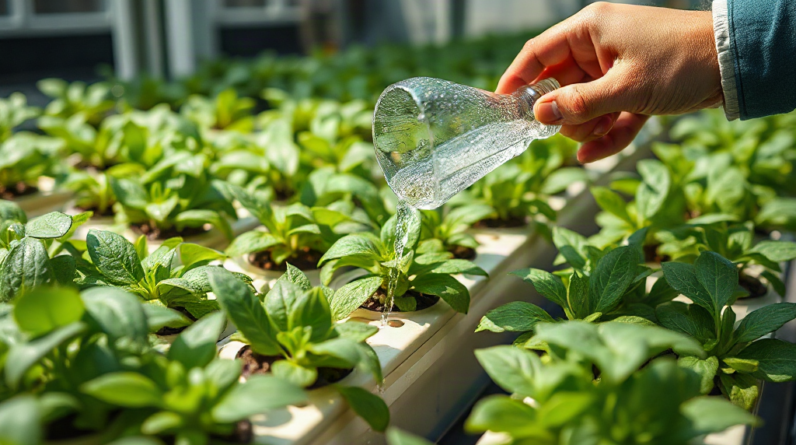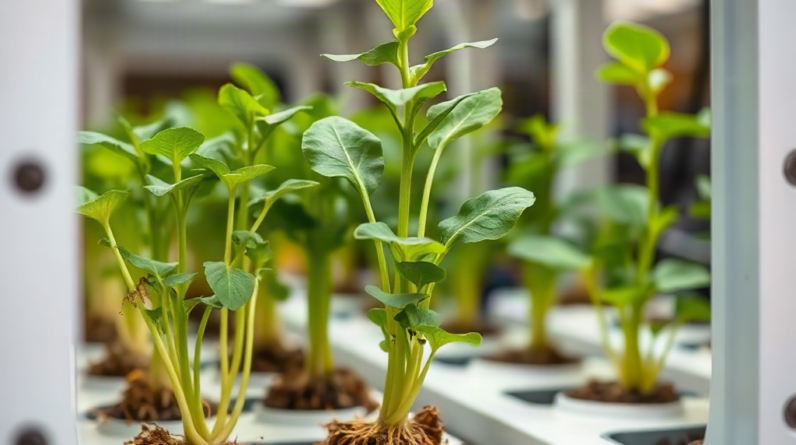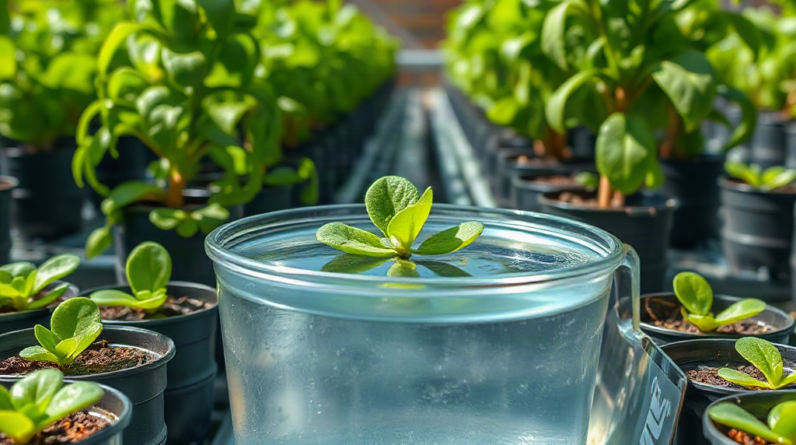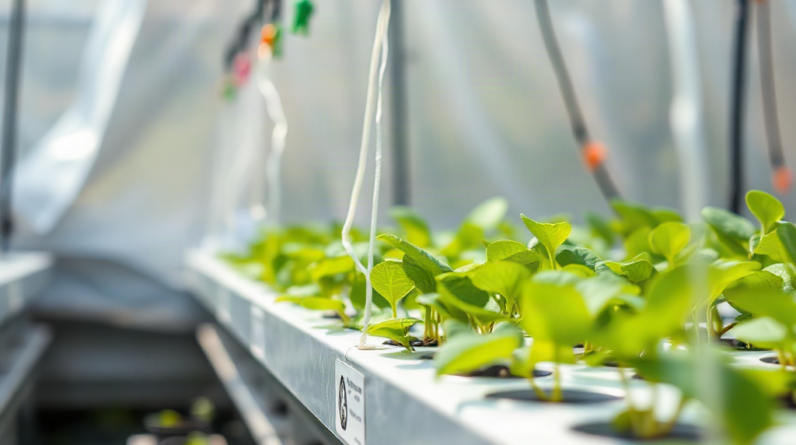
Healthy hydroponic transpiration requires humidity levels that maintain a moderate vapor pressure deficit rather than one fixed relative-humidity target. As a practical baseline, seedlings often perform well around 65–75% RH, established leafy plants around 55–70% RH, and flowering or fruiting crops around 45–60% RH, provided temperature and airflow are appropriate. Excess humidity slows water movement and raises condensation and disease risk, while very dry air can drive wilting, leaf-edge damage, and rapid reservoir uptake. Measure humidity at canopy height, compare daytime and nighttime conditions, and adjust ventilation, dehumidification, humidification, and air circulation gradually.
How Humidity Controls Transpiration
Transpiration is the movement of water from the root zone, through the plant, and out through microscopic leaf openings called stomata. Hydroponic roots may have constant access to solution, but that does not make atmospheric moisture irrelevant. The difference between moisture inside a leaf and moisture in the surrounding air influences how strongly water is pulled through the plant.
Relative humidity describes how close the air is to saturation at its current temperature. Warm air can hold more water vapor than cool air, so the same RH reading can represent a different drying demand after temperature changes. A grow room at 60% RH and 20°C does not exert the same pressure on leaves as a room at 60% RH and 28°C. This is why growers often use vapor pressure deficit, or VPD, alongside RH. VPD expresses the drying difference between the leaf and the air more directly.
When humidity is very high, the moisture gradient around the leaf becomes small. Transpiration can slow, reducing the movement of water and dissolved mineral ions through the plant. High humidity also allows cool leaves, walls, pipes, and fixtures to approach the dew point. Condensation and persistently damp leaf surfaces create favorable conditions for fungal and bacterial problems, especially within a dense canopy.
Very low humidity creates the opposite pressure. Leaves can lose water faster than roots and vascular tissue can replace it, even when the reservoir is full. Stomata may partially close to conserve water, limiting carbon dioxide exchange and slowing growth. Young leaf margins may curl or dry, while reservoir level and electrical conductivity can change faster than expected as plants take up proportionally more water.
A common mistake is treating RH as an isolated control number. Temperature, leaf temperature, light intensity, airflow, root-zone oxygen, and plant size all affect the response. The practical aim of hydroponic humidity levels for healthy transpiration is therefore a stable moisture demand that plants can meet—not the lowest or highest RH the equipment can maintain.
Practical Humidity Targets by Growth Stage
Useful humidity targets change as leaf area, root capacity, canopy density, and crop development change. Seedlings and newly rooted cuttings generally tolerate a more humid environment because their small root systems cannot replace water rapidly. A working range of roughly 65–75% RH is often suitable, but prolonged leaf wetness and stagnant air remain undesirable. A propagation dome should be vented progressively after roots form rather than removed abruptly.
Established leafy greens and vegetative plants commonly perform within about 55–70% RH. Lettuce or basil under moderate lighting may be comfortable near the upper part of that range, while a vigorous, crowded canopy may need lower room humidity to offset the moisture released by many leaves. Air should move gently through the foliage without continuously bending or desiccating the plants.
Flowering and fruiting crops are often managed closer to 45–60% RH. Larger plants release substantial moisture, while flowers and tightly packed foliage can trap humid air. Moving toward the lower portion of the range can reduce condensation risk as the canopy thickens, but forcing RH downward too aggressively may increase water demand and cause stress under intense lighting.
- Seedlings and cuttings: approximately 65–75% RH, with gradual acclimation after rooting.
- Vegetative and leafy growth: approximately 55–70% RH, adjusted for canopy density and temperature.
- Flowering and fruiting: approximately 45–60% RH, with close attention to hidden moisture inside the canopy.
These ranges are starting points rather than universal prescriptions. Crop genetics, growth stage, leaf temperature, light level, and room design can justify different settings. For example, 55% RH may be manageable for mature tomatoes in a warm, brightly lit room but unnecessarily dry for small lettuce plants under gentle lighting. VPD charts can refine the choice, although a chart based only on air temperature may mislead when leaves are noticeably cooler or warmer than the room.
Nighttime deserves separate attention. Transpiration and equipment heat decline after lights switch off, causing air temperature to fall and RH to rise. A room that holds 55% RH during the day may climb toward saturation overnight without any new source of water. The better target is a controlled day-to-night transition with enough extraction or dehumidification to avoid condensation. Do not chase an exact percentage while ignoring wet surfaces, canopy microclimates, or rapid overnight spikes.
Measure Canopy Conditions, Not Room Averages
Humidity data are only useful when the sensor represents the air touching the leaves. A meter mounted near a ceiling, dehumidifier outlet, open doorway, or humidifier plume can report conditions that differ sharply from those inside the canopy. Place the primary sensor near canopy height, shield it from direct mist and radiant heat, and leave enough clearance for air to circulate around it.
Large or layered gardens benefit from more than one measurement point. A second sensor beneath dense foliage can reveal trapped moisture that the room controller misses. Consider a vertical rack where the upper tier receives warm supply air while the lower tier remains cooler. Both tiers might share one room-average RH reading, yet the cooler lower leaves can sit much closer to the dew point and experience greater condensation risk.
Check accuracy before making expensive equipment changes. Hygrometers can drift or respond slowly, particularly after repeated exposure to very damp conditions. Compare two sensors side by side for several hours under stable conditions. A consistent disagreement suggests that one needs calibration or replacement. Sensors should not rest against metal supports or exterior walls because those surfaces may be cooler than the surrounding air.
A short environmental log is more informative than a single reading. Record air temperature, RH, light status, reservoir level, and any visible plant response at several points across the day. If possible, include leaf temperature from a suitable infrared thermometer while recognizing that reflective surfaces, distance, and measurement angle can affect readings. The goal is to identify patterns such as a humidity surge after irrigation, a dry period during peak lighting, or a nighttime rise after ventilation slows.
A focused inspection can follow this order:
- Read temperature and RH at canopy height before changing controls.
- Check upper, lower, and interior foliage for different conditions.
- Look for condensation on leaves, ducts, pipes, walls, and reservoir lids.
- Compare daytime peaks with the first hours after lights turn off.
- Verify the sensor before attributing plant symptoms to humidity alone.
The weak approach is adjusting equipment whenever the display crosses a chosen number. The stronger approach uses trends, plant condition, and microclimate readings together. This measurement discipline makes a target for hydroponic humidity levels for healthy transpiration operational rather than theoretical.
Correct High or Low Humidity Without Shocking Plants
Humidity correction should address the source and proceed in controlled increments. High RH often reflects a mismatch between plant moisture release and the room’s ability to remove water vapor. Mature foliage, exposed channels, wet floors, poorly covered reservoirs, and outside air can all add moisture. Extraction may solve the problem when outdoor air is drier, but it can be ineffective or counterproductive in humid weather.
Dehumidifiers provide more predictable removal in enclosed rooms, although they also release heat. That added heat can alter VPD and increase cooling demand, so capacity should be evaluated under the room’s actual moisture load rather than by floor area alone. Drain collected water reliably; a full internal bucket can shut the unit down during the most humid nighttime period. Clean filters and maintain clear airflow around the intake and discharge.
Air circulation does not remove moisture from the room, but it prevents saturated boundary layers and damp pockets from forming around leaves. Use circulating fans to mix upper and lower air and move air through, not merely over, the canopy. Directing a strong fan at one row can dry those leaves while leaving the canopy interior humid. Pruning or spacing may be more effective than adding fan speed when foliage is tightly packed.
Low RH can be corrected with a clean, appropriately sized humidifier, reduced unnecessary extraction, or better isolation from very dry supply air. Avoid spraying foliage as the primary humidity-control method. Droplets create uneven wetting, can leave mineral residue, and do not provide stable room regulation. If a humidifier uses a reservoir, clean it frequently and follow its operating instructions so the device does not become a source of deposits or contamination.
Change setpoints gradually while watching plant response. Moving rooted seedlings immediately from a closed dome to very dry room air can cause rapid wilting. Open vents first, increase air exchange over a day or more, and then remove the cover when leaves remain firm. Likewise, a sudden large reduction in RH around mature plants may accelerate water uptake and shift reservoir EC. Check solution level and concentration more often during the transition.
Signs of successful correction include fewer overnight spikes, no visible condensation, firm leaves through peak lighting, and steadier reservoir behavior. Failure is indicated by recurring wet surfaces, persistent leaf-edge drying, strong differences between sensor locations, or equipment cycling without bringing the canopy into range. Fix distribution and moisture sources before buying additional capacity.
Read Plant and System Warning Signs Together
Humidity symptoms overlap with nutrient, root-zone, temperature, and airflow problems, so leaves should not be diagnosed from appearance alone. High humidity may accompany soft growth, slow drying of wet surfaces, edema-like blistering, or disease pressure. Those signs become more meaningful when canopy measurements also show prolonged high RH, weak air movement, or condensation after lights-out.
Low humidity may coincide with curled margins, dry tips, midday wilting, and unexpectedly rapid reservoir decline. Yet similar wilting can result from warm solution, damaged roots, inadequate dissolved oxygen, blocked flow, or excessive salinity. If leaves wilt while the root zone smells abnormal or roots appear slimy, lowering transpiration demand may provide temporary relief but will not correct the underlying root problem.
Reservoir trends add useful context. Under dry air and strong light, plants may remove water faster than mineral ions, causing EC to rise as the solution volume falls. Under milder demand, water and nutrient uptake may remain more balanced. This relationship varies by crop and stage, so use each system’s established trend rather than assuming every EC increase proves low humidity. Confirm meter calibration and inspect for leaks or dosing errors first.
Consider a dense basil canopy that looks healthy in the morning but develops dark, damp interior leaves. A wall-mounted sensor reads 58% RH, apparently within range. A probe placed between plants records much wetter air after lights-out, and droplets appear on cooler lower leaves. The appropriate response is improved canopy spacing, air mixing, and nighttime moisture removal—not lowering daytime RH indiscriminately until exposed leaves become stressed.
A different scenario is young lettuce with crisping margins while the reservoir remains full. If canopy RH is low, temperature is high, and airflow is directed continuously at the leaves, excessive atmospheric demand is plausible. Raising RH moderately and redirecting the fan may help. If the symptom continues, inspect solution strength, pH, root health, and circulation rather than continuing to add humidity.
The most reliable troubleshooting sequence connects environmental readings, plant location, timing, and reservoir behavior. Note whether symptoms affect exposed leaves or sheltered leaves, appear during peak light or overnight, and improve after a measured adjustment. That evidence distinguishes a humidity problem from a coincidental reading and prevents repeated corrections that destabilize the growing environment.
Frequently Asked Questions
What humidity is best for a hydroponic grow room?
A practical range is about 55–70% RH for established vegetative plants and 45–60% RH for flowering or fruiting crops. Seedlings often tolerate 65–75% RH. Temperature, crop type, canopy density, and leaf temperature should refine the target.
Can hydroponic plants have too much humidity?
Yes. Persistently high humidity can slow transpiration, create condensation, and keep dense foliage damp. Check nighttime peaks and the canopy interior, because a room-average sensor may not reveal the wettest conditions.
Does a fan lower humidity around hydroponic plants?
A fan redistributes humid air and reduces stagnant pockets but does not remove water vapor from the room. Extraction, air conditioning, or dehumidification is needed when the total moisture load is too high.
Why does humidity rise when grow lights turn off?
Air cools after lights-out and can hold less water vapor, so relative humidity rises even if the amount of moisture changes little. Plants and exposed solution may continue adding vapor, increasing the nighttime peak.
Should humidity be controlled by RH or VPD?
Use RH for straightforward monitoring and VPD for a more temperature-aware view of drying demand. VPD is most useful when leaf temperature is reasonably known; an inaccurate leaf-temperature assumption can produce a misleading target.
Conclusion
Humidity management works best as a balance among crop stage, temperature, canopy structure, and moisture-removal capacity. Begin with a stage-appropriate RH range, then verify conditions where the leaves actually sit and during the hours when lights switch off. Give priority to condensation, abrupt reservoir changes, persistent wilting, and large differences between open-room and interior-canopy readings.
Correct moisture sources and poor air distribution before forcing a more extreme setpoint. Use extraction or dehumidification for excess room moisture, humidification for genuinely dry air, and circulation to reduce local pockets. Make gradual changes and track temperature, RH, solution level, EC, and plant response together. Stable trends and dry leaf surfaces are more useful evidence than hitting one percentage on a controller.