Hydroponic fodder production turns cereal grain into a dense mat of shoots and roots, but useful yields depend on viable seed, controlled moisture, airflow, and strict hygiene. Barley is commonly favored for reliable germination, while wheat, oats, rye, sorghum, and corn may suit local prices or livestock needs. Fresh-mat weight can be several times the original dry-seed weight, largely because the seedlings absorb water, so output should also be judged by dry matter and feed value. Clean seed, sanitized trays, good drainage, and prompt removal of sour-smelling or moldy batches are more important than maximizing mat weight. Feeding changes should be gradual and coordinated with a livestock nutrition professional.
Choosing Grain for Reliable Fodder Mats
Seed quality has more influence on a fodder tray than the sophistication of the growing rack. Grain must be alive, reasonably uniform, free from visible damage, and capable of germinating rapidly. Commodity grain that looks clean may still perform poorly if it was stored under hot or damp conditions, treated with a product not intended for feed production, or handled in a way that damaged the embryo.
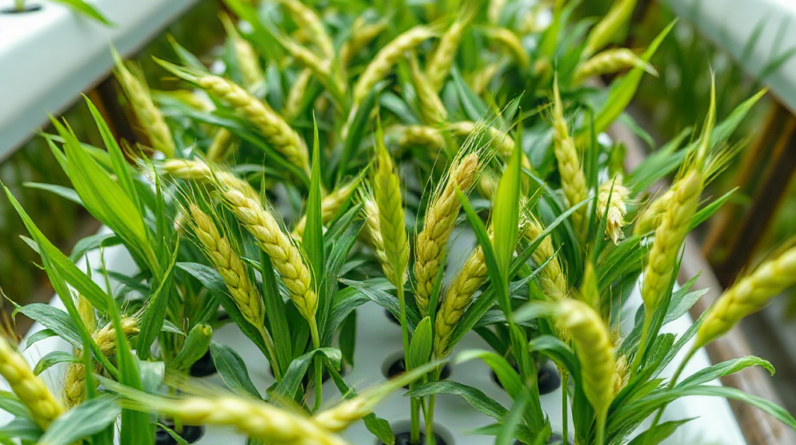
Barley is widely used because it typically forms a cohesive root mat and produces substantial shoot growth within a short cycle. Wheat and rye can produce similarly manageable mats where suitable grain is available. Oats may germinate less uniformly when hull condition or seed quality is inconsistent. Corn and sorghum need closer attention to temperature, seed size, and varietal suitability; they can be slower or less even than small grains, and some sorghum materials raise livestock-feeding concerns that warrant advice from a qualified nutrition professional.
The cheapest bag is not necessarily the lowest-cost crop. A moderately priced lot with strong, even germination can fill trays predictably, while a bargain lot with dead kernels leaves open areas where stagnant moisture and microorganisms accumulate. Test each lot before committing it to daily production. Place a counted sample on moist paper or in a clean test tray, keep it under the same temperature conditions as the fodder room, and record how many kernels produce healthy roots and shoots. Uneven emergence, unpleasant odor, discolored roots, or a high proportion of inert kernels are reasons to reject or further investigate the lot.
Crop choice should follow the livestock ration rather than visual appeal. A thick green mat contains shoots, roots, residual grain, and considerable water; it is not nutritionally interchangeable with an equal fresh weight of dry grain or hay. Palatability, fiber, starch changes, mineral contribution, and total dry-matter intake all matter. Introduce fodder gradually and treat it as a ration ingredient, not an automatic replacement for forage or concentrate.
For a practical purchasing decision, compare grain lots on four points:
- Intended use: Confirm that the seed is suitable for sprouting and feeding, with no incompatible treatment.
- Germination: Favor rapid, uniform emergence over advertised variety alone.
- Condition: Reject lots with insects, mustiness, heat damage, broken kernels, or abnormal discoloration.
- Supply: Choose a source capable of delivering consistent lots, because abrupt seed changes can disrupt tray timing.
A small trial also exposes whether the grain suits the installed equipment. Large corn kernels may require different seeding depth and irrigation than barley, while hulled oats can hold moisture differently across the tray. Readers comparing crop options can use this hydroponic fodder production: crops, yields, and hygiene reference as a reminder that crop performance must be evaluated together with yield quality and sanitation.
Interpreting Fresh Yield and Dry Matter
Fresh tray weight is an incomplete measure of production because most of the apparent gain comes from absorbed water. A heavy mat may look productive while supplying no more—and potentially less—dry matter than the original seed after respiration losses. Germinating seedlings consume stored carbohydrate for energy, releasing carbon dioxide and heat as roots and shoots develop. The mat gains water and green tissue, but it does not create feed mass from nothing.
Record three weights separately: dry seed loaded, harvested mat, and uneaten residue. For example, if a tray begins with a measured quantity of grain and ends with a much heavier mat, the ratio describes fresh output only. Comparing that number with dry hay or grain on an equal-weight basis would exaggerate the fodder contribution. A representative sample can be submitted to a feed-testing laboratory for dry matter and nutrient analysis, especially when fodder will become a regular ration component.
Operational yield also includes consistency. Two racks may produce the same total fresh weight, yet the rack with uniform mats, clean roots, and little rejection is more useful than one containing exceptionally heavy trays alongside spoiled batches. Track rejection rate, harvest age, labor, water, electricity, seed cost, and animal refusal. These measures reveal whether the unit is producing usable feed rather than merely moving water through grain.
Longer growth does not automatically improve value. Extending the cycle can create taller shoots, but it also increases respiratory losses, root density, water demand, and the time during which contamination can develop. Harvest timing should be based on repeatable germination, acceptable root condition, animal acceptance, and the needs of the ration. A short, clean cycle may be preferable to waiting for maximum height.
Weak yield assumptions often begin with a single conversion ratio promoted without context. Results shift with species, seed lot, seeding density, harvest age, drainage, room temperature, and the amount of free water left on the mat at weighing. Operators should therefore avoid promising a fixed yield before running trials under their own conditions. Weigh trays at the same point after irrigation or drainage so comparisons are meaningful.
Signs of a sound production trend include narrow variation between trays, vigorous white roots without slippery decay, even shoot development, predictable harvest timing, and low refusal at feeding. Warning signs include rising fresh weight paired with waterlogged mats, increasing spoiled-tray counts, or declining animal intake. The decision is not whether the mat looks lush; it is whether clean, analyzed, usable dry matter is being produced at a defensible cost.
Running a Consistent Seed-to-Feed Cycle
A repeatable cycle depends on controlling seed depth, hydration, drainage, temperature, and airflow as one connected process. Excess water is often blamed on irrigation frequency alone, but shallow drainage channels, tilted racks, overloaded trays, or tightly packed grain can leave kernels wet between irrigation events. Germinating seed also releases heat, so a dense rack may be warmer and more humid than the room sensor suggests.
Begin by assigning each seed lot a batch code and recording the loading date. Remove foreign material and visibly damaged grain before hydration. If grain is soaked, use potable water, a clean vessel, and a defined soaking period established through trial rather than leaving seed submerged indefinitely. Prolonged immersion restricts oxygen and may encourage fermentation. Drain thoroughly before spreading seed in a uniform layer; mounds create wet, oxygen-poor zones, while sparse areas dry faster and break the mat.
Irrigation should wet the developing roots without leaving standing water. Inspect the last tray on each line, not only the first, because pressure and flow may differ across the rack. Between cycles, water should leave the tray promptly. Air movement must remove humidity from the crop canopy without blasting one side dry. Condensation on walls, persistent droplets under upper trays, or a warm odor near the center of a rack indicates that moisture and heat removal are falling behind biological activity.
A compact daily control sequence keeps small problems from becoming batch losses:
- Before loading: Verify seed identity, tray cleanliness, drain function, and the previous batch record.
- During germination: Check emergence uniformity, root color, odor, standing water, and temperature differences within the rack.
- Before harvest: Separate questionable trays, allow excess irrigation water to drain, and record fresh output consistently.
- After harvest: Measure refusal where possible, clean food-contact surfaces, and note any change in animal acceptance.
Automation can improve timing, but it cannot correct poor rack geometry or contaminated surfaces. A timer may deliver identical irrigation to every tray even when blocked emitters, uneven loading, or different crop ages require attention. Manual systems demand more labor but make it easier for a careful operator to observe each tray. The better option is the one that can be inspected, cleaned, and documented reliably with available staff.
Scale only after several consecutive cycles produce comparable results. Expanding a rack before identifying the source of wet pockets multiplies the same fault across more feed. Production records should connect crop observations with seed lot, room conditions, irrigation changes, and harvest results. A detailed hydroponic fodder production: crops, yields, and hygiene log is most valuable when it leads to a specific correction, such as lowering seed depth or repairing a drain, rather than simply accumulating numbers.
Preventing Mold, Slime, and Feed-Safety Failures
Hygiene must be designed into every batch because warm, wet grain is also a favorable substrate for microorganisms. Cleaning removes seed fragments, root residue, and biofilm that shield contamination. Sanitizing is a separate step applied to an already clean surface, using a product appropriate for the equipment and intended use according to its label. Applying sanitizer over visible organic material is not a substitute for washing.
Separate dirty and clean movement wherever possible. Harvested mats, used trays, drain waste, and discarded grain should not pass through the area where clean trays are loaded. Brushes and containers used on dirty equipment should not return to seed preparation without cleaning. Potable water should be used where water contacts seed or fodder, and tanks, lines, nozzles, floors, and drains need inspection rather than attention only after an odor appears.
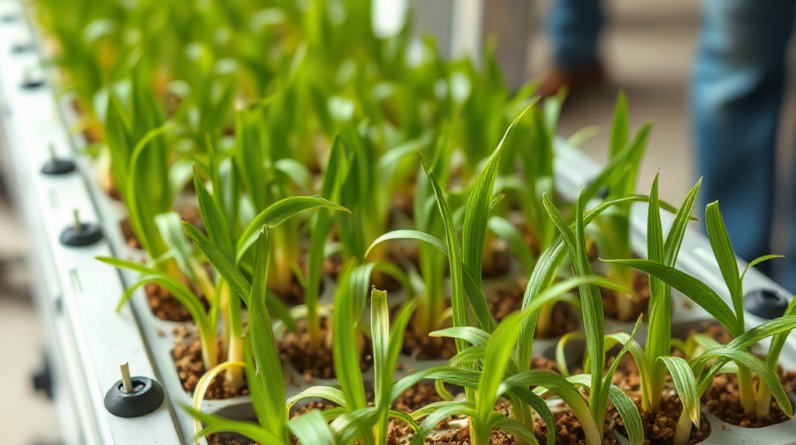
Root hairs are commonly mistaken for mold. Healthy root hairs tend to appear as fine, uniform fuzz close to emerging roots and become less obvious when wet. Suspect fungal growth is more likely to form irregular patches, spread across kernels or shoots, show unusual color, or accompany musty odor and deteriorating tissue. Appearance alone is not always enough to identify a contaminant, so a questionable tray should be isolated rather than mixed into feed.
Sour odor, slimy kernels, discolored roots, unusual heating, standing water, or rapidly expanding patches are failure signals. Do not try to rescue a spoiled mat by rinsing the surface and feeding it anyway. Rinsing may change appearance without addressing organisms or by-products within the mass. Remove the affected batch, prevent drips or tools from spreading material to neighboring trays, clean the production area, and investigate seed condition, soaking time, tray loading, drainage, airflow, and temperature before restarting.
Seed disinfection may reduce surface contamination in some operations, but it is not a universal remedy and must not be improvised with unapproved chemicals or concentrations. Product suitability, contact time, worker safety, residue concerns, and local requirements all matter. Guidance should come from applicable labels, feed-safety authorities, extension resources, and veterinary or livestock-nutrition professionals. No treatment compensates for contaminated seed, neglected equipment, or poor moisture control.
Keep a written release rule for harvested fodder. A batch should have the expected smell and appearance, drain normally, match its production record, and contain no unresolved spoilage signs. Staff should have authority to reject a tray without pressure to preserve an output target. Feed value disappears when maximizing yield encourages questionable material to enter the ration; the economic loss from discarding one tray is usually easier to contain than an unexplained animal-health or intake problem.
Frequently Asked Questions
Which grain is best for hydroponic fodder?
Barley is often selected for fast, uniform germination and cohesive mats, but the best choice is the untreated, feed-suitable grain that performs consistently, fits the livestock ration, and is economical in the local market.
How should hydroponic fodder yield be measured?
Record seed input, fresh harvest weight, rejected trays, and uneaten residue under consistent weighing conditions. Use dry-matter testing when comparing fodder with hay, grain, or silage because fresh weight is dominated by water.
Is white fuzz on fodder roots always mold?
No. Fine, uniform root hairs close to healthy roots can look fuzzy and often become less visible when wet. Irregular spreading patches, discoloration, musty odor, slime, or damaged tissue justify isolating and rejecting the tray.
Can hydroponic fodder replace hay or grain completely?
It should not be assumed to replace either on an equal fresh-weight basis. Its role depends on dry matter, nutrient analysis, livestock class, forage needs, and the complete ration; changes should be gradual and professionally reviewed.
What causes repeated mold in fodder trays?
Common contributors include contaminated or weak seed, excessive soaking, dense loading, standing water, poor airflow, warm rack centers, retained crop residue, and ineffective cleaning. Records help identify which condition changed before failures appeared.
Conclusion
Successful fodder output is better defined by clean, consistent, usable feed than by the heaviest possible tray. Start with a germination test and a small crop trial, then measure seed input, fresh harvest, rejected material, dry matter where practical, and animal refusal. Use those records to select grain and set harvest timing instead of relying on a universal conversion claim.
Moisture control deserves equal attention to crop choice. Trays must drain freely, airflow must reach the center of the rack, and equipment must be cleaned before an appropriate sanitizer is applied. Establish clear rejection criteria for sour odor, slime, abnormal heat, discoloration, and suspicious growth. Once several cycles remain uniform and acceptable, scale gradually and have the resulting feed incorporated into the livestock ration according to its analyzed value rather than its fresh weight.