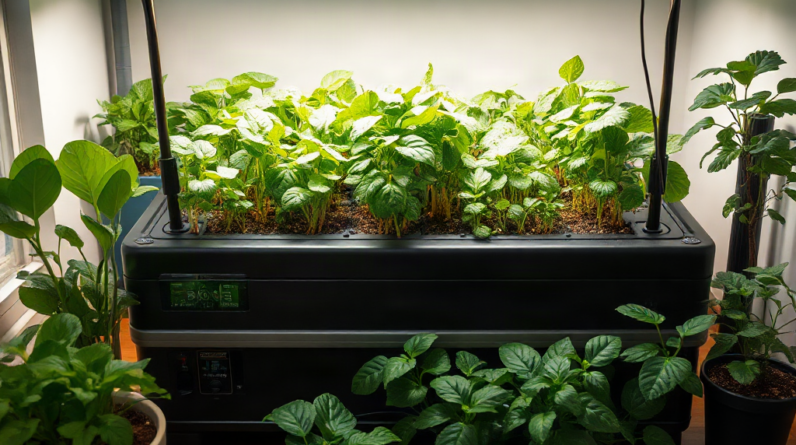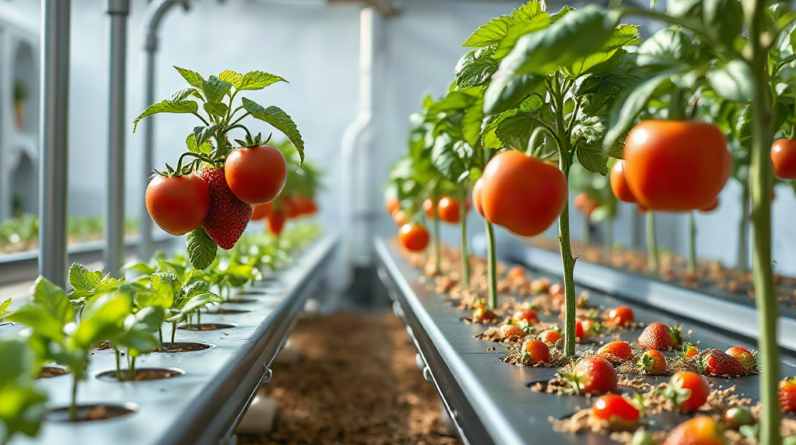
Hydroponic systems with passive nutrient delivery feed plant roots without pumps by using capillary wicks, a gradually falling reservoir, or moisture-retentive media to move water and dissolved minerals. Wick systems suit herbs and small greens, while the Kratky method gives roots both nutrient contact and an expanding air gap as the solution level drops. Success depends on matching reservoir size, root-zone oxygen, nutrient concentration, and media wicking capacity to crop demand. Large fruiting plants often consume solution faster than passive movement can replace it, so lettuce, basil, and compact herbs are usually more dependable choices.
How Passive Nutrient Delivery Works
Passive delivery replaces continuous pumping with physical processes that require no powered circulation. A wick draws nutrient solution upward through capillary action, a Kratky container exposes more root surface to air as its solution level falls, and a capillary bed distributes moisture through absorbent media. The plant still receives water and dissolved mineral ions, but delivery is governed by material properties, reservoir height, root growth, and plant demand rather than a timer or pump.
Capillary action works when narrow pores in a wick or growing medium pull liquid against gravity. Cotton cord can move solution readily but may decay or become biologically fouled. Synthetic felt, braided polyester, and suitable capillary matting generally last longer. A thick wick does not automatically supply more water: compression, salt deposits, an air gap, or poor contact with the medium can interrupt the liquid pathway. The wick must remain wet at both ends and touch a medium capable of spreading that moisture through the root zone.
The Kratky method uses a different mechanism. A young plant begins with part of its root system in nutrient solution. As the plant consumes water, the liquid level drops and creates a humid air space beneath the lid. Upper roots obtain oxygen from that space while lower roots continue contacting solution. Topping the container back to its original level can submerge air-adapted roots and cause oxygen stress. If replenishment is necessary, it should preserve a substantial air gap instead of restoring the starting depth.
Passive systems work most predictably when crop demand is modest and the growing period is short. A head of lettuce can often complete its cycle from a properly sized reservoir, whereas a mature tomato may need frequent replenishment and stronger root aeration. Hot, dry conditions increase transpiration and can push consumption beyond a wick’s delivery rate. Cool conditions reduce water use but may leave the medium excessively wet.
The weak assumption is that “no pump” means “no management.” Passive operation removes moving parts, noise, and electrical dependence, but it also removes forced mixing and active oxygenation. Growers must therefore pay closer attention to solution depth, root appearance, moisture distribution, and concentration changes. A broader treatment of Hydroponic systems with passive nutrient delivery should always distinguish mechanical simplicity from biological self-sufficiency.
Choosing Between Wick, Kratky, and Capillary Systems
System choice should follow crop water demand rather than container appearance or simplicity alone. Wick systems are well suited to basil, mint, small lettuces, and other compact plants because each net pot can receive a controlled moisture pathway. They are forgiving when the medium spreads water evenly, but delivery may lag once a plant develops a large canopy or enters a period of rapid growth.
A basic wick setup places a plant in an inert or low-nutrient medium above a covered reservoir. One or more wicks pass from the solution into the root zone. The reservoir can be inspected or refilled without lifting the plant, which makes this format useful for windowsills and small indoor gardens. Its common failure is uneven wetness: the area around the wick remains saturated while outer roots stay dry. Mixing a capillary material such as coco coir with a coarser component can improve lateral moisture movement without eliminating air spaces.
Kratky containers are often better for leafy crops that have a defined harvest date. The reservoir is sized to provide most or all of the solution needed for that crop cycle, and an opaque lid limits algae growth. This approach avoids wick replacement and media saturation problems, but it is less tolerant of leaks, undersized reservoirs, or incorrectly positioned seedlings. A young transplant must initially reach moisture; a mature plant must retain an oxygen-rich gap above the solution.
Capillary beds and self-watering planters serve multiple plants through a moist lower layer, mat, or media column. They distribute water across a wider footprint and can work for mixed herbs or nursery plants. Their limitation is shared moisture: a thirsty crop can draw heavily from the same reserve used by slower plants, while dense or degraded media may remain waterlogged. These beds also accumulate salts near surfaces where evaporation occurs, especially when the reservoir is repeatedly topped up without periodic cleaning.
A practical selection rule is to match the system to the crop and level of intervention:
- Choose a wick system for individual herbs or greens when easy reservoir access matters.
- Choose Kratky for lettuce and similar short-cycle crops when the container can hold enough solution for most of the grow.
- Choose a capillary bed for several compatible plants that have similar water demands.
- Choose an active system instead for large fruiting crops, very warm rooms, or production where circulation and rapid correction are priorities.
Passive designs are inexpensive at small scale, but they are not automatically the lowest-risk option for every crop. Adding a pump may be justified when reservoir temperature rises, roots fill most of the container, or demand fluctuates sharply. Simplicity has value only when the selected mechanism can keep pace with the plant.
Reservoir, Nutrient, and Root-Zone Setup
Reservoir design determines how long a passive system can remain stable between inspections. An opaque, food-compatible container limits light exposure and makes algae less likely than a clear jar. The lid should support the plant securely while allowing enough access to measure the solution. Small reservoirs are easy to place but undergo faster changes in temperature, concentration, and water level.
Start with a complete hydroponic nutrient formulated for the crop type and mix it according to its label rather than combining products by guesswork. Electrical conductivity, when measured, indicates the total concentration of dissolved ions but does not reveal whether individual nutrients remain balanced. As plants remove water and minerals at different rates, topping up with full-strength solution every time can drive concentration upward. Plain water may sometimes be the appropriate refill, while a fresh nutrient batch is preferable when the remaining solution has become concentrated, discolored, or difficult to correct.
Solution pH affects nutrient availability, yet repeated adjustment without considering water alkalinity can produce unstable results. Measure after the nutrient has been thoroughly mixed and allowed to settle. In a passive reservoir, take the sample from the liquid itself rather than relying on runoff from the growing medium. Large swings can point to a very small reservoir, contaminated equipment, decomposing roots, or source water that strongly resists pH change.
Root-zone oxygen deserves equal attention. In a Kratky container, leave the developing air-root zone intact. In a wick planter, avoid packing fine media tightly around the stem, because capillary delivery combined with low porosity can exclude air. Healthy roots are commonly light colored and firm, although nutrient staining can alter their appearance. Slimy texture, unpleasant odor, and rapid browning accompanied by wilting are more concerning than color alone.
A sound setup sequence reduces avoidable corrections:
- Clean the reservoir, lid, net pot, and measuring tools before mixing solution.
- Prepare nutrient solution in a separate container and verify its concentration and pH.
- Pre-moisten the wick or medium so capillary flow is established before transplanting.
- Position young roots close enough to moisture while preserving the system’s intended aeration space.
- Block light from the reservoir, mark the starting liquid level, and record the setup date.
The starting mark is especially useful. It reveals consumption rate and helps distinguish ordinary uptake from a leak. For a lettuce container, gradual decline with firm leaves and expanding roots suggests the reservoir volume is broadly matched to demand. A steep decline while the medium dries indicates inadequate capacity or weak capillary transfer. More detailed planning for Hydroponic systems with passive nutrient delivery should account for expected plant size, room temperature, and the grower’s inspection schedule before selecting container volume.
Monitoring Performance and Correcting Failures
Plant posture, root condition, reservoir level, and medium moisture provide a more useful diagnosis when read together. Wilting alone does not prove that a passive system needs more solution. A plant may wilt because the wick is dry, the medium is saturated and oxygen-poor, the reservoir is hot, or roots have been damaged. Adding water without identifying the mechanism can worsen a saturated root zone.
Check the physical delivery path first. Confirm that a wick remains immersed, wet along its length, and in firm contact with the medium. In a capillary bed, inspect several locations rather than touching only the surface above the water column. Dry outer zones with a wet center indicate poor lateral spread. A second wick or a better-distributing medium may solve the problem, but adding more wicks to an already wet planter can reduce aeration.
For Kratky plants, inspect the relationship between roots and liquid. If the reservoir ran nearly dry before harvest, add solution only to a lower level that leaves the upper root mass exposed to humid air. If roots are crowded, brown, and foul-smelling, simply raising the level is unlikely to restore function. Remove dead material only when it can be done without tearing healthy roots, lower root-zone temperature where practical, and consider transferring the crop to an aerated recovery container if it has enough value and vigor to justify intervention.
Salt accumulation produces a different pattern. Leaf margins may scorch, water uptake may slow, or a pale crust may form on the medium or container. Measurements can confirm whether concentration has climbed, but meters must be calibrated and probes rinsed to remain useful. When the reservoir chemistry is uncertain, replacing the solution and cleaning deposits is usually more controlled than making repeated small additions.
Use a compact weekly check even when plants look healthy:
- Compare the current solution level with the marked starting point.
- Inspect leaves for new distortion, edge burn, or loss of firmness.
- Check roots for firmness, odor, crowding, and contact with moisture.
- Verify that the wick, mat, or medium remains continuously connected to the reservoir.
- Measure concentration and pH often enough to recognize the normal trend for that container.
A working system shows steady new growth, predictable water use, and roots occupying both moist and oxygenated zones. Repeated midday wilting, accelerating solution loss, persistent algae, blocked wicks, or rising concentration signals that the design is operating too close to its limit. Moving to a larger reservoir may extend stability, but an active aerated or recirculating system is the better correction when crop demand consistently exceeds passive delivery.
Frequently Asked Questions
What plants grow best with passive nutrient delivery?
Lettuce, basil, mint, and compact leafy greens are dependable choices because their water demand and crop duration are moderate. Large tomatoes, cucumbers, and other heavy-feeding fruiting plants usually need more reservoir capacity and aeration.
Does a passive hydroponic system need an air pump?
Not when the design preserves oxygen around part of the root system. Kratky containers rely on an air gap, while wick systems depend on porous media; an air pump may still help if roots become crowded or oxygen stress develops.
Should a Kratky reservoir be refilled to the top?
No. Refilling to the original level can submerge roots that adapted to the humid air space. If more solution is needed, keep the upper root zone exposed and replenish only the lower portion of the container.
Why is the growing medium wet near the wick but dry elsewhere?
The medium is not spreading moisture laterally, or the wick capacity is too low for the container. Improve wick contact, adjust the media blend, or add a carefully positioned wick without saturating the entire root zone.
How often should passive nutrient solution be changed?
There is no universal interval. Replace it when concentration or pH becomes difficult to manage, roots or debris contaminate it, or repeated top-ups have altered the balance; short-cycle Kratky crops may finish without a full change.
Conclusion
Passive delivery is most reliable when the crop, reservoir, and moisture pathway are sized as one system. Use wicks for modest individual plants, Kratky containers for suitable short-cycle greens, and capillary beds where plants share similar water needs. Protect the solution from light, preserve root-zone air, and avoid treating every drop in reservoir level as a reason to add full-strength nutrients.
Begin with one compact leafy crop and mark its starting solution level. Track uptake, inspect the delivery path, and note how roots occupy wet and aerated areas. Those observations reveal whether the container can complete the crop cycle or needs more capacity. If demand repeatedly outruns capillary flow or oxygen declines as roots expand, changing to an actively aerated system is a practical design correction rather than a failure of technique.