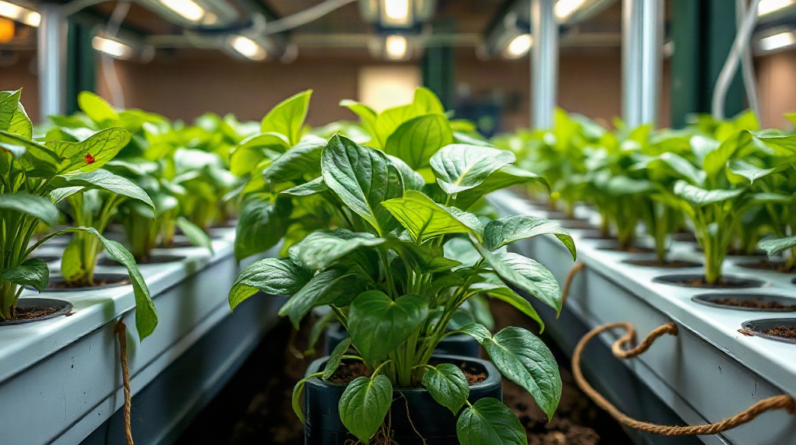
Large-scale hydroponic farming infrastructure requires a site and capacity plan that coordinates the growing system, water treatment, electrical service, climate control, drainage, sanitation, storage, and postharvest workflow. Utility loads should be calculated from simultaneous peak demand rather than equipment nameplate averages, with backup power reserved for pumps, controls, communications, and other crop-critical circuits. The building must separate clean production areas from receiving, chemical handling, waste, and packing activities while allowing equipment access for maintenance. Designs should also include redundant circulation, alarmed environmental controls, water-quality testing, and expansion space so a single failure or later production increase does not force a disruptive retrofit.
Match the Site and Building to the Production Model
A commercial hydroponic site should be selected around the crop process rather than an attractive building price. Greenhouse lettuce, vine crops under glass, and fully enclosed vertical production impose different demands on floor loading, ceiling height, light, cooling, water storage, and material movement. A warehouse with inexpensive rent may become costly if its electrical service cannot support lighting and cooling, while a greenhouse site with strong sunlight may still be unsuitable if drainage, storm access, or water quality is poor.
Begin with a room-by-room production model showing propagation, growing, harvesting, packing, cold holding, input storage, water treatment, maintenance, waste handling, and employee hygiene areas. Calculate area from weekly output and crop residence time, not from a target number of channels or towers alone. A farm harvesting continuously needs room for several crop stages at once, plus empty spaces moving through cleaning and replanting. Ignoring turnover time commonly produces a facility that appears large enough on paper but cannot sustain its intended weekly volume.
The building envelope determines how much mechanical equipment must compensate for outdoor conditions. Greenhouses exchange more heat with the environment and depend on shading, ventilation, heating, and sometimes evaporative cooling or dehumidification. Enclosed farms offer tighter control but place photosynthetic lighting, sensible heat removal, and moisture removal almost entirely on engineered systems. Neither format is automatically more efficient; the useful comparison is total infrastructure and operating demand for the chosen crop, climate, market schedule, and quality specification.
Physical details deserve early verification. Confirm structural load limits for water-filled tanks, stacked growing levels, suspended pipes, lighting, and maintenance platforms through qualified design professionals. Check clear heights, column spacing, roof penetrations, fire access, equipment delivery routes, and whether floors can be sloped or curbed without compromising the structure. Local planning, building, fire, water-discharge, worker-safety, and food-handling requirements should be reviewed with the relevant authorities before equipment is ordered.
Site access also affects daily reliability. Trucks need all-weather routes and turning space, while loading areas should keep incoming growing media, fertilizers, and packaging away from outgoing produce. A remote parcel may lower land cost but complicate labor, service calls, replacement-part delivery, and refrigerated distribution. Readers developing Large-scale hydroponic farming infrastructure requirements should therefore compare sites with a lifecycle model that includes utility upgrades, logistics, permitting constraints, and required building modifications rather than rent or land price alone.
Size Water, Nutrient, Drainage, and Sanitation Systems
Water infrastructure must deliver suitable source water, stable nutrient solution, reliable circulation, and controlled disposal or reuse. A source-water analysis should cover the characteristics that affect crop nutrition and treatment decisions, including alkalinity, pH, electrical conductivity, major ions, suspended material, and microbial risk where applicable. A high flow rate does not make unsuitable water acceptable; excess sodium, chloride, alkalinity, or variable well-water chemistry can undermine nutrient formulation and increase treatment or discharge costs.
Storage capacity should reflect peak irrigation, treatment production rate, cleaning demand, fire or regulatory needs where applicable, and the time required to recover from an interruption. Treatment equipment such as filtration, disinfection, softening, or reverse osmosis must be selected from laboratory results and crop requirements rather than installed as a standard package. Reverse osmosis can produce consistent feed water, for example, but it also creates a concentrate stream and requires storage, pretreatment, membrane maintenance, and enough production capacity to refill tanks on schedule.
Nutrient rooms need corrosion-resistant surfaces, ventilation, controlled access, spill containment, accurate dosing equipment, and safe separation of incompatible concentrates. Concentrated calcium should not share a stock tank with concentrated sulfates or phosphates because precipitation can remove nutrients and obstruct dosing lines. At commercial scale, labeled tanks, verified injection ratios, calibration procedures, and independent confirmation of reservoir EC and pH are more dependable than trusting controller displays alone.
Recirculating designs reduce raw-water demand and nutrient discharge, but they connect growing zones biologically and hydraulically. A root-zone problem, dosing error, or contaminant can spread through a shared loop. Separate reservoirs or hydraulically isolated production zones limit the size of an incident, although they increase equipment and monitoring requirements. Large farms often benefit from modular loops that correspond to crop type, age, or harvest block instead of one central reservoir serving the entire facility.
Drainage is production infrastructure, not an afterthought. Floors should move wash water and leaks toward accessible drains without allowing standing water beneath benches or electrical equipment. Drain capacity must accommodate cleaning flows and credible failures, not only routine irrigation runoff. Backflow protection and clear separation between potable water, process water, nutrient solution, and wastewater reduce cross-connection risks. Discharge options should be confirmed before operation because nutrient-rich water may not be acceptable in storm drains or on adjacent land.
A practical commissioning review should verify four conditions:
- Capacity: Tanks, pumps, treatment equipment, and drains can handle peak operating and cleaning periods.
- Isolation: Valves allow one zone to be serviced without stopping the whole farm.
- Verification: Flow, pressure, EC, pH, temperature, and tank level can be checked independently.
- Cleanability: Pipe runs avoid stagnant sections and provide access for flushing, inspection, and replacement.
Warning signs include drifting pressure at distant channels, frequent injector correction, unexplained sediment, uneven plant growth between zones, and recurring biofilm soon after cleaning. Those symptoms often indicate hydraulic imbalance, inadequate pretreatment, inaccessible piping, or sanitation procedures that do not reach the full circuit.
Engineer Electrical, Climate, and Control Capacity
Electrical and environmental systems should be modeled as one load rather than separate equipment purchases. Lighting adds electrical demand and heat; plants and open water add moisture; dehumidification may add heat that must be removed or reused. Pumps, air compressors, chillers, fans, heaters, dosing units, cold rooms, packing equipment, and office loads may operate simultaneously. Capacity planning based on average consumption can therefore leave the service, transformer, switchgear, or generator undersized during peak production.
An electrical load schedule should identify continuous loads, startup currents, operating sequences, future circuits, and equipment that must remain energized during an outage. Qualified electrical designers should determine service size, protection, grounding, wet-location suitability, emergency disconnects, and applicable code requirements. Corrosion-resistant enclosures and correctly rated connectors matter in humid growing rooms; household extension cords and improvised power strips are not commercial distribution systems.
Backup design should distinguish crop-critical loads from comfort and full-production loads. Keeping every light and cooling unit online may require a very large generator, but maintaining nutrient circulation, aeration, controls, alarms, network equipment, essential ventilation, and freeze protection may preserve the crop through a shorter interruption. The correct priority depends on crop sensitivity and climate. A shallow-rooted leafy-green system can deteriorate quickly if circulation stops in hot conditions, while an unheated greenhouse in winter may place heating controls and fuel delivery at the top of the emergency list.
Climate-control calculations need local design weather, crop transpiration, lighting heat, building leakage, envelope properties, plant density, and expected production stage. Temperature alone is inadequate. Relative humidity, vapor pressure relationships, air speed through the canopy, root-zone temperature, and condensation surfaces all affect crop behavior and disease pressure. Simply installing more circulation fans does not remove moisture; fans redistribute air, while ventilation, cooling coils, or dedicated dehumidification must carry water vapor out of the growing space or condense it for disposal or reuse.
Controls should organize the facility into understandable zones and record conditions at useful intervals. Sensors belong where crops experience conditions, with additional measurements for supply air, return air, nutrient tanks, and equipment status. Redundant sensors are most valuable for variables capable of causing rapid loss, but duplication without calibration only creates conflicting readings. The operating plan should specify calibration frequency, alarm limits, escalation contacts, and the manual procedure used if automation fails.
A strong alarm reports actionable conditions such as low tank level, loss of pump current, abnormal supply pressure, high solution temperature, or climate deviation sustained beyond an acceptable interval. A weak alarm system floods staff with minor notifications until alerts are ignored. During commissioning, test alarms by simulating failures rather than assuming connected devices will notify the correct person. This operational layer is central to Large-scale hydroponic farming infrastructure requirements because automation only protects production when sensing, communications, and human response all work together.
Design Workflow, Redundancy, and Expansion Before Construction
Facility layout should move plants, people, tools, packaging, and waste in deliberate directions. Propagation should feed production without crossing dirty receiving or waste routes. Harvested produce should reach packing and cooling with minimal delay and handling, while chemical storage, repair work, and discarded plant material remain separated from exposed product. Long travel paths create labor cost every day, even when the growing equipment itself performs well.
Map representative work cycles before finalizing walls and utilities. Follow a seed tray from filling through germination and transplanting; follow a mature crop through harvest, channel cleaning, packing, and cold storage. Include cart widths, door clearances, hose reach, pallet staging, handwashing access, and the space needed to remove a pump or fan. Equipment that fits into a mechanical room may still be unserviceable if filters cannot be withdrawn or a replacement motor cannot pass through the doorway.
Sanitation is easier when incorporated into surfaces and traffic patterns. Smooth, durable finishes, accessible drains, washable wall junctions, and tool-storage points reduce hidden wet areas and improvised cleaning. Zoning may separate propagation, production blocks, packing, and utility areas with dedicated tools or controlled movement. The objective is not cosmetic cleanliness; it is to prevent plant debris, nutrient residue, standing water, and uncontrolled traffic from creating persistent contamination routes.
Redundancy should target credible single points of failure rather than duplicate everything. Parallel pumps with automatic or simple manual changeover may protect a central loop. Spare dosing pumps, sensor probes, valves, fuses, and communication hardware can reduce repair time when exact components have long lead times. Two pumps connected to the same failed electrical panel, clogged intake, or software controller are not genuinely independent. Trace each critical function from power source to crop and identify where one fault could stop the process.
Expansion planning requires reserved capacity and physical access. Extra panel space, capped pipe connections, network ports, control addresses, tank-pad area, and routes for larger ducts or cables are inexpensive before construction and disruptive afterward. Reserving empty floor area without checking cooling, water treatment, drainage, and transformer capacity creates only the appearance of scalability. Expansion should be modeled as a defined production module with its own incremental utility loads and effects on packing, cold storage, labor, and shipping.
Before procurement, assemble a capacity plan that links weekly saleable output to nursery slots, production positions, harvest hours, wash capacity, cooler volume, water demand, and peak utility load. Stress-test it against a hot day, a delayed harvest, a failed pump, source-water interruption, and a temporary labor shortage. Signs of a workable design include accessible maintenance points, measurable reserve capacity, isolated production zones, documented manual overrides, and workflows that remain passable during cleaning. Signs of a fragile design include shared bottlenecks, no bypasses, inaccessible valves, undocumented controls, and production claims that assume every crop cycle is perfect.
Independent design review is especially valuable before concrete, switchgear, plumbing mains, or climate equipment are committed. Grow-system suppliers understand their equipment, but the owner still needs coordination among structural, mechanical, electrical, plumbing, food-safety, and operational requirements. A coordinated review of Large-scale hydroponic farming infrastructure requirements can expose incompatible assumptions while changes remain drawings rather than demolition.
Frequently Asked Questions
What utility should be evaluated first for a large hydroponic farm?
Evaluate water quality and available electrical capacity early because either can make a site uneconomic. Test the source water and prepare a peak electrical load estimate before signing a lease or ordering production equipment.
How much backup power does a commercial hydroponic facility need?
Size backup power from a documented emergency load list, not total building demand by default. Priorities commonly include circulation, aeration, controls, alarms, communications, essential ventilation, and climate protection required by the crop and local weather.
Is one central nutrient reservoir better than multiple reservoirs?
A central reservoir can simplify dosing but increases the number of plants exposed to one error or waterborne problem. Multiple or isolatable loops cost more to equip yet provide better crop separation, scheduling flexibility, and incident containment.
Should expansion capacity be installed during the initial build?
Install difficult-to-retrofit provisions such as service capacity, panel space, pipe routes, capped connections, drainage access, and structural allowances when financially practical. Add production equipment later only after confirming that climate, packing, and cold-storage capacity can support it.
What is a common infrastructure planning mistake?
A frequent mistake is sizing growing equipment without modeling propagation, crop turnover, cleaning, packing, cooling, and peak utility demand. The result is often unused growing capacity constrained by a smaller downstream process.
Conclusion
A viable commercial hydroponic facility is built around coordinated capacity, maintainable systems, and controlled failure boundaries. Verify the site’s water, power, drainage, structure, logistics, and regulatory path before committing to a layout. Then connect production targets to every supporting process, including propagation, treatment, climate control, sanitation, packing, and cold storage.
The next step is to produce a room schedule, process-flow drawing, peak utility schedule, and critical-load list for the proposed crop plan. Test those documents against realistic weather, equipment failure, cleaning, and harvest scenarios. Resolve bottlenecks while they are still design decisions, preserve access for maintenance, and reserve expansion capacity only where supporting utilities can serve it. That work is less visible than growing hardware, but it determines whether the farm can operate consistently at commercial scale.