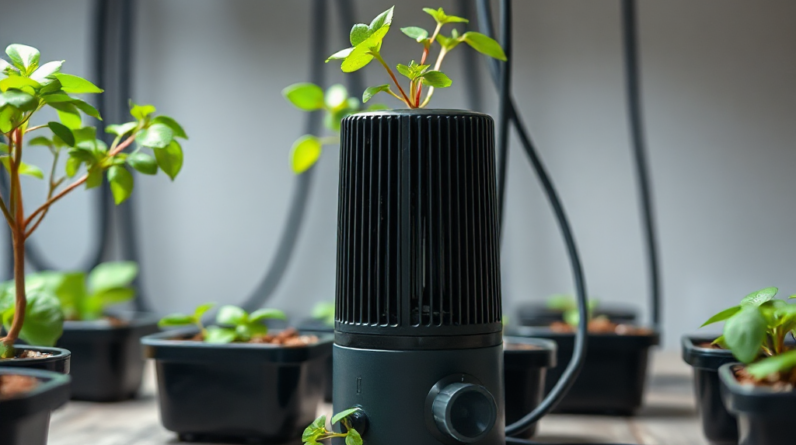
Quiet air pumps for indoor hydroponics work best when low operating noise is matched with adequate airflow, a stable mounting surface, and correctly sized air stones. Compare sound claims under similar conditions, then check whether the pump can supply the number and depth of stones your reservoir requires. Rubber feet, soft isolation, and a short flexible airline can reduce transmitted vibration, while a check valve helps protect the pump from back-siphoning during outages. An oversized pump operated against restrictive tubing may hum more than a smaller, properly matched model. Watch for weak bubbles, rising heat, rattling, or water movement that changes noticeably, since those signs can indicate blockage, wear, or an undersized setup.
What Makes an Air Pump Quiet in an Indoor Grow
Quiet operation depends on both the pump’s internal design and the way vibration travels through the grow area. A diaphragm pump creates repeated pulses as its membrane moves air. Those pulses may produce a low hum, clicking, or a faint mechanical buzz. The sound becomes more noticeable when the pump rests on a hollow cabinet, touches a wall, or sits directly on a metal shelf that acts as a resonating surface.
Manufacturers may publish a decibel figure, but ratings are useful only when the testing distance, room acoustics, and operating load are known. A pump advertised as quiet can sound louder in a small bedroom than in a large utility room. Air pressure also affects the result: forcing air through a deep reservoir, narrow airline, clogged stone, or several splitters makes the motor work harder and may increase vibration.
For a small indoor system, prioritize a smooth motor sound over a merely low number on a product page. A steady, soft hum is easier to live with than an intermittent rattle. If the pump will run near a bed or desk, place your hand on the shelf while it operates. A strong physical vibration suggests that isolation may matter more than changing to another pump.
A common mistake is assuming that “silent” means inaudible. Air pumps must move mechanical parts, and bubbles themselves create sound at the reservoir surface. Covering ventilation openings or enclosing the pump tightly may reduce perceived noise briefly but can trap heat and shorten service life. A ventilated location with vibration isolation is usually a better compromise. Readers comparing equipment can also use Quiet air pumps for indoor hydroponics as a related reference point when planning a complete system rather than judging the pump alone.
How to Match Airflow, Reservoir Depth, and Air Stones
Airflow should be matched to the reservoir’s oxygenation needs, water depth, and diffuser resistance rather than chosen by wattage alone. In a deep container, the pump must overcome greater water pressure before air reaches the stone. Fine-pore stones can create smaller bubbles, but they also resist airflow more than coarse diffusers. A pump that performs well with one shallow tote may produce weak output in a tall bucket.
Start by listing the actual air load: the number of reservoirs, the depth of each stone, the length of airline, and any manifold or splitter. A single outlet feeding one small stone has different requirements from a four-site deep-water culture system. The pump should have enough reserve capacity to maintain visible, consistent bubbling after the airline and diffuser are connected, but excessive capacity is not automatically better.
Oversizing can create unnecessary noise, turbulent splashing, and wasted energy. It may also force a grower to close valves to reduce flow, leaving the pump operating against back pressure. Undersizing creates a different problem: bubbles become sparse, roots receive less water movement, and the pump may run hot while failing to deliver useful aeration. Neither condition should be judged by bubble size alone; a calm stream of bubbles distributed across the reservoir can be more useful than violent agitation in one corner.
Compare air stones before replacing the pump. A stone coated with mineral deposits or biological residue can restrict flow and make a healthy pump appear defective. Replace or clean compatible diffusers according to their material and the manufacturer’s instructions, then retest with fresh airline. Avoid making the stone so fine that the chosen pump cannot push through it. The quiet air pump selection process should account for this complete pressure path, not just the pump’s advertised output.
For practical sizing, connect the intended stones at the final water depth and observe the system for several hours. Healthy performance usually looks like steady bubbling across the diffuser, no rapid pump heating, and no sudden change in sound. If a pump becomes quieter only after flow is restricted, do not treat that as a successful solution; the reduced airflow may be masking an undersupported root zone.
Mounting and Installation Choices That Reduce Noise
Isolation is often the fastest way to make an acceptable pump suitable for an indoor room. Set it on its supplied rubber feet or on a firm, noncompressible pad that separates the motor from the shelf. A thin piece of dense foam, silicone mat, or rubber shelf liner may reduce vibration transfer. Very soft material can be counterproductive if the pump rocks, blocks an intake, or allows the housing to touch the surface.
Keep the pump above the reservoir whenever the installation allows it, and install a check valve in the airline with the arrow pointing toward the water. The valve helps limit back-siphoning if power fails or the airline disconnects. It also needs to be compatible with the pump’s airflow; a restrictive valve can add pressure and increase noise. Leave ventilation around the housing rather than placing it inside a sealed box.
Airline routing affects both sound and reliability. Shorten unnecessary loops, avoid sharp bends, and prevent the tube from pressing against a wall or cabinet. A vibrating airline can transmit a buzzing sound even when the pump itself is relatively smooth. If several reservoirs share one pump, use a suitable manifold and balance the outlets without crushing tubing. Marking the normal valve positions makes later troubleshooting easier.
Consider the room as part of the installation. A reservoir lid can soften splashing, but a loose lid may rattle continuously. An air stone resting against the container wall can turn bubble movement into a tapping noise. In a bedroom grow, moving the diffuser away from the sidewall and securing the airline often produces a greater improvement than buying a premium pump. In a utility area, the same changes may be unnecessary, making airflow reserve and serviceability more valuable than the lowest possible sound.
The frequent failure mode is placing the pump on a suspended shelf and then blaming the motor for the resulting resonance. Test the unit on the floor or a heavy bench briefly, without creating a water hazard. If the tone changes substantially, improve the mounting surface first. That simple test separates transmitted vibration from internal mechanical noise.
Diagnosing Noise, Weak Bubbles, and Pump Wear
A new noise should be treated as a change in system condition, not simply as an annoyance. Rattling can come from a loose cover, worn foot, damaged diaphragm, or an airline tapping the reservoir. A rising pitch may indicate restricted airflow, while a pulsing or intermittent output can point to a clogged diffuser or a failing internal membrane.
Use a controlled check rather than changing several parts at once. First inspect the housing, feet, power cord, and airline. Then disconnect the airline briefly and compare the pump’s free-air sound with its connected sound, following the manufacturer’s operating guidance. If the pump is quiet without the load but noisy when connected, inspect the diffuser, check valve, tubing bends, and water depth. If it remains noisy with no connected load, internal wear or a loose component becomes more plausible.
Weak bubbles can also result from a partially blocked stone. Mineral deposits reduce the open area through which air passes, increasing resistance and motor strain. A split airline can create an apparently weak outlet while another outlet receives most of the flow. Inspect each branch separately and confirm that the manifold has not been closed or knocked out of position during reservoir maintenance.
Temperature matters because a pump that runs warm in a poorly ventilated location may become louder over time. Do not cover the vents to suppress sound. Instead, move the unit into open air, keep it dry, and replace worn diaphragms or other service parts when the model supports maintenance. A pump that repeatedly loses output after cleaning may be approaching the end of its useful service life.
Do not ignore electrical and water separation. Keep connections above possible spill level, use a drip loop where appropriate, and disconnect power before handling equipment near the reservoir. Noise reduction should never involve placing the pump where condensation or splashes can reach the electrical components. The indoor hydroponics equipment checklist should treat quietness, airflow, heat, and water safety as connected decisions.
A Practical Buying and Setup Checklist
The best pump for a quiet indoor installation is the smallest reliable unit that can maintain the intended airflow through the finished system with some useful reserve. A product with multiple outlets may suit several small reservoirs, while a single-outlet model can be simpler and quieter for one compact container. Match the pump to the actual diffuser resistance instead of selecting solely by the lowest advertised noise figure.
Before buying, check whether replacement diaphragms, feet, valves, and compatible tubing are available. A slightly louder model with accessible service parts may be a better long-term choice than a very quiet unit that must be discarded after a minor membrane failure. Confirm that the manufacturer provides operating information for the intended water depth and outlet configuration.
Use this short priority order during setup:
- Confirm adequate airflow at the final water depth with the actual diffuser attached.
- Place the pump on a stable, ventilated, vibration-isolating surface.
- Route airline smoothly and install a correctly oriented check valve.
- Listen for a steady hum rather than rattling, scraping, or abrupt pulsing.
- Recheck bubbles, housing temperature, and tubing connections after several hours.
For example, a compact deep-water culture bucket in a sleeping area may benefit from one properly sized pump, a low-resistance stone, a soft isolation pad, and a check valve. A multi-reservoir rack may need more output, but splitting one pump across too many restrictive branches can make the entire arrangement noisier and less predictable. Separate pumps provide redundancy but add more motor noise; one larger pump reduces the number of motors but concentrates the effect of a single failure.
Do not chase silence by reducing aeration until bubbles are barely visible. Plants and roots still need the water movement and gas exchange supplied by the system. Judge the final setup by stable airflow, acceptable temperature, secure water protection, and a sound level you can tolerate during the hours the pump operates. That approach produces a quieter room without sacrificing the function the pump was installed to provide.
Frequently Asked Questions
How quiet should an indoor hydroponic air pump be?
A steady low hum is a realistic target; “silent” claims do not mean the motor or bubbles will be inaudible. Mounting and room acoustics strongly affect perceived noise.
Does a larger air pump always oxygenate a reservoir better?
No. A larger pump may create excess turbulence, heat, or back pressure. Adequate, evenly distributed bubbling through the actual diffuser is more useful than maximum output.
Why does my pump get louder after connecting the airline?
The diffuser, check valve, narrow tubing, or water depth may be restricting airflow. Inspect those parts for blockage, bends, or excessive resistance before replacing the pump.
Can foam make an air pump quieter?
A dense, stable isolation pad can reduce vibration transferred to a shelf. Do not use material that blocks ventilation, lets the pump rock, or exposes the unit to moisture.
Is a check valve necessary for an indoor hydroponic air pump?
A check valve is a useful safeguard against back-siphoning during a power interruption or disconnected airline. Install it in the correct direction and replace it if it becomes restrictive.
Further Reading
Authoritative Sources
- Academy of Nutrition and Dietetics
eatright.orgProfessional nutrition guidance, healthy eating resources, and practical dietitian-reviewed advice.
- U.S. Department of Agriculture
usda.govOfficial food, nutrition, agriculture, and consumer guidance from the USDA.
- NIH Office of Dietary Supplements
ods.od.nih.govResearch-based fact sheets on nutrients, supplements, dietary intake, and safety considerations.
- International Society of Sports Nutrition
sportsnutritionsociety.orgEvidence-informed sports nutrition resources and position stands for active people and athletes.
Conclusion
Choose quiet air pumps for indoor hydroponics by judging the complete aeration setup, not the marketing label on the motor. Confirm airflow at the reservoir’s real depth, use a diffuser that does not impose unnecessary resistance, and isolate the pump from shelves and walls. A check valve, ventilated placement, smooth airline routing, and secure electrical separation add reliability without complicated modifications. When sound changes, inspect the diffuser, tubing, mounting surface, and pump temperature before assuming the motor has failed. The practical next step is to assemble the intended parts, run them together, and listen for stable operation while checking bubble coverage and heat. A modest, correctly matched pump will often be quieter and more dependable than an oversized unit throttled into restriction.