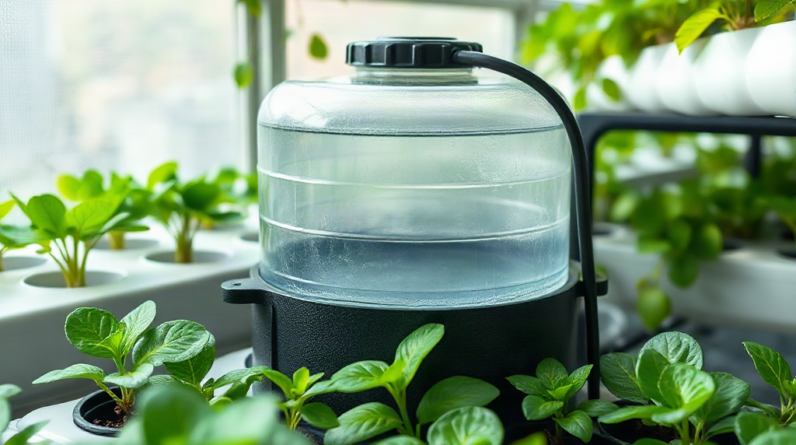
A practical reservoir size for a small hydroponic garden is usually based on plant count, mature plant demand, and the volume that remains after pumps and plumbing begin operating. Leafy greens often need less reserve capacity than fruiting tomatoes or cucumbers, while warm rooms, strong airflow, and exposed channels increase water loss. Choose a tank that can carry the garden through the intended refill interval without exposing the pump or allowing pH and nutrient concentration to swing sharply. For many compact gardens, sizing at roughly 1–2 gallons of working solution per small plant is a useful starting estimate, but a measured 24-hour consumption test provides the safer final decision.
Calculate Capacity From Plants and Working Volume
Reservoir labels describe total container capacity, but growers need to plan around usable working volume. A 10-gallon tote may hold 10 gallons only when filled close to its rim. The normal operating level must leave room for returning solution, displaced equipment, aeration, and movement during maintenance. Its dependable working volume may therefore be closer to 7 or 8 gallons.
Begin with the number and mature size of the plants rather than the dimensions of the shelf. Small lettuce, basil, and young herbs can often be planned at approximately 1 gallon of working solution per plant. Larger leafy plants and compact fruiting plants benefit from more reserve, while mature tomatoes, cucumbers, and other thirsty crops can justify several gallons per plant. These figures are starting allowances, not fixed biological requirements. Plant density, lighting, temperature, and irrigation design can move actual demand substantially.
For example, six lettuce plants with an initial allowance of 1 gallon each suggest 6 gallons of working solution. If the selected tote loses about 2 gallons of nominal capacity to headspace, the pump, and a safe low-level margin, an 8- to 10-gallon container is more credible than a nominal 6-gallon bucket. Six mature fruiting plants would place far greater pressure on that same volume, especially under bright indoor lights.
The low-level margin deserves special attention. A submerged pump must remain covered at the end of the longest planned interval between checks. In a deep-water culture setup, roots must retain the intended contact with solution as the level falls. The minimum safe level is therefore defined by equipment and root-zone geometry, not merely by the last inch of liquid in the tank.
Use this compact capacity calculation:
- Estimate a starting working volume from mature plant count and crop size.
- Add the amount likely to be consumed before the next refill.
- Add enough reserve to keep the pump intake covered and circulation stable.
- Select a container whose nominal capacity accommodates that total plus headspace.
A common mistake is sizing around seedlings. Seedlings may use very little water, making a small tank appear adequate for several weeks. Demand rises as leaf area and transpiration increase. Plan the reservoir size for a small hydroponic garden around mature plants unless the crop will be harvested young.
Adjust for Crop Type, Climate, and Refill Timing
Daily water demand determines whether a calculated capacity remains practical between visits. Plants remove water through transpiration, and some additional water can be lost from uncovered openings or warm solution surfaces. As water falls, dissolved salts generally remain behind, so electrical conductivity may rise even before the pump reaches its minimum operating depth.
Crop type creates the first major adjustment. A tray of young greens has modest demand compared with an equally sized canopy of flowering peppers. Fruiting plants usually develop larger root systems and leaf areas, remain in the installation longer, and encounter periods of high water uptake. Mixing a few large plants with herbs can therefore make an apparently generous reservoir behave like an undersized one.
The growing environment creates the second adjustment. Warm air, low relative humidity, strong fans, intense lighting, and direct sunlight can all accelerate water loss. A covered, opaque tank in a cool indoor room may change slowly, while a balcony installation exposed to summer heat can require frequent top-ups. Increasing tank capacity offers more operating buffer, but it does not correct overheated solution or uncovered planting holes. Shade, insulation, fitted lids, and appropriate airflow address those causes more directly.
Refill timing is the practical decision point. A grower who checks the installation every morning can operate with less reserve than someone who needs a weekend buffer. Suppose an established garden loses 1.25 gallons per day during warm conditions. A three-day absence represents nearly 4 gallons before adding pump protection or uncertainty. A 5-gallon reservoir would be a poor choice even if the plants appear comfortable immediately after filling.
Do not treat a larger tank as permission to ignore water quality. Greater volume usually slows changes in temperature, pH, and nutrient concentration, but stale solution, root debris, incorrect nutrient mixing, and inadequate aeration can still cause trouble. Oversizing also adds weight, consumes floor space, and makes full solution changes more cumbersome. Water weighs roughly 8.3 pounds per gallon, so a filled 20-gallon tank imposes a substantial load before counting the container and equipment.
The useful compromise is enough capacity to cover measured peak demand plus a reserve, without creating a tank that is difficult to access, clean, or drain. If the planned refill interval changes, recalculate rather than assuming the original capacity remains adequate.
Match the Tank to the Hydroponic Layout
System design controls how much of the reservoir can actually be used. Recirculating channels, buckets, drip lines, and grow beds temporarily hold solution outside the tank whenever the pump runs. The reservoir must operate safely both during circulation and after the pump stops and the liquid returns.
In a nutrient film technique installation, channels and supply lines may contain only a shallow film individually, but their combined hold-up volume reduces the level in the tank. The pump intake must remain submerged after every channel fills. When power stops, returning liquid must fit below the reservoir rim. A tank selected solely from plant count can overflow during shutdown if headspace was not reserved.
Recirculating drip and bucket arrangements may hold more liquid in plumbing, root zones, or media. Drain-back can be delayed by roots, uneven slopes, or partially blocked fittings. A media bed can retain a meaningful quantity even after drainage appears complete. Test the installation rather than relying on the advertised volume of its components.
Deep-water culture requires a different interpretation. If plants sit directly over a shared container, the tank is also the root chamber. A larger footprint can provide root space and stable solution conditions, but an excessively shallow container may expose roots quickly as water is used. Separate bucket systems need their own level management unless they share a control reservoir. Adding the nominal capacity of every bucket does not reveal how much solution is available at the pump or control point.
Container shape matters alongside capacity. A tall, narrow tank may preserve pump depth as volume declines, while a wide, shallow tote can lose depth rapidly. Wide lids are easier to open for cleaning but may bow under weight unless supported. Opaque, food-compatible containers are preferable because light entering the solution encourages algae, and unknown containers may carry residues unsuitable for a garden.
Before buying, record the available footprint, required lid clearance, drain or siphon access, pump minimum depth, and maximum return volume. Where space forces a small tank, an automatic top-off reservoir can extend operating time by replacing water. It should add plain water in a controlled manner rather than repeatedly dosing concentrated nutrients. Automation reduces level risk, but sensors and valves still require inspection; it is not a substitute for adequate emergency capacity.
A layout review is often more valuable than simply moving to the next container size. The detailed choice of reservoir size for a small hydroponic garden should account for liquid held in circulation and the full drain-back event.
Test the Chosen Size Before Relying on It
A short operating test converts a rough capacity estimate into a dependable refill plan. Conduct it after plants are established and repeat it when the canopy becomes larger or seasonal conditions change. Consumption recorded during the seedling stage will underestimate the demands of mature growth.
Mark or measure the normal operating level after the pump has run long enough to fill every line and channel. Record the amount of solution in the reservoir, the pH, and electrical conductivity if those measurements are part of the nutrient routine. Recheck at the same time the following day without changing irrigation settings. The volume needed to restore the original level approximates daily water use under those conditions.
Run the test across several representative days rather than trusting one reading. Plant uptake may differ between a cool, cloudy day and a hot day under long lighting hours. Use the highest credible daily consumption when planning unattended time. If peak use is 1 gallon per day and the system must run for four days, reserve more than 4 gallons above the minimum pump level to allow for measurement error and changing weather.
Inspect behavior as well as volume. A suitable reservoir should keep the intake submerged, maintain reliable flow at the farthest outlet, and avoid rapid swings in concentration. Frequent pump noise, bubbles entering the supply line, noticeably weaker return flow, exposed roots, or large day-to-day conductivity changes indicate that the working reserve may be too small. Repeatedly topping up several times a day is another sign that capacity or automation no longer matches plant demand.
Testing must include a controlled pump-off check. Watch how high the water rises as channels and pipes drain. Keep electrical connections protected and be ready to restart the pump if the container approaches its safe limit. The final resting level identifies the headspace that cannot be assigned to normal operating volume.
When readings show inadequate reserve, the choices are to install a larger container, add a correctly designed top-off supply, reduce plant load, shorten the refill interval, or reduce avoidable evaporation. Concentrating nutrients to fit more feed into a small volume is not a valid solution; it changes root-zone chemistry rather than increasing water capacity.
Write the normal fill line, minimum pump line, measured daily loss, and maximum days between checks on a maintenance record. Revisit those values after adding plants, changing lights, or entering warmer weather. That record turns a one-time sizing decision into a workable operating limit.
Frequently Asked Questions
Is a 5-gallon reservoir large enough for a small garden?
It may suit a few herbs or young greens, but its true working volume will be lower than 5 gallons. Confirm that it covers mature plant use, pump submersion, and the intended time between refills.
Can a hydroponic reservoir be too large?
Yes. Excess capacity adds weight, occupies space, and makes draining and cleaning harder. Choose enough buffer for stable operation rather than the largest container that physically fits.
Should reservoir size be based on seedlings or mature plants?
Base it on mature plants unless crops will be harvested young. Water use commonly rises as roots, leaf area, lighting exposure, and fruit production increase.
Does an automatic top-off allow a smaller reservoir?
It can extend the refill interval, but the main tank must still maintain pump depth and accept drain-back. Leave enough reserve to handle a sensor, valve, or supply failure.
How often should reservoir capacity be reassessed?
Recheck consumption after major canopy growth, crop changes, lighting adjustments, or seasonal temperature shifts. Measure daily loss again if the minimum level is reached sooner than expected.
Conclusion
Choose capacity from the system’s working conditions, not the number molded into the container. Start with mature plant demand, subtract space occupied by equipment and circulating solution, protect the pump’s minimum depth, and preserve room for complete drain-back. Then measure actual daily consumption under the warmest or brightest conditions the garden is likely to encounter.
A useful next step is to mark the normal and minimum levels on the tank and run a multi-day test while the plants are established. If the reserve disappears too quickly, increase storage, shorten the inspection interval, or install a monitored top-off supply. The best reservoir is not necessarily the largest one available; it is the smallest practical tank that remains accessible, keeps circulation reliable, and carries the mature garden safely through its planned refill schedule.
Related Content
- How to Troubleshoot Pump Failures in Hydroponics: Common Causes and Effective Solutions
- 10 Effective Hydroponic Gardening Tips for a Thriving 2025 Garden
- The Ultimate Guide to 10 Effective hydroponic systems for 2025
- Achieve Peak Growth Efficiency with Hydroponics
- Hydroponic Garden Automation: Essential Tools and Techniques for Efficient Growth