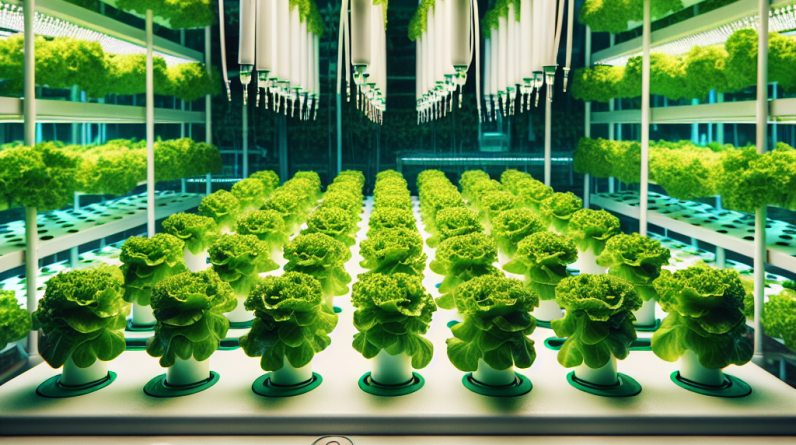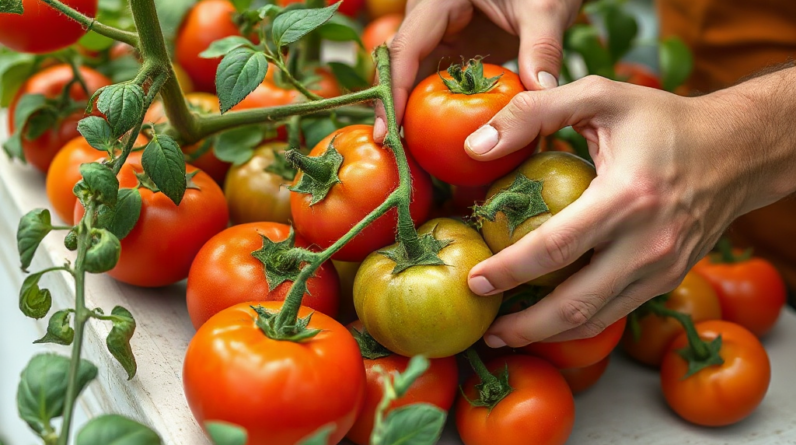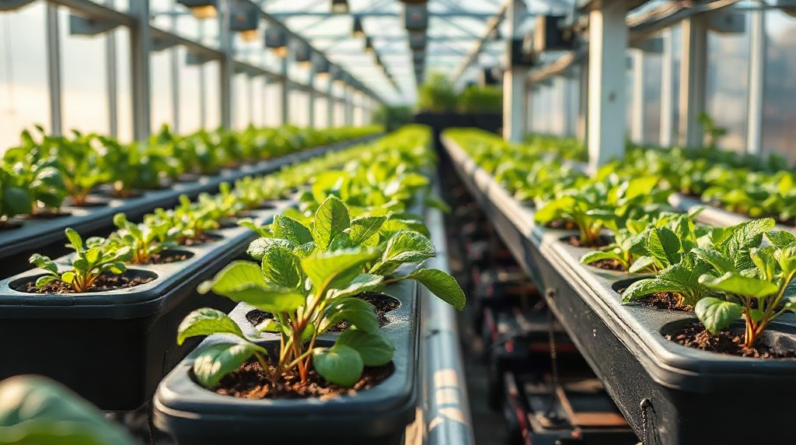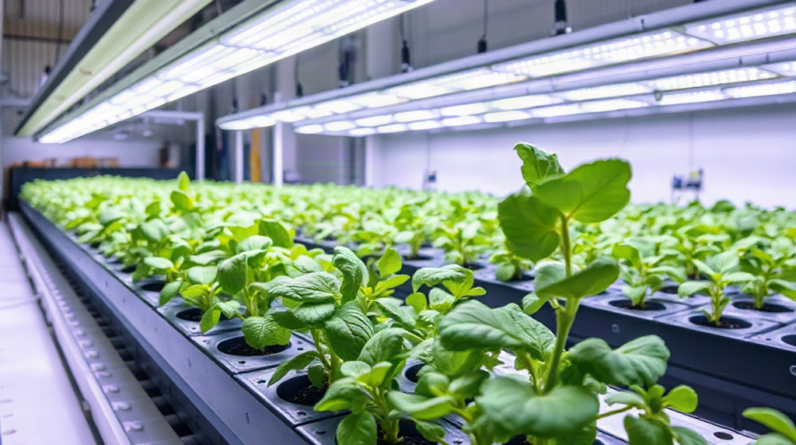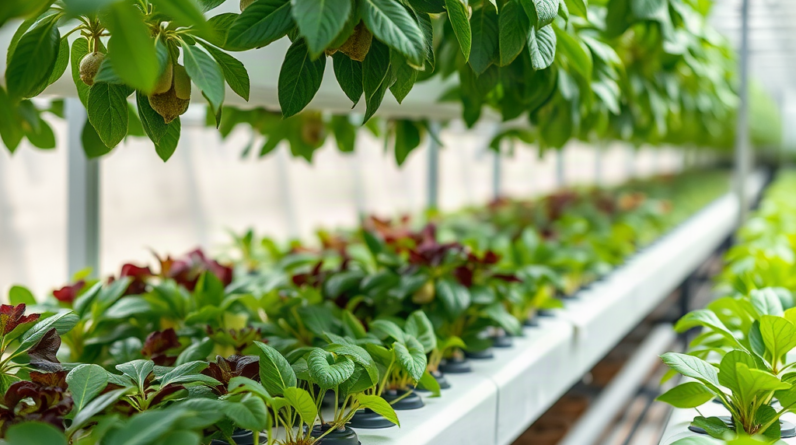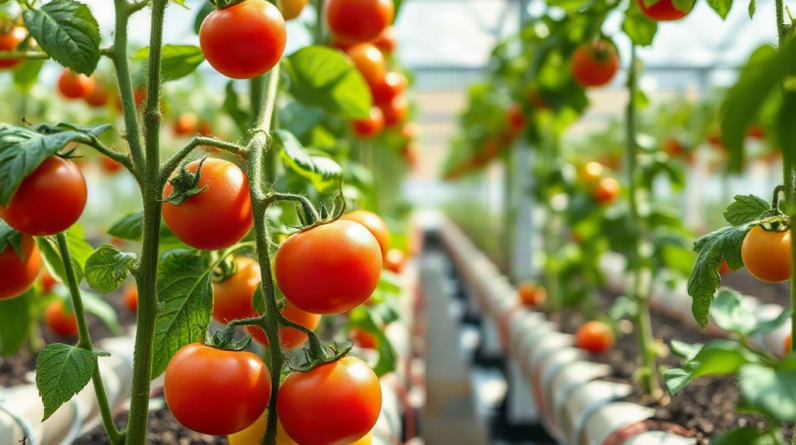
Hydroponic tomato system needs and fruiting support are best met with a large, aerated root zone, stable nutrient delivery, strong light, reliable trellising, and active pollination. Choose a drip-fed substrate system or well-managed recirculating setup that can handle mature roots without prolonged saturation. During flowering and fruit fill, maintain consistent root-zone moisture, monitor pH and nutrient strength, provide steady airflow, and vibrate flower clusters to release pollen. Support each main stem before fruit becomes heavy, then prune selectively rather than stripping away productive foliage. Irregular irrigation, excessive nitrogen, weak light, and poor pollination commonly produce lush vines with few or misshapen tomatoes.
Choose a System That Can Carry a Mature Tomato Crop
A tomato setup must accommodate a crop that becomes tall, top-heavy, thirsty, and densely rooted. A small countertop unit may keep a seedling alive, but its reservoir volume, planting space, and light footprint rarely suit an indeterminate vine carrying several trusses. System selection should therefore be based on mature plant demand rather than transplant size.
Drip irrigation into coco coir, perlite, or a blended substrate is a practical choice because it gives each plant a distinct root zone and allows drainage to remove excess salts. Dutch buckets follow the same general principle and are especially useful when growers want separate containers connected to a common reservoir. Deep-water culture can grow tomatoes, but it demands dependable aeration, control of solution temperature, and enough space to prevent roots from obstructing plumbing. Nutrient film technique is less forgiving for large tomatoes because a heavy root mass can disrupt the shallow flow and leave plants vulnerable during pump interruptions.
Reservoir capacity matters because mature vines can change solution volume and concentration quickly. A container that requires constant topping up creates larger swings in pH and nutrient strength than a generously sized reservoir serving the same number of plants. Opaque reservoirs, covered channels, and light-blocking tubing also restrict algae. Pumps should be accessible for cleaning, while return lines and drains need enough capacity to handle roots, debris, and the full irrigation flow without overflowing.
Physical crop support must be independent of lightweight lids, channels, and reservoir covers. A loaded vine can pull over a weak frame or distort a growing channel. Anchor trellis lines to a ceiling-rated support, wall frame, or rigid freestanding structure designed for the anticipated load. If structural anchoring is not possible, compact determinate cultivars are a more realistic choice than long-vining indeterminate types.
Before planting, complete this setup check:
- Root space: Use a container or channel that will not be choked by a mature root mass.
- Failure protection: Confirm that plants will not dry out immediately if a pump stops.
- Drainage: Test the system at full flow and check every return point for backup.
- Aeration: Keep dissolved oxygen available through air delivery, circulation, or well-drained substrate.
- Load support: Install trellising before stems and fruit make access difficult.
A common mistake is choosing a design because it is labeled hydroponic rather than because it fits a fruiting vine. The broader principles in Hydroponic tomatoes: system needs and fruiting support should be applied to the cultivar, available height, and tolerance for pump or power failures.
Match Light, Air, and Temperature to Flowering
Strong vegetative growth does not prove that a tomato receives enough light to flower and fill fruit well. A vine can stretch toward a weak fixture, make broad leaves, and still abort blossoms because the canopy receives inadequate intensity. Fruiting plants need a capable full-spectrum horticultural fixture, even coverage, and sufficient clearance as the canopy rises.
Fixture wattage alone is a poor decision tool because efficiency, mounting height, beam shape, and growing area change the light reaching leaves. Follow the fixture maker’s crop-specific hanging guidance where available and inspect the whole canopy. Pale or curled upper leaves can indicate excessive intensity or heat near the lamp, while long internodes, thin stems, and flower loss may accompany inadequate light. Raising a dim fixture usually worsens intensity; lowering a powerful fixture without measuring or observing the canopy can cause stress. Dimming, repositioning, or adding side coverage may be more useful than changing the daily schedule.
Air temperature affects pollen release and flower retention, but the target cannot be reduced to one fixed number for every cultivar and room. Very hot conditions can impair fruit set, while cool or humid conditions may keep pollen from shedding freely. Track day and night conditions at canopy level rather than relying on a sensor near the floor, door, or exhaust outlet. A gentle temperature drop at night is generally more natural than holding the room at an unchanging value, provided the root zone and foliage are not exposed to abrupt cold.
Airflow should move leaves slightly without blasting flower clusters. Continuous stagnant humidity around dense foliage increases condensation and makes pollination less dependable. Conversely, a fan aimed directly at one side of the crop can dry the substrate unevenly and damage tender growth. Oscillating circulation combined with controlled exhaust gives a more uniform environment. Keep leaves from pressing against walls, where trapped moisture can persist.
Imagine two identical vines under one fixture: the center plant remains compact and sets fruit, while the edge plant stretches and drops flowers. Increasing fertilizer for the edge plant would treat the wrong constraint. Repositioning the containers, improving reflective boundaries, or widening light coverage addresses the actual difference. Environmental corrections should precede aggressive nutrient changes whenever symptoms follow a clear location pattern.
The mistake to avoid is treating flowering as a calendar event that occurs automatically after several weeks. It is an energy- and environment-dependent stage. Record light hours, canopy temperature, humidity trends, and flower behavior so a failed truss can be connected to conditions present when it opened.
Manage Irrigation and Nutrition Through Fruit Fill
Consistent water availability is more valuable than repeatedly chasing a supposedly perfect nutrient number. Tomatoes move substantial water through their foliage, and demand rises with plant size, light, heat, and fruit load. Long dry intervals followed by heavy irrigation can split fruit, concentrate salts around roots, and interfere with calcium movement into rapidly expanding tissue.
In a substrate system, irrigation frequency should respond to how quickly the root zone dries rather than a fixed schedule copied from another garden. Small, well-timed applications during the light period often produce steadier moisture than one large dose. Some drainage is useful in drain-to-waste systems because it shows that the entire container has been wetted and carries accumulated salts out. Excessive runoff, however, wastes water and fertilizer. Recirculating systems conserve solution but require closer observation because plant uptake can change the remaining mixture.
Measure pH and electrical conductivity with calibrated meters, then interpret the readings alongside reservoir level and plant appearance. When water disappears faster than dissolved nutrients, concentration can rise even though no fertilizer was added. Repeatedly topping up with full-strength solution may intensify that problem. Plain water or a newly mixed solution may be appropriate depending on the measured trend, but arbitrary dilution can create deficiencies. Replace or refresh the reservoir when its composition has become difficult to infer from additions and corrections.
Tomatoes require a complete hydroponic fertilizer containing macronutrients and essential micronutrients. Fruiting formulas generally reduce the emphasis on excessive vegetative nitrogen and provide an appropriate balance of potassium, calcium, magnesium, and other elements. More potassium is not a universal cure for poor fruiting, and adding separate products without accounting for the base formula can create antagonism or excessive conductivity. Calcium-related fruit damage is often associated with irregular water movement or root stress rather than a simple absence of calcium in the tank.
A useful operating sequence is to check reservoir volume, inspect roots and delivery lines, measure pH and conductivity, and only then make one documented adjustment. Clean water quality affects every later decision; hard source water contributes minerals and alkalinity, while very low-mineral water may require a formula intended for that condition. The recommendations under Hydroponic tomatoes: system needs and fruiting support work best when meter readings are evaluated as trends rather than isolated pass-or-fail values.
Healthy progress appears as firm new growth, functioning white-to-tan roots, regular flower formation, and fruit that expands without repeated cracking or dark sunken ends. Failure signals include a sour reservoir odor, slimy roots, rapid daily pH drift, emitters delivering unequal volumes, and plants wilting despite a wet root zone. Adding stronger nutrients to a root-oxygen problem usually accelerates decline instead of correcting it.
Support, Prune, and Pollinate the Fruiting Vines
Training converts an unruly tomato vine into a canopy that light, air, and the grower can reach. Indeterminate cultivars are commonly maintained as one or two main stems, each secured with clips or gently wound around a hanging string. Determinate cultivars need less continuous training, but cages or stakes may still be necessary once several fruit clusters gain weight.
Attach support below developing clusters without pinching the stem. Check clips and ties as stems thicken, since a tie that was loose at installation can later restrict vascular flow. Lowering and leaning long vines can extend production where ceiling height is limited, but it requires spare horizontal space and careful handling. A small home setup may be better served by topping the vine after a manageable number of trusses rather than forcing a commercial-style lowering method into a cramped room.
Pruning should preserve an effective leaf canopy while preventing excessive crowding. Remove unwanted side shoots when they are small, using clean hands or sanitized tools. Large, delayed cuts create bigger wounds and remove stored photosynthetic capacity. Lower leaves can be removed gradually once they age, become damaged, or crowd the base, but stripping healthy foliage above and around fruit exposes the crop to excess light and reduces the leaf area feeding it.
Tomato flowers contain both male and female reproductive structures, yet indoor crops may lack the wind and insect activity that releases pollen. During flowering, gently vibrate the support line or touch an electric pollinator to the flower stem for a brief period. A soft tap on open clusters can also work for a small garden. Pollinate when flowers are open and conditions are not excessively humid, repeating across newly opened blossoms rather than relying on a single treatment.
Fruit set is visible when the flower base begins to swell after petals fade. A dry flower that drops cleanly without swelling was not successfully retained. If most flowers on one truss fail, review temperature, humidity, light, and irrigation before increasing pollination force. Vigorous shaking will not make nonviable pollen productive and can damage flowers.
The common pruning misconception is that fewer leaves automatically direct more energy into fruit. Leaves manufacture the carbohydrates used for fruit growth; the goal is organized, illuminated foliage rather than a bare stem. Use the crop-specific approach described in Hydroponic tomatoes: system needs and fruiting support to balance access, airflow, and productive leaf area.
Diagnose Weak Fruit Set Before Changing Everything
Poor fruiting should be traced from flowers back through the environment, root zone, and canopy instead of answered with several simultaneous changes. Multiple corrections erase the evidence needed to identify the cause and may introduce a second problem. Start with observations that separate a pollination failure from a whole-plant growth limitation.
A vigorous dark-green vine with long internodes and few flowers points toward excessive vegetative growth, weak light, or both. Flowers that open but repeatedly fall may reflect temperature or humidity outside a useful range, insufficient pollen movement, water stress, or a nutrient solution that is too concentrated. Fruit with a dark, sunken blossom end calls for an irrigation and root-health review, particularly when the reservoir already contains calcium. Cracking often follows rapid changes in water availability as fruit expands.
Location provides valuable evidence. If every plant served by one emitter wilts while neighboring plants remain firm, inspect flow before reformulating the reservoir. If only the canopy edge fails to set fruit, compare light exposure and airflow. If the entire room declines after a warm spell, examine environmental records. Root problems commonly affect water uptake even when the solution is nutritionally complete, so check for heat, low aeration, restricted drainage, and decaying roots.
Make one targeted correction and observe the next flowers or new growth. Existing damaged fruit will not become undamaged, so judging a change by old symptoms leads to unnecessary intervention. New trusses, fresh leaves, reservoir stability, and more uniform water use are better indicators. Keep a short log of irrigation changes, meter readings, room conditions, pruning, and pollination dates.
The most costly mistake is responding to every symptom with another additive. Products cannot compensate for blocked drippers, a hot root zone, weak trellising, poor canopy light, or flowers that never released pollen. Mechanical and environmental checks should come first, followed by measured nutritional corrections. That order limits wasted inputs and gives the crop a stable basis for the next fruiting cycle.
Frequently Asked Questions
Which hydroponic system is most practical for tomatoes?
Drip irrigation into coco, perlite, or Dutch buckets is practical for many growers because it provides root space, controllable moisture, and dependable drainage. Deep-water culture can work but requires strong aeration and careful solution management.
Do indoor hydroponic tomatoes need hand pollination?
They usually benefit from assisted pollination because indoor air movement may not release enough pollen. Briefly vibrate open flower clusters or their support line and repeat as new blossoms open.
Why do hydroponic tomato flowers fall off?
Flower drop may follow weak light, unsuitable temperature or humidity, water stress, excessive nutrient concentration, or poor pollen release. Check environmental records and root-zone conditions before adding fertilizer.
Should tomato plants be heavily pruned during fruiting?
No. Remove unwanted side shoots and aging lower leaves selectively, but retain enough healthy foliage to power fruit growth and shade developing tomatoes. Heavy stripping can reduce production and stress the vine.
What should be checked when blossom-end rot appears?
Check irrigation consistency, root health, solution strength, drainage, and rapid environmental changes. The disorder can occur even when calcium is present because stressed roots and irregular water movement limit delivery to expanding fruit.
Conclusion
A productive tomato installation is built around mature plant demand, not the convenience of a seedling-sized unit. Provide ample root volume, dependable oxygen and drainage, even canopy light, and a frame that can safely carry long vines and loaded trusses. Once flowering begins, favor stable irrigation and measured nutrient management over frequent formula changes. Train stems early, retain productive foliage, and assist pollen release as each group of flowers opens.
When fruit set weakens, inspect the pattern before acting: compare plants, locations, emitters, roots, flowers, and recent environmental records. Correct the clearest constraint and judge the response in new growth or later trusses rather than damaged fruit. A short operating log and routine equipment inspection will usually reveal more than another additive, while also making future crop cycles easier to manage.