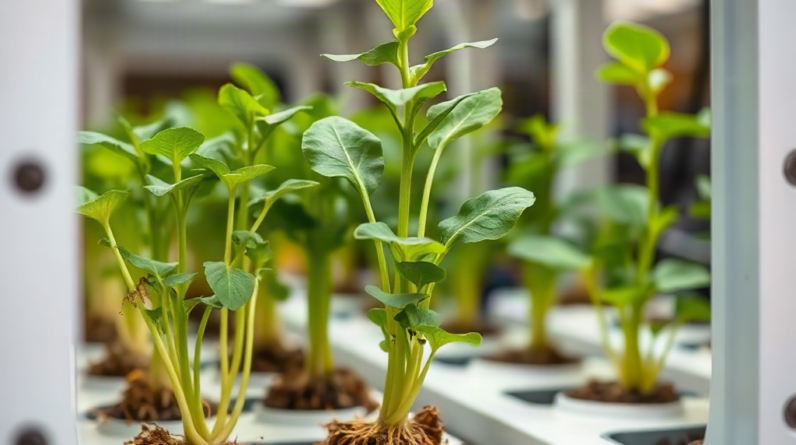
Hydroponic powdery mildew in enclosed spaces is controlled by removing infected leaves, improving airflow through the canopy, limiting humidity swings, and applying a crop-approved treatment before colonies spread. The white fungal growth develops on foliage rather than in the nutrient solution, although crowded plants and a poorly ventilated enclosure accelerate transmission. Isolate affected plants, bag contaminated material inside the room, and inspect leaf undersides and crowded growing tips. Avoid spraying with the lights at full intensity or leaving foliage wet near the dark period. Success depends on combining environmental correction with repeated inspection rather than relying on a single spray.
Why Powdery Mildew Spreads Inside a Grow Space
Enclosed cultivation rooms concentrate the conditions that let powdery mildew move quickly between leaves. Plants sit close together, fans recirculate air within a limited volume, and foliage may form a dense layer that receives little direct air movement. Once spores reach a susceptible crop, living leaf tissue provides the surface needed for fungal colonies to establish and produce more spores.
Unlike root diseases, powdery mildew usually does not originate in the hydroponic reservoir. The visible growth occurs on leaves, petioles, stems, or flowers, depending on the crop and mildew species involved. Cleaning a nutrient tank may be worthwhile for routine sanitation, but it does not correct an infected canopy. Attention belongs first on foliage, air circulation, plant spacing, and contaminated tools or clothing.
Humidity behavior matters more than a single reading taken at the room sensor. A sensor mounted above the lights may report acceptable conditions while humidity remains higher inside overlapping leaves. Transpiration releases moisture into this sheltered boundary layer, particularly when plants are large and air velocity is low. Rapid humidity changes around the light transition can also create favorable periods even when the daily average appears reasonable.
For example, a tightly trained cucumber canopy may look dry from the aisle while older leaves overlap near the trellis. A fan aimed across the room moves the upper leaves but leaves the interior nearly still. Removing a few unproductive leaves and redirecting air through, rather than merely over, the canopy can change that local environment. Excessive defoliation is the opposing mistake: removing too much healthy foliage at once reduces photosynthetic capacity and stresses the crop.
Temperature, crop susceptibility, plant age, and nitrogen management can influence outbreak severity, but no universal temperature or humidity number guarantees control. Different powdery mildew fungi favor different hosts and conditions. Treat environmental targets as operating ranges to verify at canopy level, not as a substitute for inspection. A practical review of Hydroponic powdery mildew in enclosed spaces should therefore distinguish room averages from the microclimate touching the leaves.
How to Confirm an Outbreak Before Treating It
Correct identification begins with the pattern and texture of the leaf damage. Powdery mildew commonly appears as discrete white or gray patches that resemble dust scattered across the surface. Colonies may expand and merge, while affected tissue can yellow, curl, or lose vigor. Early spots are easy to miss on pale or textured leaves, so examine plants under neutral white light rather than relying only on colored cultivation fixtures.
A loose residue is not automatically mildew. Mineral deposits from foliar sprays or humidifiers may leave a light film, and dried nutrient splashes can produce sharp-edged marks. Pest activity can create pale stippling, while natural leaf hairs may appear white under magnification. Gently wiping a small area can provide a clue, but it is not conclusive because fungal growth and spray residue can both smear. The surrounding pattern, progression over several days, and presence on neighboring leaves carry more diagnostic weight.
Inspect the entire crop systematically. Start with the plant where the mark was found, then check adjacent plants, older shaded foliage, leaf undersides, stems, and crowded growing tips. Use a clean hand lens if available. Record the plant location and photograph the same leaf so that expansion can be compared later. If the crop is valuable or symptoms remain ambiguous, a local plant diagnostic laboratory or extension service may offer more reliable identification than repeated trial treatments.
A compact inspection checklist keeps an early outbreak from becoming a room-wide search:
- Map the location: mark affected plants and the nearest air circulation path.
- Check both leaf surfaces: include shaded foliage in the canopy interior.
- Review recent inputs: note foliar products, humidifier water, and pesticide residues.
- Compare over time: watch whether patches enlarge or appear on new growth.
- Sanitize afterward: clean the lens and tools before examining unaffected plants.
Do not carry leaves from plant to plant or brush through the canopy while inspecting. Spores can move on hands, sleeves, scissors, and airflow. Work from apparently clean areas toward the affected zone, then change gloves or wash hands. A common failure is treating every white mark immediately without confirming its behavior; unnecessary spraying can injure leaves, complicate identification, and leave the environmental weakness untouched.
Immediate Containment and Treatment Order
Containment should begin before products are mixed. Reduce unnecessary traffic around the affected plants, switch off circulation fans briefly while handling infected material, and place removed leaves directly into a bag. Carrying uncovered foliage across the room can release spores along the route. Do not compost infected material beside an intake vent or near plants that will return to the enclosure.
Remove heavily colonized leaves when the plant can tolerate the loss, but avoid turning cleanup into severe defoliation. Leaves with isolated early spots may be candidates for treatment, whereas foliage covered by established colonies is a continuing source of spores. Use sanitized scissors and disinfect them between plants. If one small plant is extensively affected while the rest of the crop appears clean, discarding that plant may impose less production loss than retaining a major source of inoculum.
After physical removal, select only a fungicide or biological product labeled for the crop, setting, and intended use. Labels govern application rate, interval, protective equipment, harvest restrictions, and whether a product is suitable for enclosed cultivation. Potential options vary by crop and location and may include horticultural oils, sulfur-based materials, bicarbonate formulations, or microbial products. These are not interchangeable. Oils and sulfur can cause plant injury when used too close together, and some formulations may damage sensitive crops or leave unwanted residues.
Coverage should reach the surfaces where colonies are developing without soaking electrical equipment, flowers, or the growing area. Apply during a suitable part of the light cycle according to the label; intense light and heat can increase the risk of foliar injury with some materials. Test an unfamiliar product on a small section first and allow enough time to observe the response. Never combine products unless their labels explicitly permit the mixture.
The practical order is isolate, remove, clean, treat, and reassess. Wipe washable nearby surfaces, clean tools and reusable trays, and replace heavily contaminated disposable ties if practical. Filters and intake screens deserve inspection, but surface sanitation cannot compensate for infected leaves left in place. Track treated plants for new spots rather than expecting old discoloration to vanish. Arrested colonies may remain visible even when they are no longer expanding.
For readers comparing intervention choices, Hydroponic powdery mildew in enclosed spaces requires crop-specific label decisions rather than a universal spray recipe. A treatment is failing when fresh colonies continue appearing, coverage misses sheltered foliage, or leaf injury follows application. Escalate identification support instead of increasing concentration beyond the label.
Environmental Corrections That Reduce Recurrence
Long-term suppression depends on changing the canopy conditions that allowed repeated infection. Air should move gently around and through foliage without producing constant leaf whipping or dehydrating plants nearest the fan. Several smaller fans positioned to break up stagnant pockets often provide more even circulation than one powerful fan aimed at the canopy edge. Smoke tests are inappropriate around crops, but lightweight survey ribbon placed away from equipment can help reveal uneven movement.
Ventilation and dehumidification serve different functions. Exhaust replaces room air when outside conditions permit, while a dehumidifier removes moisture without necessarily exchanging air. In a sealed room, circulation fans merely redistribute humidity; they do not remove water released by transpiration. Conversely, aggressive exhaust may destabilize temperature or introduce untreated outdoor air. Choose the approach according to enclosure size, outdoor climate, crop load, and the capacity of existing climate equipment.
Measure conditions where leaves actually grow. Place a calibrated sensor near canopy height without touching wet foliage or sitting directly in a fan stream. A second sensor inside a dense area can reveal a hidden difference from the room controller. Check the transition after lights turn off, when temperature changes may push relative humidity upward. If humidity remains elevated, reduce excess foliage carefully, increase moisture-removal capacity, or alter irrigation timing so avoidable surface moisture does not persist into the dark period.
Plant spacing is a production tradeoff rather than unused floor area. More plants may raise theoretical yield per room, but overlapping foliage increases inspection time and creates sheltered zones where outbreaks are discovered late. Keep access lanes wide enough to examine the back of the canopy. Prune according to the crop’s growth habit, removing senescent or congested tissue gradually instead of stripping healthy plants in one session.
Sanitation closes the remaining gaps. Quarantine incoming plants or cuttings, inspect them under neutral light, and avoid sharing unclean tools between rooms. Launder work clothing after handling an outbreak, clean fan guards when the equipment is powered down safely, and remove fallen leaves promptly. Reservoir management still matters for plant health, but changing pH or nutrient concentration is not a direct mildew treatment.
Signs of progress include no new colonies on recently expanded leaves, stable humidity during light transitions, and visible air movement within previously stagnant areas. Continued spotting near one wall, repeated infection after each pruning cycle, or condensation on cool surfaces indicates that the room correction remains incomplete. Keep a dated map of findings for at least several inspection cycles; memory alone tends to underestimate slow spread.
Frequently Asked Questions
Can powdery mildew live in a hydroponic reservoir?
Powdery mildew primarily colonizes living above-ground plant tissue, not the nutrient solution. Clean the reservoir as part of normal hygiene, but prioritize infected foliage, tools, airflow, and canopy conditions.
Should every infected hydroponic plant be discarded?
Not necessarily. A lightly affected plant may be managed by removing colonized leaves and treating appropriately. Discarding is more reasonable when a small plant is extensively infected or threatens a largely clean crop.
Does lowering humidity eliminate powdery mildew?
Lowering persistent canopy humidity may reduce favorable conditions, but it does not remove established colonies. Combine climate correction with sanitation, infected-tissue removal, and a crop-approved treatment when warranted.
Can fans make an outbreak worse?
Fans improve canopy drying and reduce stagnant pockets, but strong airflow can also distribute spores from infected leaves. Contain and remove heavily affected tissue before reconfiguring circulation.
How can I tell whether treatment is working?
Watch new growth and previously clean leaves for fresh colonies. Old marks may remain visible, so lack of expansion and fewer new spots are more useful than expecting damaged tissue to look normal.
Conclusion
Powdery mildew control in an enclosed hydroponic room is an operational process, not a one-time spray. Confirm that the white residue behaves like fungal growth, map its location, and handle affected plants without carrying spores through the crop. Remove heavily colonized tissue conservatively, sanitize tools, and use only products permitted for the crop and setting.
Then correct the room at canopy level. Verify humidity during light transitions, move air through sheltered foliage, maintain workable spacing, and match ventilation or dehumidification capacity to the moisture produced by the crop. Reinspect new growth on a schedule and document where fresh spots appear. If colonies continue spreading despite correct application and environmental changes, seek laboratory or extension-based identification before intensifying treatment.