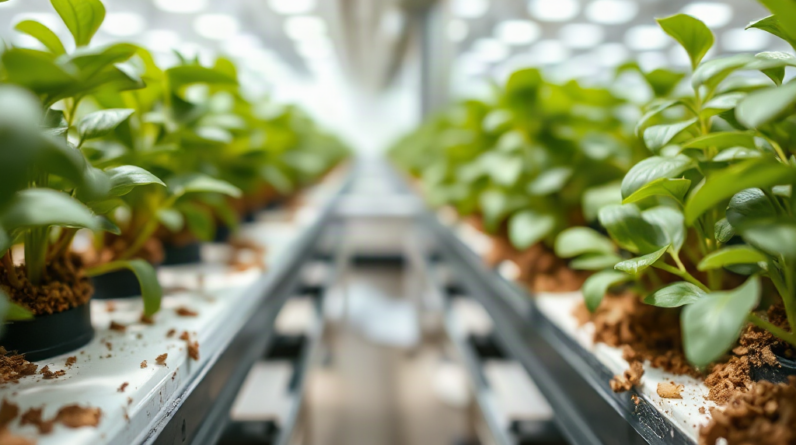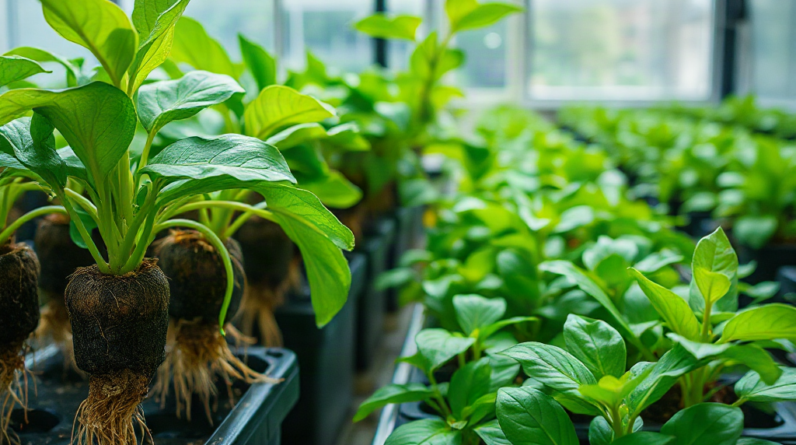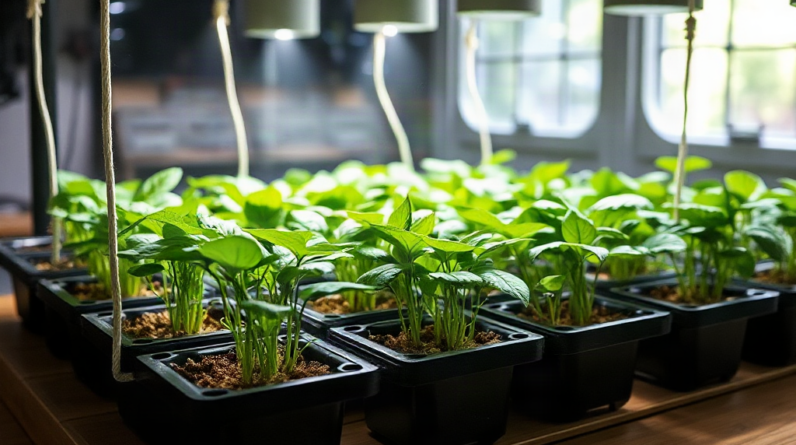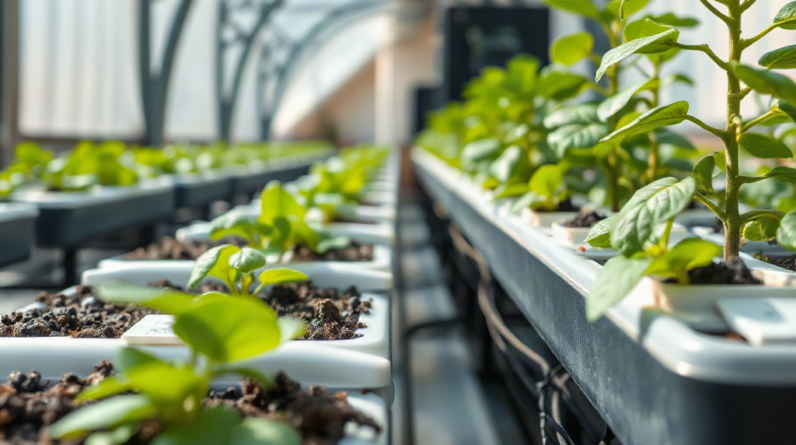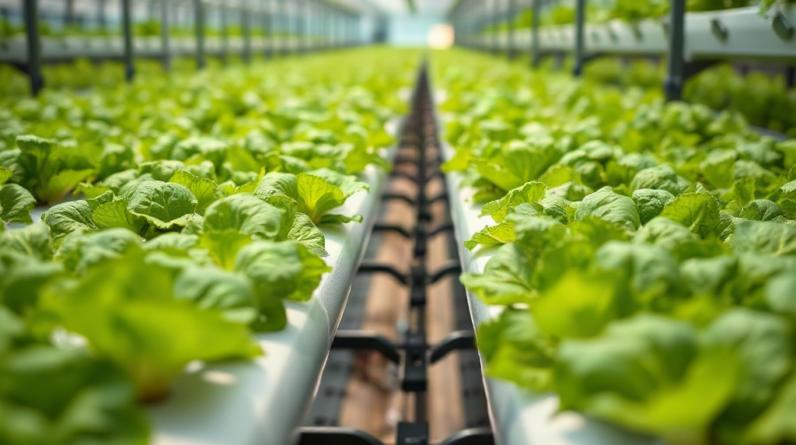
Leafy green channel spacing in hydroponic systems should be based on the mature canopy, not the seedling footprint: compact baby-leaf crops may fit 10–15 cm apart, while full-size lettuce often needs 20–30 cm and broad varieties may require more. Adequate spacing keeps neighboring leaves from overlapping heavily, allows airflow through the canopy, and preserves access for inspection and harvest. Measure both plant-hole spacing within each channel and the clear distance between adjacent channels. Dense layouts can raise production per square metre early in the cycle, but crowding later promotes uneven light, trapped moisture, stretched growth, and smaller marketable heads.
Spacing Ranges for Common Leafy Greens
Mature harvest size provides a more reliable spacing target than the dimensions of a plug or net cup. A newly transplanted lettuce seedling may occupy only a few centimetres, yet its leaves can extend well beyond the channel within several weeks. Planning around the transplant creates an apparently efficient layout that becomes crowded during the period when plants need the most light and airflow.
For baby-leaf production, holes are commonly arranged about 10–15 cm apart because the crop is harvested before a large rosette forms. Small butterhead, loose-leaf lettuce, pak choi, and compact herbs may use roughly 15–20 cm where they are harvested young. Full heads of lettuce generally need about 20–30 cm between plant centres. Large romaine types, mature Swiss chard, kale, or broad Asian greens may need 25–35 cm or more, depending on cultivar, harvest age, and environmental conditions. These figures are planning ranges rather than universal prescriptions.
The intended product matters as much as the species. Lettuce grown for individual young leaves can tolerate a much denser arrangement than the same cultivar grown into a uniform head. Likewise, chard harvested repeatedly for outer leaves develops a wider, longer-lived canopy than chard cut once while small. Seed-supplier descriptions, trial plants, and the measured width of a mature crop are therefore more useful than a generic crop label.
Spacing also interacts with season and light intensity. A cultivar that remains compact under strong, even lighting may stretch and spread under insufficient light. Warm conditions can accelerate leaf expansion or bolting, while high humidity makes dense leaf contact more troublesome because wet surfaces dry slowly. More holes do not necessarily produce more saleable mass if interior plants become shaded, misshapen, or difficult to inspect.
A practical starting hierarchy is:
- 10–15 cm: baby leaves and very early harvests.
- 15–20 cm: compact greens harvested below full maturity.
- 20–30 cm: many full-size lettuce crops.
- 25–35 cm or more: broad, tall, or repeatedly harvested greens.
Treat the range as a trial setting, then verify it against the actual cultivar. The most common mistake is copying a lettuce layout for every leafy crop. Crop-specific planning makes Leafy green channel spacing in hydroponic systems more dependable than relying on net-cup diameter alone.
How Canopy Size Changes Channel Layout
Plant-hole spacing and the gap between channels solve different problems. Hole spacing controls competition along a row, while channel spacing determines whether adjacent rows merge into a continuous canopy. A layout can provide 25 cm between holes yet still be crowded if neighboring channels are placed so closely that leaves overlap from both sides.
Measure channel placement from centreline to centreline when comparing layouts. This avoids confusion caused by channels of different widths. If a mature lettuce canopy is expected to reach 24 cm across, channel centres set only 15 cm apart will produce substantial overlap. Some overlap near harvest may be acceptable, but continuous leaf-on-leaf contact can block light from lower foliage and reduce air movement around the crown.
Canopy dimensions are not always circular. Upright romaine may remain relatively narrow near its base but create height-related shading when rows sit close together. Butterhead lettuce tends to form a lower, wider rosette. Chard and kale can project leaves into aisles or over adjacent channels even when their stems remain upright. Measure the widest healthy leaves rather than assuming that crop height predicts the required footprint.
The physical growing environment changes the acceptable degree of overlap. Strong horizontal airflow can move air above a canopy without reaching the damp pockets below it. Fans should create gentle movement through and beneath the leaves, not merely cause the tops to flutter. If plants touch heavily and condensation or irrigation splash remains on interior leaves, additional separation is often more useful than simply increasing fan speed.
Lighting geometry deserves equal attention. Under narrow fixtures, widely separated channels may place outer leaves beyond the useful beam. Under a broad, evenly distributed fixture, extra channel separation may improve canopy uniformity without sacrificing much light. Check illumination at mature canopy height and at the outside rows rather than assessing an empty system at channel level.
Access is another spacing constraint that yield calculations often omit. Leaves should not need to be crushed or repeatedly lifted to examine roots, remove damaged foliage, clean a spill, or harvest a head. A commercial raft or NFT layout may use movable channels to increase early density and widen rows later. A fixed home system usually benefits from modestly wider final spacing because channels cannot be shifted as the crop expands. The failure mode is optimizing only the number of sites: the nominal capacity rises while inspection quality, crop uniformity, and harvest speed deteriorate.
Calculating Hole and Channel-Centre Distances
A useful layout starts with three measurements: expected mature canopy width, desired overlap at harvest, and the physical width of the channel. These values separate the crop requirement from the hardware constraint. They also make it easier to compare staggered holes, straight rows, and different channel profiles without guessing from photographs.
For holes along one channel, choose a plant-centre distance close to the expected canopy diameter when growing full heads with minimal overlap. A 24 cm lettuce canopy, for example, suggests starting near 24 cm between hole centres. A grower harvesting it earlier might test 20 cm, while a humid room with limited under-canopy airflow may justify 26–28 cm. The decision should reflect the crop stage at harvest rather than the maximum size the cultivar could reach if left indefinitely.
For parallel rows, calculate centre-to-centre spacing rather than the empty gap between channel edges. Add the channel width to the desired edge gap. Two 10 cm-wide channels with a 12 cm clear gap have centres 22 cm apart. Recording only “12 cm spacing” creates ambiguity because another grower may interpret that as centre-to-centre distance.
Staggering the planting holes in adjacent channels can reduce direct competition between neighboring plants. Each plant faces a gap rather than another crown, allowing canopies to interlock more evenly. Staggering does not create unlimited space, however. When rows are extremely close, leaves still overlap, airflow remains restricted, and harvesting becomes awkward. It is a refinement to adequate spacing, not a substitute for it.
Use this compact layout check before drilling channels or ordering a rack:
- Record the cultivar and planned harvest stage.
- Estimate mature width from supplier information or a small trial.
- Select hole-centre spacing based on acceptable overlap.
- Set channel centres using canopy width, channel width, and access needs.
- Confirm that outer rows remain beneath useful light.
- Leave room to remove channels, inspect roots, and clean surfaces.
Allow for walls and rack posts when checking the final plan. A canopy pressed against a reflective wall may trap moisture even if plant-to-plant distances look adequate. Root mass can impose a separate limit in NFT channels: generous canopy spacing does not compensate for a narrow flow path blocked by mature roots. Channel slope, nutrient-film continuity, and drainage still need independent verification. A sound Leafy green channel spacing in hydroponic systems calculation therefore checks both foliage above the channel and root occupancy inside it.
Testing a Layout Before Expanding It
A small crop trial reveals spacing problems more reliably than a theoretical maximum-site calculation. Plant one or two channels at the proposed density, keep the cultivar and harvest age consistent, and observe them through the final growth period. Empty-system measurements cannot show how petioles angle toward light, how outer leaves drape, or where moisture persists after irrigation and routine handling.
Measure canopy width at several points rather than selecting the largest specimen. Variation matters: if only the smallest plants fit comfortably, the layout will become inconsistent as stronger plants dominate their neighbors. Note when adjacent leaves first touch, whether contact becomes continuous, and whether the inner plants begin leaning or developing unequal heads. Photographs taken from the same position each week make canopy closure easier to compare.
A workable density leaves the crop reasonably uniform and accessible at harvest. Signs that the spacing is holding include visible air paths near crowns, limited overlap before the final stage, even development across interior and outer rows, and dry leaf surfaces between wetting events. Warning signs include pale or shaded lower foliage, persistent dampness where leaves touch, plants leaning toward openings, difficult crown inspection, and damage caused while removing one plant from between its neighbors.
Compare yield by usable output, not simply by the number of occupied holes. Suppose a short channel holds six lettuce plants at 20 cm spacing or five at 25 cm. The denser arrangement wins only if the additional plant offsets any reduction in head size, uniformity, quality, and harvesting efficiency. For household production, five clean, accessible heads may be more valuable than six crowded ones. A production grower should compare marketable mass and crop consistency over repeated cycles.
If crowding appears only near harvest, widening every row may not be the only option. Earlier harvesting, alternating crop sites, choosing a more compact cultivar, or moving channels apart during the second half of the cycle can preserve early space efficiency. Fixed racks have fewer adjustment options, so they should be designed for the largest planned crop rather than the smallest.
Change one variable at a time during follow-up trials. Widening channels while changing cultivar, lighting, and harvest age makes the result difficult to interpret. Record hole centres, channel centres, transplant date, harvest date, observed canopy width, and usable yield. That simple record turns Leafy green channel spacing in hydroponic systems from a borrowed rule into a setting matched to the room, equipment, and product being grown.
Frequently Asked Questions
How far apart should lettuce holes be in an NFT channel?
About 20–30 cm between centres suits many full-size lettuces. Baby-leaf or early-harvest crops can be closer, while large romaine and broad cultivars may need more room.
Should channel spacing be measured from the edges or centres?
Use centre-to-centre measurements for layout records. If measuring the clear edge gap, add the channel width so the result can be compared accurately with other systems.
Can staggered planting holes allow closer channels?
Staggering reduces direct crown-to-crown competition and can use space efficiently, but it cannot correct severe canopy overlap, poor access, or stagnant air between dense rows.
Is some leaf overlap acceptable?
Limited overlap near harvest is often manageable. Continuous contact early in the cycle, trapped moisture, unequal growth, or difficulty inspecting crowns indicates that the layout is too dense.
Can channels start close together and be moved later?
Yes, movable systems can use tighter early spacing and wider finishing spacing. Plan the final rack width, plumbing movement, channel support, and safe access before relying on this approach.
Conclusion
Choose spacing from the canopy expected on harvest day, then verify that choice under the actual lights, airflow, channel profile, and room constraints. Record hole distances and channel-centre distances separately so the layout remains clear when equipment changes. Compact baby greens can justify close sites, while full heads and repeatedly harvested crops need space for lateral growth and routine handling.
Before committing an entire rack, run a representative channel through harvest and watch for early canopy closure, persistent wet contact, leaning plants, uneven heads, and obstructed access. Compare usable yield rather than plant count alone. If the trial becomes crowded, widen the layout, harvest earlier, stagger sites, or select a smaller cultivar. The best arrangement is the densest one that still produces uniform crops without sacrificing airflow, light distribution, inspection, or harvest quality.