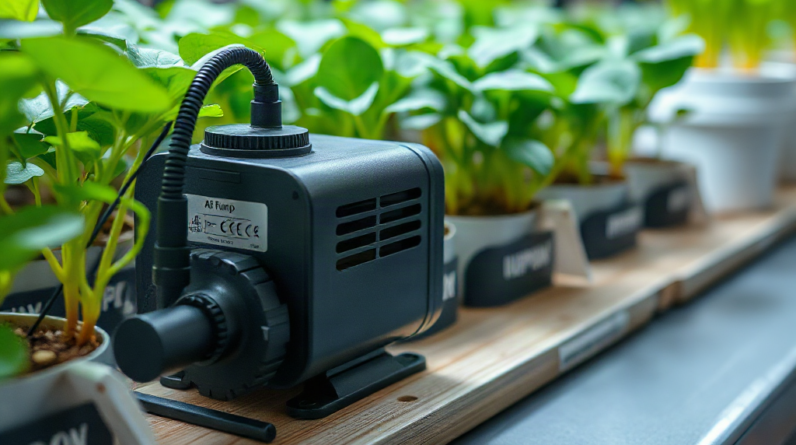
Size an air pump for hydroponic root oxygenation by matching delivered airflow—not merely the pump’s advertised output—to reservoir volume, water depth, diffuser resistance, and root demand. A practical starting range for deep-water culture is roughly 0.5 to 1 liter of air per minute for each gallon of nutrient solution, with the higher end favored for warm water, dense roots, or multiple diffusers. Pressure loss through deep tanks, long tubing, check valves, and fine-pore stones reduces actual flow. Confirm the result by checking vigorous circulation around every root zone, stable pump output, clean diffusers, and adequate dissolved oxygen rather than relying on bubbles at one corner.
Convert Reservoir Volume Into a Starting Airflow
Reservoir volume provides a useful first estimate because it defines how much nutrient solution must be circulated and exposed to air. For deep-water culture, a working starting range is approximately 0.5 to 1 liter per minute of air for each gallon of solution. This is a planning range rather than a universal biological threshold. The lower end may serve a cool, lightly planted reservoir with short airline runs, while the upper end offers more margin for warm conditions, mature roots, or restrictive diffusers.
To use the range, multiply the operating volume—not the container’s printed capacity—by the selected airflow rate. A 10-gallon tote holding eight gallons of solution would call for about 4 to 8 liters per minute at the reservoir. If two buckets each contain four gallons, calculate the combined requirement and then consider whether the manifold will divide that airflow evenly. An eight-liter-per-minute pump does not necessarily deliver four liters per minute to each bucket once backpressure and unequal tube lengths enter the system.
Advertised pump output is normally measured under favorable conditions. Air must still travel down to the diffuser and escape through its pores, so the rated number should not be treated as guaranteed delivery at root level. Selecting a pump exactly equal to the calculated minimum leaves little capacity for a dirty air stone, a pinched line, or the gradual increase in resistance that occurs during use. A modest capacity reserve is generally more useful than running a marginal pump continuously at its limit.
System type changes how the calculation should be interpreted. In deep-water culture, roots depend heavily on aeration within a standing solution, making airflow distribution critical. Recirculating systems may receive additional gas exchange from waterfalls, return jets, or exposed channels, but those effects can vary when flow rates change. Aeroponic and drip-fed roots are exposed to air differently, so a gallons-based DWC rule should not be transferred to them without considering irrigation design and root exposure.
A compact sizing sequence keeps the initial purchase grounded in actual operating conditions:
- Measure the normal nutrient-solution volume across all aerated containers.
- Multiply gallons by 0.5 to 1 liter per minute, choosing the higher end for demanding conditions.
- Add capacity for depth, manifolds, tubing length, and diffuser resistance.
- Check whether the pump can provide the required pressure as well as nominal airflow.
- Plan enough outlets and diffusers to distribute air across every root zone.
This calculation is the baseline for Air pump sizing for hydroponic root oxygenation, not the final proof of performance. A correctly sized pump must still move air through the installed plumbing and distribute bubbles where roots consume oxygen.
Account for Depth, Tubing, and Diffuser Resistance
Airflow falls as the pump works against water pressure and restrictions in the delivery path. The deeper the diffuser sits, the more pressure is required before air can emerge. Fine-pore diffusers create additional resistance, and every narrow fitting, valve, bend, or long airline contributes another loss. Pump specifications that include a pressure or depth curve are therefore more informative than a single unrestricted liters-per-minute rating.
Consider two reservoirs that each hold ten gallons. A shallow tray with a diffuser several inches below the surface presents less backpressure than a tall bucket with the diffuser near the bottom. The same pump may create aggressive bubbling in the tray but weak, intermittent output in the bucket. Buying solely by reservoir gallons would miss that difference. For a deep installation, choose a model rated to operate at the actual diffuser depth while still supplying the target flow.
Diffuser selection involves a tradeoff. Smaller bubbles offer more total surface area for a given air volume and can remain in the water longer, but fine pores require greater pressure and tend to clog more noticeably. A coarse diffuser may transfer oxygen less efficiently per liter of air, yet it can maintain dependable circulation with a lower-pressure pump. Vigorous water movement is valuable because it replaces oxygen-depleted water around roots with newly aerated solution. Bubble size alone does not determine whether the whole root mass receives oxygen.
Manifolds introduce another common failure mode. Air follows the path of least resistance, so one clean, shallow diffuser can take most of the flow while a deeper or dirty unit receives little. Equal airline lengths can reduce imbalance, but individual control valves are usually needed for tuning. Avoid closing too many valves on a pump that relies on airflow for cooling. If excess capacity must be released, an unused outlet or bleed line may be preferable, subject to the manufacturer’s operating instructions.
Check valves help stop solution from siphoning toward the pump during an outage, especially when the pump sits below the waterline. They also add resistance and can be installed backward. Positioning the pump above the maximum solution level provides another layer of protection, though secure mounting matters because vibration can cause it to move. Keep tubing free of kinks and use the diameter recommended for the pump rather than forcing high output through undersized line.
For multi-container installations, compare one central pump with several smaller units. A central pump simplifies electrical connections and may be more efficient, but one failure affects every root chamber. Separate pumps cost more to maintain and may create additional noise, yet they provide fault isolation. The sensible choice depends on crop value, available outlets, and whether backup aeration is ready. These pressure and distribution details should be included whenever applying Air pump sizing for hydroponic root oxygenation to more than one vessel.
Adjust Capacity for Water Temperature and Root Load
Warm nutrient solution needs a larger operating margin because it holds less dissolved oxygen while roots and microorganisms may consume oxygen rapidly. An airflow level that appears adequate in a cool young planting can become marginal after the canopy matures or summer temperatures raise the reservoir temperature. Pump capacity cannot fully compensate for overheated solution, but stronger circulation and dependable aeration reduce the chance that a borderline setup will deteriorate unnoticed.
Root mass matters as much as plant count. Four seedlings in a bucket impose a very different demand from four mature plants whose roots fill much of the water column. Dense roots can surround a diffuser, redirect bubbles, and create poorly circulated pockets. They can also make visual inspection difficult. Size for the expected mature crop rather than the transplant stage, and leave physical space around the diffuser so water can move through the root zone.
Crop behavior also affects the margin worth buying. Fast-growing, large-rooted plants in individual culture buckets usually justify more airflow and redundancy than a short-cycle planting with a small root system. This does not mean that excessive bubbling is automatically better. Very forceful turbulence can splash nutrient solution onto collars, stems, lids, or nearby surfaces, encouraging salt deposits and persistent moisture where it is not wanted. Oversized pumps can also add noise and heat to the growing area.
A practical example is a four-bucket installation holding roughly three gallons per bucket. The baseline range is about 6 to 12 liters per minute delivered across the system. If the buckets are deep, the air lines are long, and the crop will develop heavy roots, selecting near the upper end—or above it to cover delivery losses—makes more sense than using a six-liter-per-minute pump. Each bucket still needs enough diffuser area and balanced flow; a large rating at the manifold does not guarantee useful circulation in all four buckets.
Waterfalls and return jets can supplement oxygen transfer in recirculating arrangements. Their contribution depends on exposed surface agitation, drop height, flow rate, and whether circulation continues reliably. Treat them as helpful system features rather than an excuse to remove dedicated aeration from a root chamber that depends on submerged roots. A clogged return or failed water pump can eliminate that oxygen source quickly, whereas a separate air pump provides a different failure path.
Plan for outages as part of sizing rather than after roots show stress. A spare diaphragm, backup pump, battery-powered aerator, or emergency transfer plan can be more valuable than buying the largest everyday unit. High stocking density and warm water shorten the margin for error. Inspecting root load and seasonal temperature before adding plants helps determine whether the existing aeration system has enough reserve or should be expanded first.
Verify Oxygen Delivery and Correct Weak Aeration
Installed performance should be judged at the roots, not by the sound of the pump or bubbles visible beside one diffuser. Strong surface movement across the reservoir, consistent output from every outlet, and circulation through the root mass indicate that air is being distributed. A dissolved-oxygen meter provides the clearest measurement when accurate verification is needed, but it must be calibrated and maintained according to its instructions. A number from a neglected probe can be less useful than careful system inspection.
Healthy-looking roots are commonly pale or cream-colored, but color alone is not a reliable oxygen test. Nutrients, beneficial microbial products, and staining can change their appearance. More concerning signs include a stagnant odor, slippery root surfaces, declining root firmness, unexplained wilting despite adequate solution, or rapidly worsening performance during warm periods. These symptoms can also involve temperature, pathogens, pump failure, or nutrient conditions, so increasing airflow should not replace a complete check.
Begin troubleshooting at the air source. Confirm that the pump is running normally and that its intake is unobstructed. Then inspect tubing for disconnections, water accumulation, kinks, and leaks. Check valve direction, manifold settings, and output at each line. If one diffuser is weak, swap it with a known clean unit or temporarily test the line without it. Strong flow from the bare line points toward a blocked diffuser; weak flow suggests upstream restriction or insufficient pressure.
Diffusers gradually accumulate mineral deposits and biological material. Cleaning or replacing them can restore output, but use a method compatible with the diffuser material and rinse it thoroughly before returning it to nutrient solution. Replacing only the pump while leaving clogged stones in place may produce little improvement. Conversely, fitting ultra-fine diffusers to a low-pressure pump can make a previously functional installation appear underpowered.
Use this priority order when performance falls:
- Restore operation: reconnect failed lines, correct closed valves, and replace a stopped pump.
- Remove restrictions: address kinked tubing, clogged diffusers, blocked intakes, and faulty check valves.
- Rebalance distribution: tune outlets so every root chamber receives visible, sustained flow.
- Reduce environmental demand: correct excessive solution temperature and remove decaying root material when present.
- Increase capacity: upgrade airflow or pressure only after confirming that plumbing is not wasting existing output.
Signs that a correction is working include restored diffuser output, broader water movement, fewer stagnant pockets, and stable plant posture through the warmest part of the light cycle. Root recovery may lag behind mechanical correction, and damaged tissue will not instantly return to a healthy appearance. Record operating volume, pump model, outlet arrangement, and maintenance dates so future changes to Air pump sizing for hydroponic root oxygenation are based on observed performance rather than guesswork.
For deeper technical context, consult university extension material on dissolved oxygen in soilless culture, manufacturer airflow-versus-pressure curves, and the operating instructions supplied with air pumps and diffusers. These resources are most useful when they address the actual water depth, diffuser type, and temperature range of the installation.
Frequently Asked Questions
How many liters per minute should a hydroponic air pump provide?
For deep-water culture, roughly 0.5 to 1 liter per minute per gallon of operating solution is a practical starting range. Increase the margin for warm water, deep containers, dense mature roots, long tubing, or restrictive diffusers.
Can a hydroponic air pump be too powerful?
Yes. Excessive turbulence can splash stems and lids, increase noise, and waste energy. Use valves or suitable diffuser capacity to distribute surplus flow, while following the pump manufacturer’s requirements for minimum open airflow.
Does a larger air stone require a larger pump?
Often, but pore size and pressure demand matter as much as physical size. A large fine-pore diffuser may need substantially more pressure than a small coarse stone, so check compatibility with the pump’s pressure curve.
Should every deep-water culture bucket have its own air stone?
Each bucket should receive direct, dependable aeration. One appropriately sized diffuser per bucket is common, though multiple diffusers may improve coverage in large containers if the pump can maintain flow through all of them.
How can I tell whether hydroponic roots need more oxygen?
Check for weak diffuser output, stagnant areas, warm solution, unpleasant odors, slippery roots, or wilting despite adequate water. Because these signs can have several causes, inspect temperature, circulation, root condition, and equipment together.
Conclusion
A useful pump selection begins with operating water volume, then accounts for the pressure needed to push air through the actual depth, tubing, valves, and diffusers. Mature root density and warm solution justify additional capacity, while good distribution matters more than impressive bubbling in a single spot. Calculate the baseline flow, inspect the manufacturer’s pressure information, and provide a reasonable reserve instead of buying at the minimum rating.
After installation, balance every outlet and verify circulation throughout each root chamber. Clean diffusers and unrestricted lines should be checked before assuming that the pump itself is undersized. Record changes as plants mature, and prepare backup aeration where a brief failure could affect an entire crop. The best-sized unit is the one that delivers stable airflow at working depth under the system’s most demanding expected conditions.