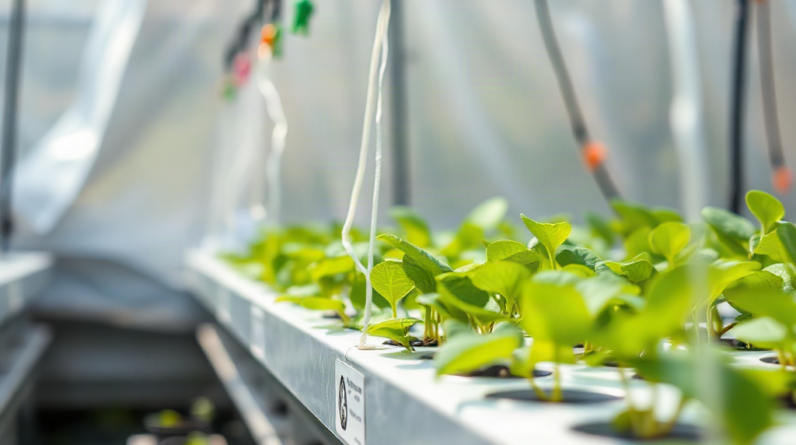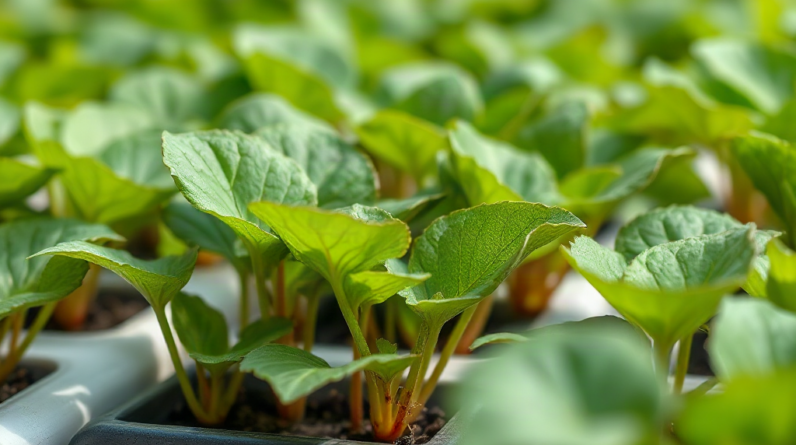
Correct iron deficiency on young hydroponic leaves by checking root-zone pH first, then confirming nutrient strength and adding a compatible chelated iron only when the reservoir cannot supply enough available iron. New growth typically turns pale between green veins because high pH, damaged roots, precipitation, or an unsuitable chelate prevents iron uptake. Restore the crop-appropriate pH gradually, inspect root health, and replace a questionable solution before adding a concentrated supplement. Successful correction appears as greener new leaves and normal expanding growth; severely chlorotic leaves may remain pale even after uptake resumes.
Confirm That the New Growth Shows Iron Chlorosis
Iron deficiency usually appears first on the youngest expanding leaves because iron moves poorly from older tissue into new growth. The leaf blade becomes pale yellow or nearly cream while the fine vein network stays greener, producing interveinal chlorosis. Growing tips may remain small when the shortage becomes severe. Older leaves can look comparatively normal during the early stage, which separates this pattern from deficiencies involving mobile elements that plants can relocate from mature foliage.
Leaf position matters as much as color. A uniformly pale plant may be short of nitrogen, exposed to weak light, or suffering from broad root stress rather than an isolated iron problem. Magnesium deficiency generally develops on older leaves first. Manganese problems can resemble iron chlorosis, but they may produce small brown spots or a less sharply defined pattern. Sulfur deficiency can pale newer tissue, although the yellowing is often more uniform across veins and surrounding tissue. Symptoms alone cannot identify the reservoir-level cause, but they can establish whether iron availability deserves priority.
Consider a young lettuce plant with two healthy green outer leaves and a newly opened center leaf that is lemon-yellow between green veins. That distribution strongly supports iron chlorosis. By contrast, a seedling whose cotyledons and lower leaves yellow before its center growth is less consistent with an iron shortage. Comparing several plants also helps: symptoms affecting the same-aged leaves across a channel point toward solution chemistry, while one affected plant beside healthy neighbors suggests a blocked emitter, damaged roots, or a local planting-site issue.
Inspect the underside and growing point under neutral white light before changing the reservoir. Intense red-blue fixtures can hide the true color, while foliar residues may make leaves look gray or mottled. Check for sap-feeding pests, physical distortion, and dead root tips. Photograph the newest leaf beside a healthy plant so later comparisons use the same tissue and lighting. The purpose of diagnosis is not to prove iron is absent from the fertilizer; it is to determine whether new tissue is failing to receive usable iron.
A common mistake is treating every yellow leaf with more micronutrients. Iron may already be present at the formula’s intended concentration but chemically unavailable because the pH is high. Adding more under those conditions raises the reservoir concentration without removing the uptake barrier. The most useful next step in Iron deficiency correction on young hydroponic leaves is therefore a root-zone and solution check, not an automatic supplement dose.
Check pH, Roots, and the Reservoir Before Adding Iron
Root-zone pH is the first measurement to verify because iron becomes less available as hydroponic solution moves too far into the alkaline range. Use a recently calibrated meter and test the circulating reservoir after the solution has mixed, not a stagnant cup collected hours earlier. Many hydroponic crops take up iron reliably in a mildly acidic root zone, commonly around pH 5.5 to 6.5, but the appropriate operating band depends on the crop, fertilizer, water alkalinity, and system instructions.
Do not force a large pH correction in one pour. Dilute the appropriate pH-adjusting product according to its label, add a small amount to the reservoir, circulate thoroughly, and retest. Concentrated acid contacting roots or undiluted fertilizer can injure tissue and create a second problem that resembles nutrient stress. If pH rises again soon after adjustment, investigate alkaline source water, exposed media, a small reservoir, or heavy plant uptake rather than repeating increasingly aggressive corrections.
Reservoir strength provides another essential constraint. Compare electrical conductivity with the normal range for the crop and growth stage, recognizing that EC reports total dissolved ions rather than iron specifically. A very weak solution may genuinely undersupply the full nutrient profile. A normal or elevated EC does not prove that iron is available; salts can accumulate while the iron fraction precipitates or remains inaccessible. For a questionable batch, replacing it with a freshly mixed complete nutrient solution is often more controlled than stacking several corrective products into it.
Root condition can override an otherwise correct formula. Healthy roots are generally firm and light-colored, although nutrient stains can change their appearance. Slime, tissue that sheds easily, sour odors, persistent warmth, and low aeration indicate conditions that can restrict nutrient uptake. In deep-water culture, restore aeration and appropriate solution temperature before expecting an iron additive to work. In drip or channel systems, verify flow at each affected plant. A blocked line can produce local chlorosis even when the main tank tests normally.
Use this order to keep the correction interpretable:
- Verify the pattern: chlorosis begins on the newest leaves and is not better explained by pests or damaged roots.
- Measure accurately: calibrate the pH meter, then record pH, EC, solution temperature, and reservoir age.
- Correct access: bring pH back gradually and restore flow, oxygenation, or root health where needed.
- Refresh when uncertain: remix the complete formula at its labeled rate if the solution is old, cloudy, or assembled incorrectly.
- Supplement only with a basis: add chelated iron when the formula, water conditions, or continued new-leaf symptoms indicate a genuine need.
Do not mix concentrated micronutrients directly with concentrated calcium fertilizer. Localized high concentrations can encourage reactions and precipitation before dilution occurs. Add each stock separately to water with circulation, following the manufacturer’s mixing sequence. A clear reservoir does not guarantee perfect compatibility, but cloudiness or sediment after mixing is a warning that the plant may not receive what the label suggests.
Choose and Apply a Compatible Chelated Iron
Chelated iron holds the metal in a soluble complex, reducing the chance that it will become unavailable before roots can absorb it. The chelating agent matters because each type remains effective across a different pH range. Fe-DTPA is commonly useful in mildly acidic to moderately alkaline hydroponic conditions, while Fe-EDDHA remains more stable at higher pH but can color the solution red and may be unnecessary when pH is well controlled. Fe-EDTA is generally better suited to acidic conditions and loses effectiveness as alkalinity rises.
Choose the product by the root-zone conditions that will actually persist, not by the strongest-sounding label. A grower who can maintain pH near 5.8 may get dependable performance from the iron already included in a complete hydroponic fertilizer. A system supplied by alkaline water that repeatedly drifts upward may need stronger pH management, a more suitable chelate, or treatment of the source water. Using EDDHA can preserve iron availability across a wider pH range, but it does not fix excessive alkalinity, poor root oxygen, or an imbalanced nutrient program.
Read the guaranteed analysis to identify the percentage of elemental iron and the named chelate. Products with different iron percentages cannot be substituted scoop for scoop. Calculate additions from actual reservoir volume and the manufacturer’s hydroponic directions, then measure with an appropriate scale or dosing tool. If the label does not provide a hydroponic rate, do not improvise a concentrated dose. A complete replacement solution or advice from the nutrient manufacturer is safer than guessing from soil or foliar instructions.
Apply the supplement to the reservoir only after diluting it in water, then provide enough circulation for even distribution. Avoid combining multiple iron products at once because the total dose becomes difficult to track. More iron is not a faster cure: excessive micronutrient additions can disturb the balance of manganese, zinc, phosphorus, and other elements, while leaving the original pH or root problem untouched. Record the product, chelate, amount, reservoir volume, pH, and EC so the outcome can be evaluated rather than remembered approximately.
Foliar iron can green contacted tissue quickly in some situations, but it is not the preferred substitute for restoring root-zone availability. Spray concentration, crop sensitivity, light intensity, and food-crop handling all affect whether foliar use is appropriate. Droplets under strong fixtures may mark tender leaves, and repeated spraying adds humidity around the canopy. Use foliar application only when the product explicitly permits it and the crop can be treated safely. For durable Iron deficiency correction on young hydroponic leaves, the reservoir and roots still need to supply new growth.
Track New Growth and Prevent the Problem From Returning
Recovery should be judged at the growing point rather than by waiting for every yellow leaf to become dark green. Once iron availability improves, leaves that emerge afterward should develop a more even green color and expand with less distortion. Mildly affected young leaves may regain some color, but tissue that formed under a severe deficiency can remain pale or damaged. Removing those leaves immediately makes progress harder to evaluate and reduces photosynthetic area the plant may still use.
Mark or photograph the newest affected leaf on the day of correction. Recheck the plant over the following several days while recording pH and reservoir behavior. Fast-growing leafy greens may reveal improvement sooner than slow-growing herbs or fruiting crops, so calendar promises are less useful than the color and shape of newly produced tissue. If the next leaf is greener and the root system remains sound, avoid another dose simply because an older chlorotic leaf has not recovered.
Failure has a different pattern: newly emerging leaves remain pale, tips become necrotic, roots deteriorate, or pH quickly returns to the problematic range. Those signs call for renewed diagnosis rather than repeated iron additions. Confirm meter calibration with fresh buffer, check the actual reservoir volume, inspect emitters, and review the nutrient mixing order. If only plants in one portion of a channel remain affected, investigate flow and root crowding. If every plant declines after a supplement, consider dosing error or incompatibility and replace the solution when appropriate.
Prevention depends on trend records rather than constant reactive dosing. Log pH at a consistent time, note how much water and nutrient concentrate are added, and compare drift with plant growth. Top-offs made only with water can gradually dilute nutrients in some operating routines, while repeated concentrate additions can push EC upward. Periodic reservoir replacement limits the accumulation of ions that plants use unevenly. The replacement interval should reflect crop demand, tank size, water quality, and the nutrient manufacturer’s instructions rather than a universal schedule.
Source-water alkalinity deserves attention when pH rises predictably after every adjustment. Alkalinity measures the water’s acid-neutralizing capacity and is not the same as a single pH reading. Growers dealing with persistent drift may benefit from a water analysis and a nutrient formula designed for their water profile. Likewise, light intensity, root temperature, and oxygen availability should remain within crop-appropriate bounds because vigorous leaves cannot compensate for impaired roots.
The common prevention failure is using iron as routine insurance. Unmeasured additions conceal patterns and can create a micronutrient imbalance that is harder to diagnose than the original chlorosis. A stable mildly acidic root zone, a compatible complete fertilizer, correct concentrate dilution, healthy roots, and written records provide a more reliable plan than repeated rescue treatments.
Frequently Asked Questions
Why does iron deficiency show first on young hydroponic leaves?
Iron is poorly mobile within the plant, so older foliage cannot readily supply it to developing tissue. Restricted uptake therefore becomes visible first as pale new growth with greener veins.
Will lowering reservoir pH correct iron chlorosis?
It may when iron is present but unavailable at an excessively high pH. Adjust gradually, circulate the solution, and verify root health; lowering pH cannot replace iron that is genuinely absent.
Which iron chelate works best in hydroponics?
The choice depends on operating pH. Fe-EDTA favors acidic conditions, Fe-DTPA covers a somewhat broader range, and Fe-EDDHA remains stable at higher pH but may color the solution.
How quickly should new leaves turn green after correction?
Look for healthier color in newly expanding tissue over the next several days, allowing for crop growth rate. Severely chlorotic leaves may not fully regain their original color.
Can too much chelated iron harm hydroponic plants?
Yes. Excessive dosing can disrupt micronutrient balance and obscure the underlying fault. Calculate from actual reservoir volume, follow the product label, and avoid stacking multiple iron supplements.
Conclusion
Pale new leaves should trigger measurement before supplementation. Confirm that chlorosis is concentrated in developing tissue, test pH with a calibrated meter, compare EC with the crop’s normal range, and inspect roots and delivery lines. Correct unstable pH, weak circulation, poor aeration, or an unreliable nutrient batch before deciding that the reservoir needs extra iron.
When supplementation is justified, match the chelate to the pH range, calculate from the true water volume, and document the dose. Judge progress by greener leaves emerging after the correction, not by demanding full recovery from tissue already damaged. If symptoms continue, reassess the meter, water alkalinity, mixing sequence, and root zone rather than repeatedly increasing iron. That measured process protects nutrient balance while revealing the condition that caused the deficiency.