Adjust nutrient levels for specific crops by matching the fertilizer strength and mineral balance to the plant’s growth stage, then verify the result with EC, pH, and plant response. Leafy greens usually need a gentler solution than fruiting tomatoes or peppers, while seedlings require the lowest strength because young roots are easily stressed. Add nutrients gradually, mix thoroughly, and measure the reservoir rather than relying only on label rates. A rising EC can indicate water loss or excess salts, whereas a falling EC may show active uptake or dilution. Change one variable at a time and monitor new growth before making another adjustment.
Match Feeding Strength to Crop and Growth Stage
Different crops do not draw identical proportions of nitrogen, potassium, calcium, magnesium, and micronutrients from a hydroponic solution. A young lettuce plant has a smaller root system and lower demand than a mature tomato carrying fruit, so applying the same concentration to both can create avoidable stress. The useful starting point is the fertilizer manufacturer’s crop-stage range, adjusted for plant size, light intensity, water temperature, and the type of hydroponic system.
Seedlings should receive the mildest solution. Their roots are still developing, and a strong mixture can raise the osmotic pressure around the roots, making water uptake harder even when the reservoir appears well supplied. Established leafy greens can usually tolerate a moderate strength, while fruiting crops often need a stronger solution once vigorous flowering and fruit development begin. That does not mean “more” is automatically better; excess salts can burn roots, suppress water uptake, and antagonize the absorption of other elements.
Consider a small system growing basil beside a tomato. Basil may produce lush foliage at a moderate concentration, but the tomato’s demand changes as it moves from vegetative growth into flowering. Increasing the entire reservoir sharply to meet the tomato’s demand may overfeed the basil. Separate reservoirs are the cleanest solution. If that is not possible, use a conservative concentration that suits both plants and accept that neither crop is receiving a fully optimized profile.
Use how to adjust nutrient levels for specific crops as a crop-by-crop decision, not as a single universal recipe. Before changing strength, identify the crop, age, production phase, and whether the symptom appears on new or old leaves. Those details narrow the likely cause and reduce the temptation to add several products at once.
Use EC and pH to Read the Reservoir
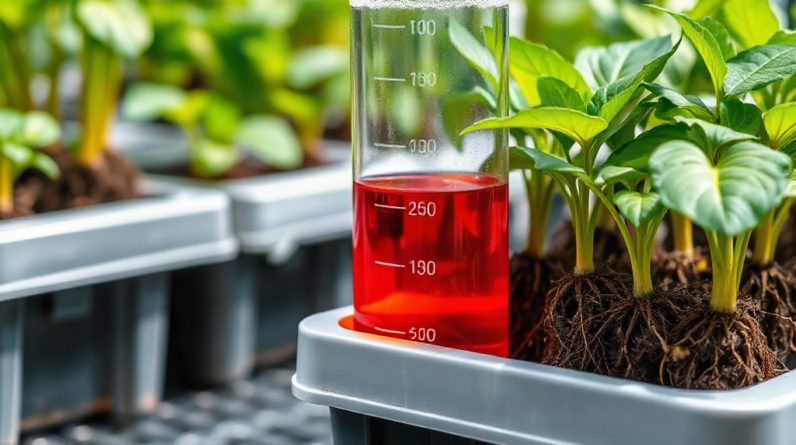
Electrical conductivity, or EC, estimates the concentration of dissolved ions in the nutrient solution; it does not identify which nutrient is present. That distinction matters because a suitable EC can still hide an imbalanced formula, while an unusual EC can result from evaporation, dilution, or concentrated salts rather than a crop-specific deficiency. Measure EC and pH with calibrated meters, record the readings, and compare the reservoir trend over time instead of reacting to one isolated number.
PH affects the chemical availability of nutrients. A solution that drifts too far from the crop’s workable range may produce deficiency-like symptoms even when the fertilizer contains the needed element. In a recirculating system, check pH after the nutrients are fully mixed and allow the solution to circulate before making a correction. Add pH adjuster in small amounts, because a large swing can create a second problem and make the cause of plant stress harder to interpret.
Reservoir behavior provides useful clues. If EC rises while the water level falls, plants may be taking up water faster than nutrients, or evaporation may be concentrating the solution. If EC falls while the water level remains similar, active nutrient uptake or accidental dilution may be occurring. Neither pattern proves a diagnosis, but both tell you to inspect the reservoir and plant roots before adding fertilizer.
A common mistake is treating the EC meter as a complete crop prescription. EC readings vary between meters, nutrient formulas, and measurement scales, including different conventions such as EC and ppm conversions. Use the units supplied by the nutrient maker, avoid comparing unrelated charts, and keep the same meter and method for trend tracking. The practical aim is a stable, crop-appropriate range rather than the highest reading the plants can endure.
Build Crop-Specific Nutrient Profiles
Crop-specific feeding begins with the fertilizer formula, not with isolated bottles of individual minerals. A complete base nutrient normally supplies the major elements and trace elements in a defined ratio. Additives can be useful for a documented purpose, but stacking multiple supplements makes it difficult to know whether a response came from the intended change, an unintended excess, or a shift in pH.
Leafy crops such as lettuce, arugula, and herbs generally prioritize steady leaf production. They need enough nitrogen to support new foliage, but excessive nitrogen can produce soft growth and may complicate quality goals. Fruiting crops such as tomatoes, cucumbers, and peppers require a changing balance as they develop flowers and fruit. Potassium demand often becomes more prominent during reproductive growth, while calcium delivery depends not only on the reservoir concentration but also on transpiration, root health, and consistent water movement.
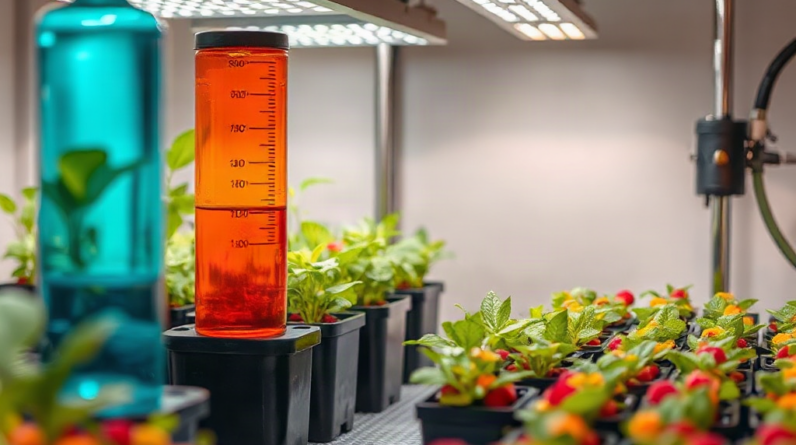
Strawberries illustrate why a crop label alone is not enough. Plants in a dim, cool space may consume nutrients differently from plants under strong light with active transpiration. A formula designed for heavy fruit production may be too concentrated for a small plant with limited leaf area. Conversely, keeping a mature, fruiting plant on a weak seedling mix can limit growth even though no dramatic deficiency appears immediately.
When selecting a profile, compare the crop’s stage with the product schedule and then make a modest adjustment for conditions. A useful working record includes the date, crop stage, reservoir volume, EC, pH, water added, fertilizer added, and visible changes in new growth. This record is more reliable than memory and helps distinguish a persistent formula problem from a one-time environmental disruption. Readers comparing crops can also review how to adjust nutrient levels for specific crops alongside their own feeding notes.
Correct Imbalances Without Chasing Symptoms
Plant symptoms should trigger investigation rather than an automatic nutrient dose. Yellowing can reflect aging leaves, low nitrogen, root oxygen problems, unsuitable pH, or excessive salts. Brown leaf edges may involve salt stress, irregular watering, heat, or a calcium transport problem. The same visual mark can have different causes, so the location, progression, root condition, and reservoir trend matter more than color alone.
Inspect roots and system conditions before changing the formula. Dark, slimy, or foul-smelling roots suggest a root-zone problem that additional fertilizer will not correct. Check aeration, water temperature, flow, emitter performance, and reservoir cleanliness. In a drip system, a blocked emitter can create local deficiency symptoms even when the main tank tests correctly. In a deep-water system, inadequate oxygen can reduce uptake across several nutrients at once.
Correcting a suspected imbalance works best as a controlled sequence. Confirm the meter, check pH and EC, compare the reading with the crop-stage target, inspect the roots, and review recent changes. If the solution is clearly too strong, dilute with suitable water or replace the reservoir according to the system’s maintenance plan. If it is too weak and the plants are actively growing, increase concentration gradually rather than doubling the dose.
Foliar feeding or single-element supplements can appear to produce a quick visual response, but they may mask the underlying issue. A foliar application cannot repair poor root oxygenation or a severely incorrect pH. Use such interventions only when the product is appropriate for the crop and the underlying reservoir and environment have been checked. New, healthy growth is a more useful confirmation than immediate improvement in old damaged leaves.
Run a Repeatable Adjustment Routine
A consistent routine turns nutrient management into a measurable process. Prepare the reservoir with clean water, add compatible products separately as directed, mix between additions, and measure only after the solution is uniform. Never combine concentrated products together before dilution, since some ingredients can react and form unavailable compounds. Keep a written baseline before making any change.
Use a small adjustment when the plants are healthy and the reading is near the intended range. Allow enough time for the crop to respond before changing another variable; the exact interval depends on crop size, system volume, and growth speed. During that period, check new leaves, root appearance, water consumption, pH drift, and EC movement. A stable reading with vigorous new growth is stronger evidence than a single attractive leaf.
A compact decision sequence is useful:
- Identify: record crop, age, growth phase, symptoms, and system type.
- Measure: verify EC, pH, reservoir level, temperature, and meter calibration.
- Inspect: examine roots, flow, aeration, lighting, and recent environmental changes.
- Adjust: change concentration or pH in a modest, documented step.
- Review: judge the response through new growth and reservoir trends.
Replacing the entire reservoir can be safer than repeatedly topping off a badly unbalanced one, especially after a long period of evaporation or several unrecorded additions. Topping off is appropriate for ordinary water loss when EC and pH remain controlled, but it is not a substitute for periodic reservoir maintenance. For more crop-specific comparisons, use how to adjust nutrient levels for specific crops as a planning reference while keeping the final decision tied to measurements and plant response.
Frequently Asked Questions
Should every crop use the same nutrient strength?
No. Seedlings, leafy greens, and mature fruiting plants usually have different demand levels. Follow the fertilizer’s crop-stage guidance and adjust conservatively for plant size and growing conditions.
What should be checked before adding more fertilizer?
Check EC, pH, water level, meter calibration, root condition, aeration, flow, and recent dilution or fertilizer additions. A deficiency-like symptom may come from poor uptake rather than a shortage in the reservoir.
Is a higher EC better for fruiting crops?
Not automatically. Fruiting plants may need a different strength from seedlings, but excessive EC can restrict water uptake and increase salt stress. Use the product schedule and plant response rather than maximizing the reading.
How often should hydroponic nutrients be adjusted?
Measure on a consistent schedule suited to the system and crop, then adjust only when readings or plant trends justify it. Frequent unrecorded changes make diagnosis harder and can destabilize the reservoir.
When is a reservoir change preferable to topping off?
Replace the solution when EC or pH is persistently difficult to control, the nutrient balance is uncertain, or repeated additions have accumulated salts. Topping off is better suited to ordinary water loss in a stable reservoir.
Conclusion
Effective crop-specific feeding depends on matching concentration and mineral balance to plant stage, then confirming the decision with EC, pH, reservoir trends, and new growth. Treat symptoms as clues rather than proof of deficiency, because root oxygen, flow, evaporation, and pH can change nutrient uptake without changing the recipe. Keep crops with sharply different demands in separate reservoirs when possible; otherwise choose a conservative compromise and monitor closely. Record every adjustment, make one change at a time, and replace a persistently unbalanced solution instead of endlessly adding products. A measured, gradual routine gives you clearer feedback and reduces the risk of trading a suspected shortage for salt stress or a new nutrient imbalance.