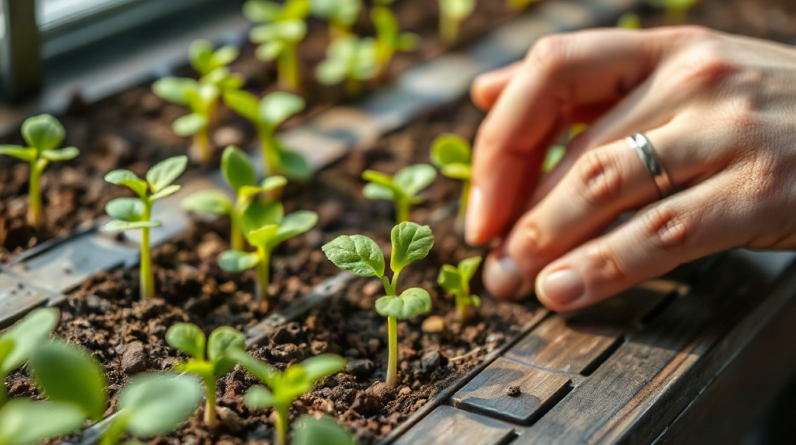
To avoid nutrient deficiencies in seedlings, use a mild, complete nutrient solution only after the first true leaves appear, keep root-zone pH within the crop’s usable range, and verify EC rather than guessing from leaf color. Seedlings can look deficient when roots are cold, oxygen-starved, overwatered, or exposed to unsuitable pH, because those conditions restrict nutrient uptake even when nutrients are present. Start with clean water and a balanced formula, monitor new growth, and change one variable at a time. Avoid correcting pale leaves with concentrated fertilizer; excess salts can damage young roots and create a second problem that is harder to diagnose.
When Seedlings Actually Need Nutrients
Seedlings do not need a strong nutrient mix as soon as a seed opens. The cotyledons, or seed leaves, contain stored food that supports the earliest stage of growth. Once the first true leaves develop, the plant begins relying more heavily on external minerals, especially when it is growing in a soilless hydroponic medium with little or no nutrient reserve.
The timing depends on the growing medium and the plant’s development. A seedling in a lightly amended starter plug may receive some nutrition already, while one rooted in inert rockwool, clay pellets, or a neutral propagation cube may need a carefully diluted complete formula after the first true leaves expand. Young roots are easily stressed, so a low-strength solution is generally more appropriate than the full concentration used for mature plants. Follow the nutrient manufacturer’s seedling directions when available rather than applying an adult feeding schedule by habit.
A common mistake is treating pale cotyledons as proof of nitrogen deficiency. Cotyledons naturally yellow and decline as their stored reserves are used. New leaves are more informative. If the first true leaves remain green but growth is steady, adding fertilizer may create unnecessary salt buildup. If new growth is uniformly pale and the plant is growing slowly, nutrition becomes more plausible, but pH, light, temperature, and moisture still need checking before the dose is increased.
Use a balanced product that supplies more than nitrogen, phosphorus, and potassium. Calcium, magnesium, sulfur, and trace elements such as iron, manganese, boron, zinc, copper, and molybdenum are needed in small amounts. A nitrogen-only supplement can make foliage greener while leaving a genuine calcium or iron issue unresolved. For a clearer comparison of feeding decisions, the site’s how to avoid nutrient deficiencies in seedlings resource can be used alongside the plant’s specific nutrient label.
pH, EC, And Root-Zone Conditions
Seedling nutrition depends on both what is in the solution and whether the roots can take it up. In hydroponic growing, pH affects the chemical form and availability of several elements. A solution that is too high or too low can produce deficiency-like symptoms even when the reservoir contains adequate fertilizer. Crop preferences vary, but many common hydroponic seedlings perform within a mildly acidic range; use a calibrated meter and the crop’s recommended range rather than chasing a single universal number.
EC, or electrical conductivity, provides an estimate of dissolved salts. It does not identify individual nutrients, and it cannot prove that a particular element is available. Even so, it is useful for detecting a solution that is far stronger or weaker than intended. A very low EC may indicate inadequate feeding or dilution from added water. A rising EC can point to evaporation or excessive fertilizer concentration. Neither reading should be interpreted without considering plant age, reservoir volume, and water quality.
Root conditions often explain failed corrections. A saturated plug with poor drainage may contain nutrients but too little oxygen, while a dry plug can prevent consistent uptake. Cold solution, compacted media, blocked emitters, and algae growth around exposed roots add further stress. For example, a seedling in a constantly wet cube may develop slow growth and pale leaves; increasing fertilizer in that situation raises salt pressure without fixing oxygen shortage.
Check the basics before changing the formula:
- Measure source-water pH and, where possible, baseline EC before mixing.
- Confirm the nutrient is fully mixed and the reservoir has adequate circulation.
- Inspect the plug or medium for both persistent saturation and dry pockets.
- Check that roots are white or cream-colored and free from foul odor or slime.
Cheap meters can drift, particularly pH meters with neglected storage or unclean probes. Calibrate according to the manufacturer’s instructions, rinse probes with suitable water, and record readings instead of relying on memory. Consistent measurements are more useful than frequent, unverified adjustments.
Recognizing Deficiencies Without Guessing
Symptoms should be read by location, timing, and pattern. Nitrogen shortage commonly affects older leaves first because the plant can move nitrogen toward new growth. Iron shortage often appears as interveinal yellowing on newer leaves, but high pH, damaged roots, or excessive phosphorus can produce a similar appearance by limiting iron availability. Calcium-related problems tend to affect new tissue because calcium is not readily redistributed within the plant, yet rapid growth, inconsistent moisture, and root stress may be involved as well.
Color alone is unreliable. Seedlings under weak light may appear pale simply because they are producing less chlorophyll, while intense light can bleach or stress leaves without indicating a fertilizer shortage. A purple stem may reflect genetics, temperature, light stress, or phosphorus-related limitations. Leaf edges that turn brown can result from high salt concentration, dry roots, or environmental stress rather than a simple potassium deficiency.
Look for a progression rather than a single unusual leaf. Compare older leaves with new growth, examine the veins, and note whether the problem is uniform across the tray. If every seedling shows the same change after a reservoir refill, solution strength or pH deserves attention. If only one plant is affected, inspect its plug, roots, emitter, and physical damage before altering the entire system.
Photographs taken under the same light and brief notes about pH, EC, room temperature, and feeding dates make diagnosis more reliable. A useful test is to correct the most likely environmental cause and watch new growth. Existing damaged tissue may not recover, so improvement means healthier emerging leaves and steadier growth rather than instant color restoration. This distinction prevents repeated dosing when the original problem has already stopped.
Do not mix several corrective products at once. Adding calcium, magnesium, micronutrients, and a stronger base nutrient together removes the ability to tell what helped and can push the root-zone EC too high. A measured correction followed by observation is slower than aggressive treatment, but it protects fragile roots and produces better information.
A Practical Prevention And Correction Routine
Prevention begins with a simple written routine. Label each tray with the crop and sowing date, use a consistent propagation medium, and record source-water EC, mixed-solution EC, pH, and visible growth. These records reveal whether a change follows a new water source, a missed irrigation, a reservoir top-up, or a change in nutrient concentration.
When the first true leaves are established, mix a complete seedling-strength solution in clean water. Add products in the order specified on the label, mix thoroughly, and measure after the solution has stabilized. Avoid using a generic “more is better” approach: seedlings have a small root system and limited demand, so a concentration suitable for mature lettuce, basil, or tomatoes may be excessive for a newly rooted plant.
Inspect the system on a repeatable schedule. Confirm that every plug receives moisture, that drainage occurs, and that roots have access to air. In a small passive setup, lifting a container and checking its weight can expose chronic saturation that is not obvious from the surface. In a drip system, a partially blocked line may leave one plant deficient while the rest of the tray looks normal. In a reservoir system, top up with measured water and recheck EC rather than adding fertilizer automatically.
Use this order when growth looks deficient:
- Inspect new growth, roots, moisture, light, and temperature.
- Measure source water and solution pH and EC with calibrated instruments.
- Correct an obvious root-zone or pH problem before increasing nutrient strength.
- Make one modest change and observe the next leaves.
- Replace badly depleted or contaminated solution when appropriate, then return to a known concentration.
Flushing is not a universal cure. It may be useful when EC is clearly excessive or the solution was mixed incorrectly, but repeated flushing can remove needed nutrients and destabilize small reservoirs. Similarly, adding a supplement without checking the base formula may create an imbalance. For detailed system-specific comparisons, the internal seedling deficiency prevention notes can sit beside a reservoir log, while nutrient deficiency troubleshooting for seedlings offers a reminder to diagnose conditions before symptoms.
Common Feeding Mistakes That Create Deficiencies
Overfeeding is one of the most damaging responses to pale seedlings. Concentrated salts can draw water away from roots, scorch leaf margins, and interfere with uptake. The resulting stress may resemble several deficiencies, encouraging the grower to add still more fertilizer. A mild formula, measured EC, and stable root moisture are safer than dramatic corrections.
Using plain water for too long creates a different problem, particularly in inert media. The plant eventually exhausts available minerals, and uniform pale new growth may follow. Water quality matters too: very soft or filtered water may contribute little calcium or magnesium, while hard source water can raise baseline EC and alter the balance of the final solution. The nutrient label should be interpreted alongside the water report or a reliable baseline measurement.
Another failure mode is changing pH every few hours. Freshly mixed solutions may drift as roots absorb ions, and a small reservoir can change quickly. Repeated large adjustments can stress roots and hide the underlying pattern. Make corrections gradually, allow the system to circulate, and judge the trend over time. If pH moves sharply or EC behaves unexpectedly, inspect the reservoir, root health, and water additions rather than treating the meter reading in isolation.
Seedlings also need adequate light and a suitable environment. Insufficient light can slow nutrient demand and make the plant look weak; excessive heat can increase water loss and expose an underdeveloped root system to stress. Good nutrition cannot compensate for poor propagation conditions. The practical goal is not the darkest green possible, but compact growth, steadily expanding true leaves, healthy roots, and measurements that remain within a sensible range for the crop and its stage.
For crop-specific nutrient ranges and deficiency photographs, consult university extension publications, hydroponic nutrient-label guidance, and horticulture departments that explain pH availability and root-zone management. These sources are more useful than symptom charts that omit water quality, root oxygen, and growing conditions.
Frequently Asked Questions
Should seedlings receive nutrients immediately after germination?
Usually not if the seed still has healthy cotyledons and the medium contains some starter nutrition. Begin a mild complete formula when the first true leaves are developing, especially in inert media.
What pH is suitable for hydroponic seedlings?
Many crops prefer a mildly acidic solution, but the useful range depends on the plant and nutrient formula. Use the crop’s guidance and a calibrated pH meter rather than one fixed number for every seedling.
Can pale leaves prove that a seedling needs more fertilizer?
No. Pale leaves may reflect low light, unsuitable pH, poor roots, excessive moisture, cold conditions, or low nutrient strength. Check new growth, roots, pH, and EC before increasing the dose.
Is plain water safe for seedlings in rockwool or another inert medium?
It can be suitable for the earliest germination stage, but prolonged use may exhaust available minerals. Once true leaves are established, an appropriately diluted complete nutrient solution is generally more suitable.
How long does it take to see improvement after correcting a deficiency?
New growth is the best indicator, and improvement may take several days depending on the cause and crop. Damaged older leaves may remain discolored even after uptake conditions improve.
Conclusion
Healthy seedlings avoid deficiency problems when feeding, pH, EC, moisture, oxygen, light, and temperature are treated as one root-zone system. Use stored seed reserves during germination, then introduce a mild complete nutrient solution as true leaves develop. Measure the solution, inspect roots and irrigation coverage, and interpret symptoms by age and pattern rather than leaf color alone. Correct the simplest confirmed cause first and change one variable at a time. A stronger dose is rarely the safest first response, particularly when roots are saturated or the pH is outside the crop’s usable range. Keep a short log for each tray, watch the next leaves for improvement, and adjust the routine only after the measurements and growth pattern point in the same direction.
Related Content
- Harvesting and Storing Hydroponic Produce
- Hydroponic Oxygenation Techniques: Effective Methods for Enhanced Root Development
- The Compact Efficiency of Hydroponic Systems
- How to Manage Light Stress in Hydroponic Plants: Causes, Symptoms, and Effective Solutions
- Impact of Oxygen Levels on Hydroponic Growth: Understanding Key Factors and Benefits