Hydroponic systems for fruiting crops indoors work best when the root zone, irrigation pattern, lighting, and plant support match the crop’s growth habit. Drip irrigation in coco coir is the most adaptable choice for tomatoes, cucumbers, and peppers, while compact strawberries can perform well in drip-fed gutters or carefully managed nutrient film technique channels. Fruiting plants need stronger light, more root volume, and steadier nutrient delivery than leafy greens. Success also depends on trellising, indoor pollination, airflow, and temperature control. Oversized plants, stagnant reservoirs, irregular watering, and inadequate light commonly cause flower drop, weak fruit set, or root stress.
Match the System to the Crop
Crop architecture should determine the hydroponic method rather than the amount of equipment that fits on a shelf. Indeterminate tomatoes and vining cucumbers become tall, heavy plants with extensive roots, whereas strawberries remain comparatively compact and produce from a crown. Peppers occupy the middle ground: they are bushier than tomatoes but still require substantial root volume and support once fruit develops.
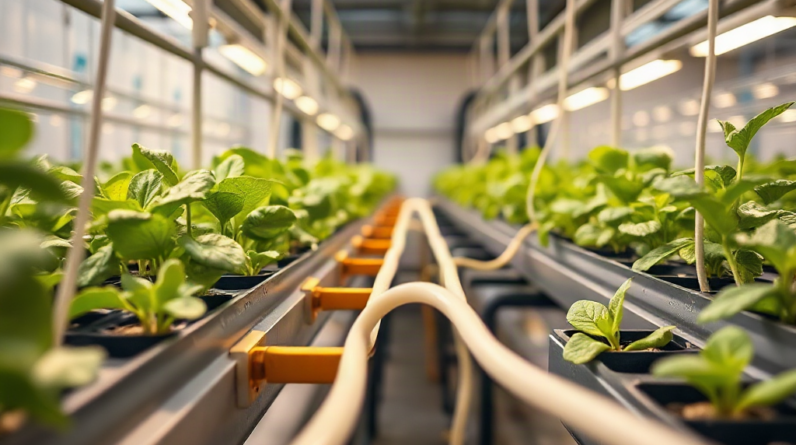
Drip irrigation into coco coir, perlite, or a blend of the two is the most forgiving arrangement for large fruiting plants. Each plant can occupy its own container, and nutrient solution reaches the root zone through one or more emitters. Containers isolate roots better than a shared channel, simplify plant replacement, and provide a moisture buffer if a pump cycle is delayed. Drain-to-waste designs are straightforward but consume more water and fertilizer. Recirculating drip systems conserve solution but require closer monitoring because root debris, pathogens, and nutrient imbalances can circulate through the entire installation.
Deep water culture can support a tomato or pepper plant if the reservoir is large and strongly aerated. Its weakness indoors is operational: a mature plant depends entirely on stable water temperature and continuous oxygen delivery. A failed air pump or warm, oxygen-poor solution can damage roots quickly. The plant and lid also become difficult to move after the canopy is tied to a trellis. This method is better suited to growers who can monitor equipment daily and maintain backup aeration.
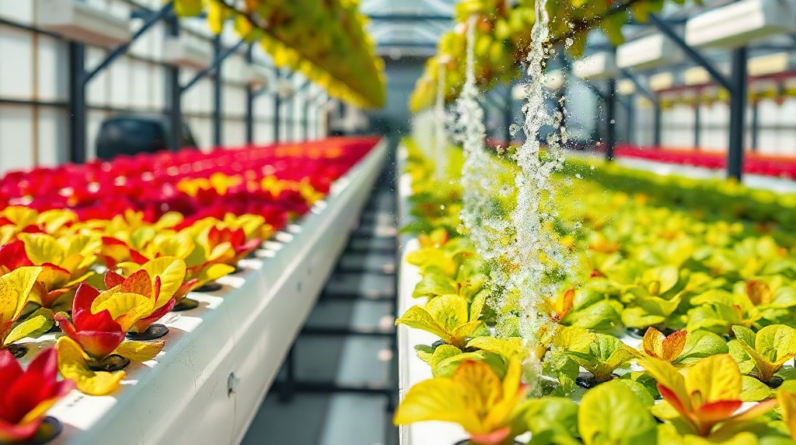
Nutrient film technique is usually a poor match for mature tomatoes, peppers, or cucumbers. Their roots can fill narrow channels, obstruct flow, and create uneven wetting farther down the run. Compact strawberry cultivars are a more practical candidate, provided the channels accommodate the root mass and maintain a shallow, uninterrupted flow. Towers save floor space for strawberries, but plants at different heights may receive unequal light, airflow, and irrigation.
A sensible crop-to-system match is:
- Tomatoes and cucumbers: drip-fed media containers with overhead trellising.
- Peppers and compact eggplants: individual drip containers or well-aerated deep water culture.
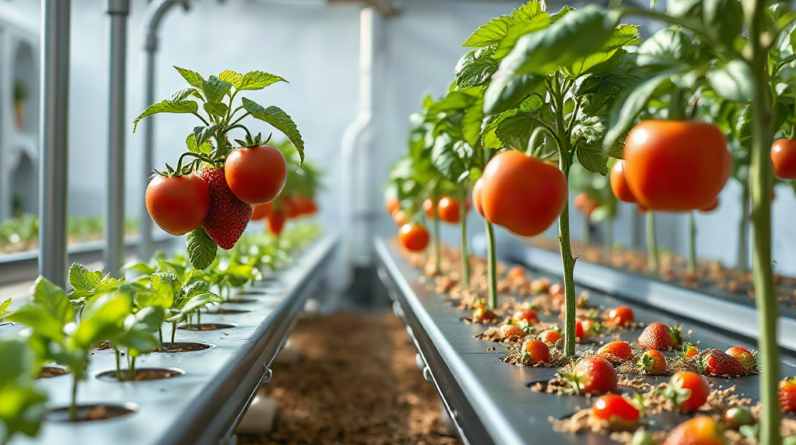
- Strawberries: drip-fed gutters, media pots, or channels designed for their roots.
For a mixed indoor garden, independent drip zones are easier to manage than placing every crop on one loop. The broader comparison of Hydroponic systems for fruiting crops indoors should begin with mature plant size, not seedling size. A layout that looks spacious during propagation can become inaccessible once vines, support strings, and fruit clusters occupy the room.
Build Enough Root Space and Irrigation Capacity
Root-zone design determines how resilient a fruiting crop will be when indoor conditions fluctuate. A small container can grow a large plant, but it leaves little margin for irrigation errors. As roots occupy the media, water storage declines and dry-back accelerates. A tomato that was adequately irrigated twice per day as a young plant may require several shorter events once it carries flowers and fruit.
Container volume should reflect crop duration, cultivar vigor, media water retention, and irrigation reliability. Coco coir holds more water than coarse perlite, while perlite supplies greater air space and drains rapidly. A blend can balance both properties. Containers must drain freely; standing solution displaces air from the root zone and encourages deterioration. Runoff should leave the growing area rather than pooling beneath foliage, where it raises humidity and complicates sanitation.
Emitter placement deserves equal attention. A single dripper may wet only one narrow path through a large container, especially after media settles or roots redirect the flow. Two emitters positioned apart improve distribution and provide limited redundancy if one clogs. Pressure-compensating emitters are useful where several containers share a line because they reduce the difference between plants near the pump and those at the end of the run. Filters and accessible flush points make maintenance easier.
Consider a four-plant tomato setup in coco. Early growth may show uniform leaves even if one emitter delivers less water, because the media remains moist for long periods. During fruit filling, the affected plant may wilt before its neighbors, develop dry leaf margins, or show inconsistent nutrient concentration in runoff. Increasing fertilizer strength would not correct the underlying delivery problem. The appropriate checks are emitter output, root-zone moisture, drainage, line pressure, and irrigation timing.
A compact pre-plant checklist prevents many expensive corrections:
- Run the complete irrigation circuit and collect output from each emitter for comparison.
- Confirm that every container drains without retaining a stagnant lower layer.
- Install reservoir aeration, filtration, and a way to inspect water level easily.
- Place pumps where they remain accessible after trellises and plants are installed.
- Test how the system responds to a blocked emitter or brief power interruption.
Constant saturation is not a substitute for reliable irrigation. Media-grown roots generally need both moisture and air, so irrigation frequency should respond to plant demand rather than a fixed schedule copied from another room. Healthy new roots, steady midday leaf posture, and reasonably consistent drainage indicate that delivery is close to demand. Repeated wilting, sour odors, brown roots, or large differences among containers signal that the root zone needs inspection.
Provide Light, Climate Control, and Pollination
Indoor fruit production is usually limited by light and heat removal before it is limited by floor area. Fruiting plants must build enough photosynthetic capacity to maintain leaves, roots, flowers, and developing produce at the same time. A bright-looking room can still deliver inadequate plant-level light, especially beneath the upper canopy or at the edges of a fixture.
Fixture selection should account for the illuminated footprint, hanging distance, dimming capability, and heat added to the room. Uniform coverage is more useful than an intense hot spot surrounded by weak edges. Tomatoes and cucumbers also need canopy management so lower leaves are not buried in shade. Training one or two main stems vertically makes the growing area easier to light and ventilate. Compact or determinate cultivars are often more practical where ceiling height is limited.
Lighting and climate cannot be separated. Stronger fixtures increase crop demand for water while adding heat that must be removed. Warm air with poor circulation can leave dense foliage humid even when the room itself seems acceptable. That combination interferes with pollen release, encourages condensation, and slows leaf drying. Oscillating air movement should gently move leaves without blasting flowers or rapidly drying one side of a container. An exhaust system, dehumidifier, or air conditioner may be needed depending on room size and local climate.
Pollination is another indoor constraint. Tomato flowers are self-fertile but benefit from vibration, which can be supplied by gently tapping support strings or using a small pollination tool. Peppers may set fruit with normal air movement, though light flower agitation can improve pollen transfer. Cucumbers differ by cultivar: some produce fruit without pollination, while others form male and female flowers and need pollen moved between them. Strawberries can benefit from gentle air movement or hand pollination to distribute pollen across the flower, reducing misshapen fruit.
Flower drop should not automatically be blamed on nutrient strength. Excess heat, cold nights, stagnant humid air, weak light, water stress, and ineffective pollination can all interrupt fruit set. Diagnosis should follow the plant’s sequence: determine whether healthy flowers formed, whether pollen was released or transferred, and whether tiny fruit began enlarging before it stopped. That process separates a pollination failure from a later water or nutrient problem.
Support hardware should be installed before plants need it. Trellis anchors must carry wet foliage and a mature fruit load, not merely an empty string. Tomato clips, cucumber strings, and pepper stakes should keep stems upright without constricting them. Readers comparing Hydroponic systems for fruiting crops indoors should treat ceiling clearance, electrical load, ventilation, and anchor strength as system requirements rather than accessories.
Manage Nutrition Through Flowering and Harvest
Nutrient management for fruiting crops depends on measurement, observation, and gradual adjustment. Electrical conductivity indicates the total concentration of dissolved ions but does not reveal whether individual nutrients are balanced. pH influences nutrient availability, yet repeatedly forcing it to an exact number can create larger swings than allowing a controlled range. A complete fertilizer formulated for hydroponic fruiting crops is safer than assembling a recipe from unrelated products.
Young plants generally use less solution than a flowering canopy. As light exposure, leaf area, and fruit load increase, plants remove water and nutrients at changing rates. If the reservoir level falls while conductivity rises, plants may be taking up proportionally more water than fertilizer. Adding stronger concentrate would intensify the imbalance. If conductivity falls rapidly, nutrient consumption or dilution may be outpacing replenishment. Interpret both measurements alongside reservoir level, water temperature, recent irrigation, and plant appearance.
Reservoir corrections should be incremental. Large additions of acid, base, or concentrated fertilizer can expose roots to extreme conditions before the solution mixes fully. Pre-dilute adjustments, circulate the reservoir, and measure again. Keep a simple log of pH, conductivity, water added, nutrient added, and visible crop changes. The value of the log is not paperwork; it reveals whether drift is gradual, tied to a growth stage, or caused by a recurring equipment problem.
Calcium-related fruit disorders illustrate why visual symptoms can mislead. A plant may have calcium in the solution yet fail to deliver enough to rapidly developing tissue when irrigation is irregular, salinity is excessive, roots are damaged, or transpiration is disrupted. Increasing one nutrient without checking root conditions and water movement may worsen the overall concentration. Tomatoes and peppers showing damaged blossom ends should prompt inspection of moisture consistency, root health, reservoir concentration, and environmental swings before fertilizer is changed.
Recirculating reservoirs need periodic replacement because topping up restores volume without necessarily restoring the original nutrient balance. Plants remove some ions faster than others, while source-water minerals and correction products accumulate. Drain-to-waste systems avoid that particular reservoir drift but require responsible collection and disposal of runoff. Neither approach is maintenance-free; one emphasizes solution analysis and sanitation, while the other emphasizes irrigation efficiency and waste control.
Signs of a stable program include consistent new growth, flowers that remain attached, gradual fruit enlargement, pale healthy roots, and similar performance among plants of the same cultivar. Sudden leaf-edge burn across the room, persistent pH movement, cloudy solution, algae, or widening differences between plants require investigation. Check meters against their calibration solutions, inspect the reservoir and emitters, and review environmental changes before reformulating nutrients. A disciplined approach to Hydroponic systems for fruiting crops indoors treats measurements as diagnostic evidence rather than targets to chase in isolation.
Frequently Asked Questions
Which hydroponic system is easiest for indoor tomatoes?
Drip irrigation into individual coco coir or coco-perlite containers is usually the most manageable option. It provides root support, accommodates trellising, and offers more protection from short irrigation interruptions than narrow channels.
Can tomatoes, peppers, and strawberries share one reservoir?
They can, but shared nutrition and irrigation timing may become a compromise as the plants mature. Separate zones or reservoirs provide better control when crops differ greatly in root volume, water use, or growth stage.
Do indoor fruiting plants need hand pollination?
Some do. Tomato flowers benefit from vibration, strawberries may need pollen distributed across each flower, and cucumber requirements depend on the cultivar. Peppers often set fruit with airflow but can benefit from gentle agitation.
Why are flowers falling off hydroponic plants?
Common causes include heat, cold, weak light, high humidity, water stress, and poor pollination. Check the room environment and root-zone consistency before assuming that the fertilizer lacks a particular nutrient.
Is nutrient film technique suitable for fruiting crops?
It can suit compact strawberries in appropriately sized channels, but mature tomatoes, peppers, and cucumbers often produce roots that restrict flow. Drip-fed containers give larger plants more root space and easier access for maintenance.
Conclusion
Successful indoor fruit production begins with choosing equipment for the plant at maturity. Drip-fed media containers provide the broadest operating margin for tomatoes, peppers, cucumbers, and compact eggplants, while strawberries can also fit purpose-built gutters or channels. After choosing the method, prioritize uniform irrigation, accessible drainage, adequate root volume, strong but even lighting, and dependable climate control.
Install trellises and ventilation before the canopy closes, then test every emitter under normal operating pressure. During flowering, verify pollination and environmental stability before changing the nutrient formula. Record reservoir behavior and crop responses so adjustments follow evidence rather than isolated symptoms. Starting with one crop and a small number of plants makes it easier to establish reliable irrigation and climate patterns before expanding the indoor system.