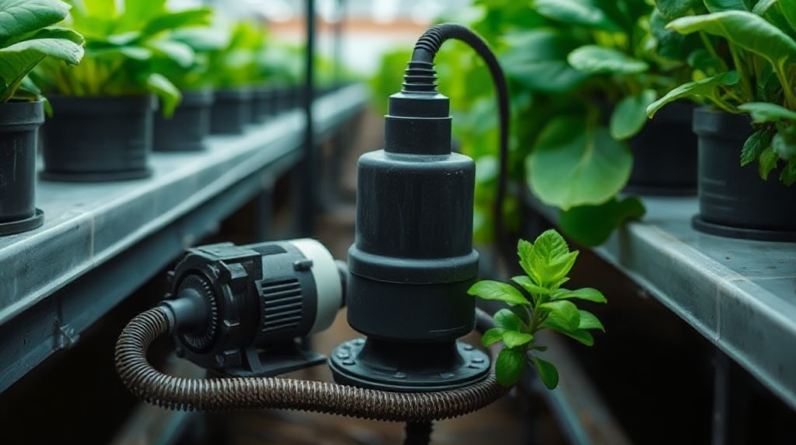
A hydroponic reservoir needs a second pump when one pump cannot provide dependable circulation, delivery, or backup coverage for the system’s layout and crop load. Typical pressure points include long return lines, multiple grow channels, elevation changes, clogged filters, uneven outlet flow, and a pump that must serve both irrigation and mixing. Test flow at the farthest outlet, observe reservoir turnover, and check whether plants receive water without excessive throttling. A second pump may be useful as a dedicated circulation pump, an independent feed pump, or an emergency spare, but it will not correct undersized plumbing, poor pipe routing, or blocked emitters.
Signs One Pump Is No Longer Enough
A second pump becomes worth considering when the existing pump cannot meet every hydraulic job at the same time. In a small deep-water culture container, one appropriately sized pump may circulate nutrient solution adequately. A larger recirculating system with several channels, separate feed zones, or a reservoir below the crop area creates different demands: the pump must overcome lift, pipe friction, fittings, filters, and outlet restrictions while still delivering useful flow.
Uneven plant delivery is a more useful warning than pump wattage. The nearest channel may receive a strong stream while the farthest channel trickles. Some outlets may stop briefly when the water level falls, even though the pump remains switched on. A reservoir can also show a quiet surface, settled debris, or a temperature difference between the pump side and the return side. Those observations suggest weak circulation, but they do not automatically prove that another pump is needed.
Compare the system’s symptoms with the likely cause before buying equipment. A clogged intake screen calls for cleaning. A kinked hose calls for rerouting. An air leak on the suction side may cause noisy operation and intermittent flow. An oversized return line or poorly balanced manifold may distribute water unevenly even when the pump has adequate capacity. Adding a second pump to a blocked line can increase noise, power use, and overflow risk without improving delivery.
Plant symptoms can provide supporting evidence. Wilting in only the farthest sites, dry media in a high channel, or roots receiving intermittent rather than steady solution points toward distribution trouble. Algae, biofilm, and debris can narrow small tubing over time. Check these physical causes first, then assess whether the remaining requirement is a separate hydraulic circuit or simply better maintenance. The internal reference When a hydroponic reservoir needs a second pump should be treated as a system-sizing question, not an automatic equipment upgrade.
Matching Pump Roles to System Demands
The most reliable reason for adding a second pump is to give each pump a clearly defined role. One unit can feed grow sites while another keeps the reservoir mixed. This arrangement prevents irrigation scheduling from controlling circulation and allows the circulation pump to run when feed cycles are paused. It is especially practical when nutrient solution must remain moving around a large tank or when the feed pump is mounted near an outlet that does not sweep the full reservoir.
A second arrangement uses independent zones. A lower group of channels may be served by one pump and an elevated or distant group by another. Separate circuits reduce the need to force one pump through excessive lift and narrow tubing. They also make balancing easier because each zone can have its own valve, timer, and inspection point. The tradeoff is added plumbing and another electrical device that must be protected from moisture and checked during maintenance.
Redundancy is a third role. A spare pump can remain disconnected but ready for a failure, or two pumps can share the load with each capable of keeping a reduced system operating. Continuous parallel operation is not automatically safer: if both pumps discharge into a shared line, a failed check valve or pressure difference may send water backward through the idle pump. A backup plan works only when the plumbing, electrical protection, and restart procedure have been tested.
Consider a four-channel setup with a reservoir on the floor and crop channels on a rack. If the pump feeds every channel through a long manifold, the upper outlets may receive less water because static lift and friction consume available head. Splitting the system into two shorter circuits may outperform installing a much stronger single pump. Conversely, a small pump dedicated to circulation may be preferable if delivery is already even but the reservoir develops settled solids. Selecting by wattage alone ignores head height and actual flow at the outlet.
How to Test Flow Before Adding Equipment
Measure delivered flow at the operating height rather than relying on the pump’s free-flow rating. Manufacturers often list a maximum flow measured with little or no lift, while a hydroponic installation includes vertical rise, elbows, tees, tubing, valves, and emitters. Place the system in its normal configuration, fill it to the usual working level, and collect water from the most distant outlet for a timed interval. Repeat the test at a nearby outlet and compare the results.
Inspect the reservoir during the same test. A circulation pump should create movement across the tank rather than a narrow whirlpool directly above its intake. A feed pump should deliver consistently without sucking air as the water level changes. Watch for pulsing, rattling, bubbles in the discharge, and a stream that weakens after several minutes. Those signs may indicate a restricted intake, a suction leak, an overheated pump, or an unsuitable installation height.
A short diagnostic sequence helps separate plumbing defects from capacity limits:
- Clean the intake screen, filter, and outlets, then repeat the timed flow test.
- Measure vertical lift from the water surface to the highest discharge point.
- Check tubing for bends, collapsed sections, mineral deposits, and undersized connectors.
- Open each zone separately to see whether the pump performs well when demand is reduced.
- Observe the lowest reservoir level used during normal operation, not only a freshly filled tank.
If the farthest outlet remains weak after cleaning and rerouting, a second pump or a divided circuit may be justified. If every outlet performs well separately but poorly together, the limitation is probably shared capacity or distribution design. If flow is strong but roots or debris settle in a remote section, a circulation circuit may solve the problem better than increasing feed pressure. Keep a simple record of outlet flow and reservoir level; repeatability matters more than a single impressive stream.
Second-Pump Placement, Plumbing, And Failure Risks
Placement determines whether an additional pump improves the system or introduces a new weak point. A circulation pump should sit where it can move solution through the reservoir volume without drawing settled material directly into its impeller. Its outlet may be aimed along the tank wall to create a broad sweep, provided the motion does not whip air into the intake. A feed pump belongs near the supply outlet, with an accessible screen and enough water around it at the lowest operating level.
Use separate suction and discharge paths when the pumps perform different jobs. A circulation pump connected to the main feed manifold can compete with the delivery pump and change outlet balance whenever either unit starts or stops. Independent lines make troubleshooting clearer. If pumps share a discharge, install suitable check valves only where backflow would otherwise occur, and confirm that the valve opens at the available pressure. A check valve that sticks can reduce flow as effectively as a clogged fitting.
Electrical safety deserves equal attention. Keep connections above possible spill height, use appropriate ground-fault protection where required, and provide drip loops on cords. Do not place a backup pump in the reservoir merely because it is available; confirm that its materials, seals, and operating instructions suit continuous water exposure. A spare that has sat dry for months may have a stuck impeller when it is needed.
More pumping also means more heat, vibration, and energy use. Submersible motors transfer some heat to the solution, which may matter in a warm indoor space. Stronger turbulence can disturb seedlings, dislodge media, or expose an intake to roots. A useful comparison is a moderate circulation pump plus a correctly sized feed pump versus two high-output pumps on one restricted manifold. The first arrangement usually offers more control; the second can create noise, fluctuating flow, and overflow if outlets cannot pass the combined volume.
A Practical Decision Checklist
Decide on the second pump only after identifying the job it must perform. “More movement” is too vague to guide selection. Write down whether the need is even delivery, reservoir mixing, a separate elevation zone, or protection against a single pump failure. Each purpose leads to different plumbing, controls, and performance checks.
A sensible order of operations is to inspect, measure, redesign, and then add capacity. Clean the pump and outlets, verify the water level, remove sharp bends, and test each zone. If the system is still constrained, calculate the required lift and choose a pump whose published performance remains suitable at that height. Avoid selecting a model by its maximum gallons-per-hour figure alone.
Before installation, confirm four practical details: the reservoir can hold the combined return volume, the outlets cannot be accidentally closed while pumps run, the electrical circuit is protected, and each pump can be isolated for cleaning. Label valves and cords so a future maintenance session does not become a guessing exercise. Run the redesigned system while watching the highest outlet, lowest water level, and overflow path.
Signs the change is working include stable flow at distant sites, consistent return volume, fewer air-suction events, and visible movement throughout the tank without violent splashing. Signs it is failing include a stronger near outlet but no improvement at the farthest one, repeated dry-running, warmer solution, or a return rate that exceeds the reservoir’s safe capacity. If those problems appear, stop the pump, check restrictions and valve settings, and reconsider the circuit layout rather than immediately adding another unit. A well-balanced single-pump system is preferable to a poorly controlled two-pump system.
For broader information on water movement, plant production, and system management, consult university Cooperative Extension publications and agricultural resources from the USDA National Agricultural Library. These sources can help place pump decisions alongside sanitation, crop requirements, and reservoir management rather than treating equipment capacity in isolation.
Frequently Asked Questions
Can a second pump replace a larger pump?
Sometimes. Two pumps can serve separate zones or separate circulation and delivery duties, but they do not automatically provide the same result as one pump correctly sized for the required head and flow.
Should the second pump run continuously?
A circulation pump may run continuously if its temperature, noise, and flow are suitable. A zone or feed pump should follow the crop system’s irrigation requirements and must not drain the reservoir below its safe intake level.
How can I tell whether low flow comes from the pump or the plumbing?
Clean the intake and outlets, then test each zone separately at normal lift. Strong isolated flow but weak combined flow points toward shared plumbing capacity or poor balancing rather than a failed pump.
Does a second pump improve oxygen in the solution?
Extra movement may improve mixing and expose more water to the air, but it is not the same as deliberate aeration. Avoid splashing that entrains air at the intake, and assess temperature and root-zone conditions separately.
Where should a backup pump be stored?
Keep a compatible, clean pump dry and accessible, with its cord and fittings labeled. Test it periodically in water so an impeller problem or electrical fault is found before a crop depends on it.
Further Reading
Authoritative Sources
- Academy of Nutrition and Dietetics
eatright.orgProfessional nutrition guidance, healthy eating resources, and practical dietitian-reviewed advice.
- U.S. Department of Agriculture
usda.govOfficial food, nutrition, agriculture, and consumer guidance from the USDA.
- NIH Office of Dietary Supplements
ods.od.nih.govResearch-based fact sheets on nutrients, supplements, dietary intake, and safety considerations.
- International Society of Sports Nutrition
sportsnutritionsociety.orgEvidence-informed sports nutrition resources and position stands for active people and athletes.
Conclusion
A second pump earns its place when it solves a defined hydraulic problem: uneven delivery across distance or elevation, insufficient reservoir circulation, independent zone control, or tested backup coverage. Flow measurements at normal water level reveal more than a pump’s advertised maximum output. Clean restrictions and correct pipe routing before increasing capacity, then separate circulation from irrigation when the system’s demands conflict. Check overflow volume, electrical protection, intake depth, and restart behavior before leaving the redesigned setup unattended. If distant outlets remain weak, divide the circuits or choose equipment based on flow at operating head. If the reservoir already moves evenly, another pump may add heat, noise, and maintenance without a useful result.