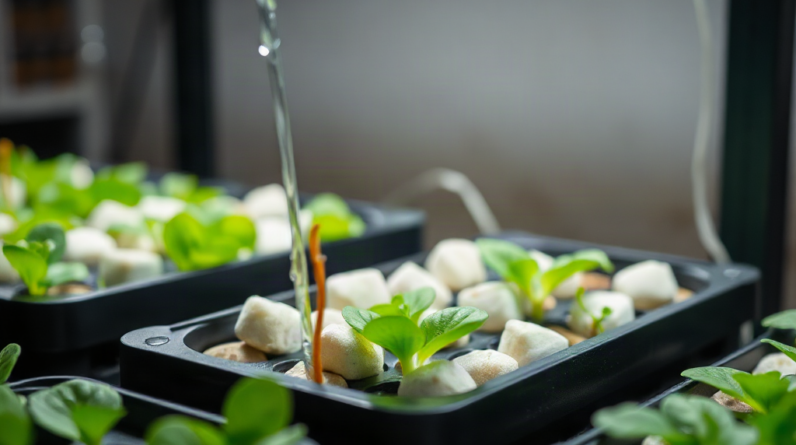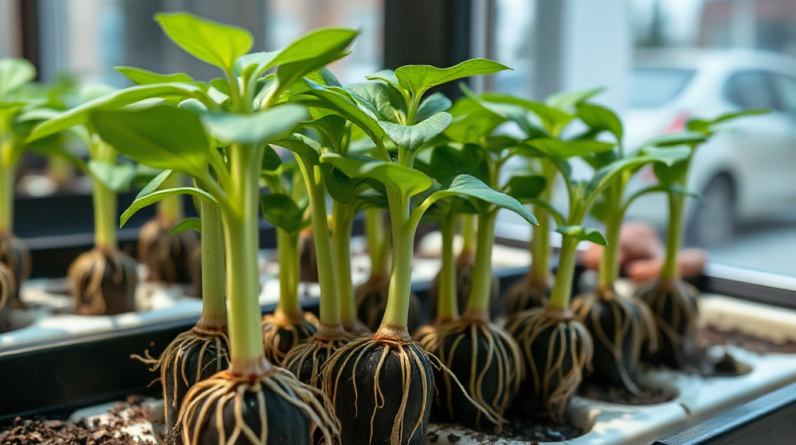
Transplanted hydroponic seedlings wilt because their roots lose reliable access to water and oxygen while adjusting to a new container, nutrient solution, light level, or airflow pattern. Root damage, dry starter media, excessive solution depth, low humidity, and sudden bright light can all increase water loss faster than the roots can replace it. Inspect the roots first, then confirm that the growing medium is evenly moist, the crown is not buried, and the new site provides gentle light with stable humidity. Avoid immediately increasing fertilizer strength; stressed roots absorb nutrients poorly, and a stronger solution can worsen dehydration through salt stress. Recovery usually depends on restoring steady moisture and oxygen rather than adding more nutrients.
What Changes During a Hydroponic Transplant
Transplanting interrupts the small root environment that supported the seedling before the move. A young plant may have been surrounded by consistently damp starter media, then placed into a net pot, coco plug, rockwool cube, or another medium with different moisture movement. Even when the new container looks wet, the root surface may not be making close contact with that moisture.
Wilting occurs when leaves lose water faster than the roots can deliver it. Moving a seedling often causes minor root tearing, compression, or exposure to air. Those disruptions temporarily reduce the root system’s ability to conduct water. The plant may droop within hours even though the leaves themselves are not diseased.
Age and root development influence how severe the response becomes. A seedling with several white roots extending through its plug usually tolerates a move better than one with only a short primary root. A plant transferred before its root ball holds together can lose more fine roots, while a root-bound plug may be difficult to position without bending or crushing roots.
Do not treat every wilted transplant as a nutrient deficiency. Pale leaves developing over several days may justify checking nutrient concentration and pH, but sudden drooping immediately after relocation points first toward water delivery, root disturbance, or environmental demand. The related topic Why transplanted hydroponic seedlings wilt is best assessed by timing: symptoms that begin right after the move deserve a different response from symptoms that appear after a week of stable growth.
A common mistake is to compensate with concentrated fertilizer. Nutrients do not repair torn roots, and a high solution concentration can make water uptake harder. Stabilizing the root zone should come before fine-tuning the feeding program.
Root, Water, and Oxygen Problems to Check
Root contact with a balanced supply of moisture and oxygen is the first practical checkpoint. A plug can be saturated on the outside while its inner root zone remains unevenly hydrated, especially if it has dried before transplanting. The opposite problem occurs when the lower part of the medium stays submerged and excludes air from roots that are not adapted to constant immersion.
Inspect the seedling without pulling aggressively. Healthy new roots are generally firm and light colored, although the exact appearance varies by plant and medium. Brown, soft, slimy, or foul-smelling roots suggest tissue breakdown rather than ordinary transplant shock. A bent stem at the plug line, a buried crown, or roots trapped above the nutrient solution can also interrupt water movement.
System design changes the diagnosis. In a deep-water culture setup, the solution level may be too low for a small root mass to reach, or too high for adequate air space around the net pot. In a drip system, a clogged emitter can leave one transplant dry while neighboring plants look normal. In a wick setup, a coarse medium may not draw water quickly enough after the move. A seedling transferred from a constantly moist plug into a rapidly draining medium can wilt even when the reservoir is full.
Check these points in sequence:
- Confirm that the starter plug is damp throughout, not merely wet at one edge.
- Make sure the crown and stem base remain above the wettest part of the medium.
- Verify that roots can reach moisture without being packed tightly or left exposed.
- Check actual delivery from each dripper, wick, or circulation path rather than assuming the system is working.
- Look for stagnant, warm, or foul-smelling solution that may indicate poor oxygenation or root damage.
More water is not always the answer. A drooping plant in dry media needs rehydration, but a drooping plant in saturated, airless media needs improved oxygen access and drainage. Comparing the plug’s moisture and root condition with an unaffected seedling is often more informative than changing several variables at once.
Use Why transplanted hydroponic seedlings wilt as a troubleshooting reference, but make the physical inspection your decision point. If the roots are sound and the plant firms up during a cooler, lower-light period, environmental demand is more likely than a failing root system.
Light, Humidity, Temperature, and Airflow Stress
A transplant can wilt even when the root zone is correctly prepared because the leaves suddenly face a higher water-loss demand. Bright grow lights, warm air, and strong fan movement increase transpiration. A seedling that was protected by a humid propagation dome may lose water rapidly when placed under full-intensity lighting with open ventilation.
The timing of the symptom provides a useful clue. Drooping that appears soon after lights turn on or after a fan is redirected toward the plant suggests that leaves are losing water faster than the recovering roots can supply it. Wilting that persists through the dark period, especially with deteriorating roots, points more strongly toward a root-zone problem.
Reduce demand without creating a stagnant enclosure. Temporarily raising the light or reducing intensity can give roots time to reconnect, while gentle air movement helps prevent still, excessively humid pockets. Sudden changes are less useful than a stable intermediate environment. For example, moving a seedling from a covered propagation tray directly beneath a powerful LED fixture is harsher than gradually increasing exposure over several days.
Temperature matters because warm air and warm nutrient solution can increase stress together. A cooler root zone may hold more dissolved oxygen, but extreme cooling can also slow root activity. Avoid chasing an exact number without considering the plant’s normal range, the room temperature, and whether the solution is being aerated.
Humidity adjustments carry tradeoffs. Higher humidity can reduce immediate leaf water loss, but prolonged very high humidity with poor air movement may encourage weak growth and disease problems. A clear recovery sign is improved leaf posture during the same light cycle without constantly wetting the foliage. A failing approach produces brief improvement followed by renewed collapse whenever the light or fan returns to its previous setting.
Seedlings that are already stressed should not be pruned heavily or exposed to multiple environmental changes. Remove only tissue that is clearly dead, maintain gentle circulation, and allow the plant to show whether it can rehydrate. The transplant wilting checklist should prioritize water access and root oxygen before climate fine-tuning.
A Practical Recovery Sequence
Recovery is more reliable when the grower changes one major pressure at a time. First, examine the plug, roots, crown, and delivery equipment. Then restore even moisture and airflow around the roots. A seedling that is slightly dry may respond after the medium is rehydrated, while one sitting in saturated material may need a better air gap or less frequent delivery.
Next, reduce leaf demand for a short period. Use gentler light, avoid direct fan blast, and keep the surrounding environment reasonably stable. Do not seal the plant in an airtight container. The aim is to narrow the gap between water loss and root uptake, not to eliminate air exchange.
Keep the nutrient solution moderate and consistent. If the transplant was moved into a stronger solution than the starter plant had been receiving, dilution may be more sensible than adding supplements. A handheld meter can reveal pH or conductivity changes, but readings cannot replace inspection of the roots and medium. Instruments show the solution condition; they do not prove that roots can access it.
After correcting the likely cause, observe the plant through one or two light periods. Leaves that gradually regain firmness, new growth that remains upright, and roots that stay firm indicate progress. Continued collapse, transparent stems, sour odors, or spreading root discoloration indicate that the issue is not simple shock.
Keep a brief record of what changed: transplant time, medium moisture, light adjustment, solution condition, and symptom timing. This prevents repeated overcorrection. A common failure mode is alternating between flooding, drying, fertilizer increases, and harsh light changes before any single correction can be evaluated.
Choose patience over aggressive intervention when the stem remains firm and the roots look healthy. Choose removal or replacement when the crown is collapsing and the roots are decomposing, because a severely damaged seedling may consume space and spread contaminated solution in a shared reservoir.
When Wilting Signals Disease or Irreversible Damage
Transplant shock should begin to stabilize after the root environment and climate are corrected. Persistent or worsening wilt deserves a closer disease and sanitation check. Soft roots, a darkened stem base, slimy residue, or an unpleasant smell are not normal signs of simple relocation stress.
Shared reservoirs make diagnosis more urgent. If several seedlings wilt together, inspect common factors such as solution temperature, aeration, water level, pump operation, and recent nutrient changes. If only one plant declines, localized root injury, a blocked emitter, poor plug contact, or a damaged stem is more likely. This comparison is more useful than assuming every plant has the same deficiency.
Do not return a visibly rotting transplant to a clean propagation area. Isolate it when practical, remove compromised material with clean tools, and avoid transferring wet debris between containers. Chemical treatments should not be added casually to a food-growing reservoir; product labels, crop suitability, and system instructions matter, and some treatments can damage roots or disrupt beneficial biology.
Weak seedlings may recover slowly even after the cause is fixed. New leaves are a better indicator than the oldest damaged leaves, which may remain limp or discolored. If the growing tip stays firm and new roots appear, maintaining stable conditions is usually more useful than trying several rescue products. If the growing point collapses, the stem pinches easily, or root decay advances, replacing the seedling may be the lower-risk choice.
For broader plant-care context, seedling transplant troubleshooting can help compare symptoms, but each system still requires a direct check of delivery, oxygen, and root condition. The practical goal is not to force a damaged plant upright; it is to determine whether the root system can resume supplying water.
University cooperative extension publications and USDA plant-science resources can provide additional background on seedling establishment, root-zone moisture, and plant stress. Use those sources alongside the specific instructions for the crop, growing medium, lighting system, and nutrient products in use.
Frequently Asked Questions
How soon can a transplanted hydroponic seedling recover?
A mildly stressed seedling may improve within the next light cycle after moisture, oxygen, and light demand are corrected. Severe root injury can take much longer or may not be reversible.
Should I increase nutrients when the seedling wilts?
Usually not as a first response. Wilting after relocation is more often linked to root access, oxygen, or environmental demand, and concentrated nutrients may worsen water stress.
Can a wet net pot still leave a seedling dehydrated?
Yes. Moisture may not contact the roots evenly, or the root mass may be too high or too damaged to absorb it. Check the plug interior, root position, and delivery path.
What does root rot look like after transplanting?
Roots may become soft, slimy, dark, and foul smelling, while the stem base can turn weak or discolored. Those signs call for isolation and investigation rather than simply adding water.
Should wilted seedlings stay under grow lights?
Keep them in light, but temporarily reduce intensity or increase distance if leaf water loss is outpacing root recovery. Avoid harsh light combined with direct fan airflow immediately after transplanting.
Further Reading
Authoritative Sources
- Academy of Nutrition and Dietetics
eatright.orgProfessional nutrition guidance, healthy eating resources, and practical dietitian-reviewed advice.
- U.S. Department of Agriculture
usda.govOfficial food, nutrition, agriculture, and consumer guidance from the USDA.
- NIH Office of Dietary Supplements
ods.od.nih.govResearch-based fact sheets on nutrients, supplements, dietary intake, and safety considerations.
- International Society of Sports Nutrition
sportsnutritionsociety.orgEvidence-informed sports nutrition resources and position stands for active people and athletes.
Conclusion
Wilt after transplanting is a symptom of a supply-demand mismatch: recovering roots cannot deliver enough water for the conditions imposed on the leaves. Inspect the roots and plug before changing nutrients, then verify moisture contact, oxygen availability, solution delivery, and the position of the crown. Reduce excessive light, heat, and direct airflow while the plant re-establishes itself, but do not create a sealed, stagnant environment. Healthy roots and a firm growing point justify a stable recovery period; soft roots, a collapsing stem, or spreading symptoms justify isolation and possible replacement. The most useful next step is a controlled check of one variable at a time, followed by observation through the next light cycle.
Related Content
- Supporting Hydroponic Peppers Without Stem Damage: Tie Points, Clips, and Growth Checks
- 10 Best Hydroponic Seeds to Grow in 2025: Effective Tips & Strategies
- Hydroponic Plant Nutrient Mix: Essential Components for Optimal Growth
- The Ultimate Guide to the Best Hydroponic Nutrient Solution Strategies for 2025
- Hydroponics Growing System: 11Pods Indoor Garden Germination Kit Review