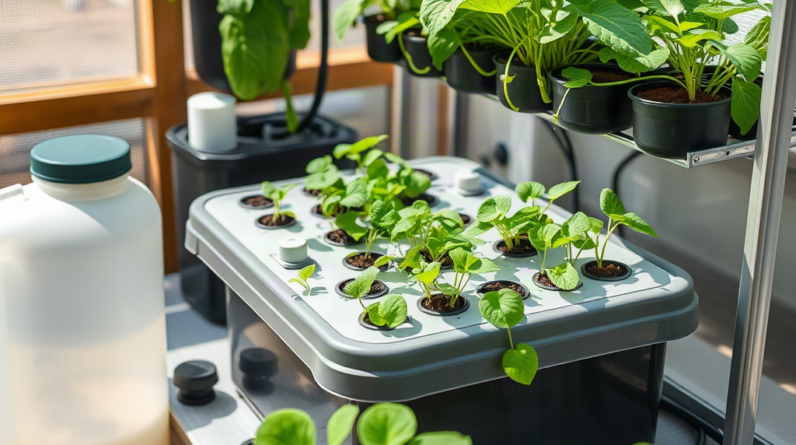
Hydroponic system backup plans during power outages should preserve root-zone oxygen first, maintain essential water circulation second, and restore normal operation without shocking the plants. Size a battery, uninterruptible power supply, or generator from measured pump wattage and required runtime rather than the equipment’s advertised maximum capacity. Deep-water culture usually needs continuous emergency aeration, while drip and nutrient-film systems need enough pumping to prevent roots from drying. Keep battery air pumps, clean water, extension cords, and restart instructions ready, then inspect solution temperature, roots, emitters, and pump priming after power returns. Test the complete backup under load before relying on it.
Identify What Must Keep Running
A useful outage plan separates life-support equipment from devices that can remain off temporarily. Air pumps, circulation pumps, irrigation pumps, and control valves may directly affect whether roots remain oxygenated and moist. Grow lights, fans, heaters, chillers, dosing equipment, and monitoring displays can matter too, but they do not all deserve equal access to limited backup capacity.
The priority depends on how the roots are supported. Deep-water culture places roots in nutrient solution, so dissolved oxygen can decline when aeration stops. Warm solution and a dense root mass make that loss more consequential. A nutrient film technique channel presents a different problem: once the pump stops, the shallow film disappears and exposed roots can begin drying. Drip systems may retain moisture in coco coir or another medium, giving the grower more response time than bare-root channels, although small containers and mature plants can use that reserve quickly.
Create an equipment inventory from the actual installation rather than from memory. Record the running wattage, starting demand where applicable, plug location, function, and consequence of failure for every electrical device. A clamp meter or plug-in power meter can provide a more realistic figure than adding nameplate ratings alone. Pumps may draw extra power when starting, while heating and cooling equipment can overwhelm a modest battery even if their normal operating load appears manageable.
Use three operating tiers to allocate power:
- Immediate: aeration or irrigation required to keep roots oxygenated and wet.
- Conditional: circulation, ventilation, heating, or cooling needed because temperature or humidity is moving outside a safe range.
- Deferrable: grow lights, automated dosing, displays, and convenience equipment that can wait during a short interruption.
Running the entire grow room from a small uninterruptible power supply is a common failure mode. Lights can consume the battery while the air pump receives little useful runtime. A better design places critical pumps on a dedicated backup circuit and labels each plug. The inventory behind effective Hydroponic system backup plans during power outages should also identify non-electrical alternatives, such as manually wetting roots or using battery-powered air pumps. That combination prevents a single undersized power source from becoming the only line of defense.
Calculate Backup Power and Runtime
Backup capacity should be based on energy use over time, not merely on a device’s watt rating. Multiply the measured running watts of the selected equipment by the desired operating hours to estimate watt-hours. A 20-watt air pump and a 30-watt water pump running together for six hours represent a theoretical demand of 300 watt-hours. The power source needs additional capacity because inverter losses, battery condition, temperature, and startup loads reduce usable runtime.
A UPS is convenient for short interruptions because it transfers power automatically, but computer-oriented models are not necessarily designed to operate pumps for many hours. Confirm the unit’s output waveform, continuous watt limit, battery capacity, and compatibility with the pump motor. Runtime claims measured with a light electronic load may not predict performance with an inductive pump. Test the actual combination and note the elapsed time at which the low-battery alarm appears.
A portable power station generally offers more energy and clearer watt-hour information. It can be practical for a small indoor garden, especially when it can be moved between aeration, irrigation, and communications needs. A generator is better suited to long outages or large installations, but it introduces fuel storage, maintenance, noise, exhaust, and safe connection requirements. Never operate a fuel-burning generator indoors, in an attached garage, or near openings where exhaust could enter an occupied building. A qualified electrician should install any transfer equipment used to supply building circuits.
Solar charging can extend runtime, but available output changes with weather, panel position, and daylight. It should not be treated as guaranteed overnight capacity. Likewise, a battery’s stated capacity is not a promise that every stored watt-hour will reach the load. Design around tested usable runtime and retain a reserve for slower-than-expected restoration.
Perform a controlled outage test after assembling the system. Disconnect utility power, verify automatic transfer if provided, and observe pump sound, airflow, flow rate, battery temperature, and projected runtime. A backup that turns on but produces weak aeration is not passing the test. Repeat the check periodically and after changing pumps or adding equipment. Batteries age even when rarely used, so a plan based on a test from several seasons ago may provide a misleading sense of protection.
Match the Backup Method to the System
Emergency support works best when it addresses the specific way each design fails. Deep-water culture and raft systems generally place aeration at the top of the priority list. A low-wattage battery air pump can be more efficient than powering the entire main air system through an inverter. Keep compatible tubing, check valves, splitters, and air stones together so the emergency pump can be connected without searching for parts in the dark.
For nutrient film technique, aeroponics, and similar exposed-root designs, preserving moisture is as urgent as preserving oxygen. A timer-based backup may cycle the pump instead of running it continuously, provided the off-period does not allow roots to dry and the pump reliably reprimes. High-pressure aeroponic equipment can have demanding startup loads and specialized pressure requirements, so a generic aquarium pump is not a functional substitute. Such installations may need a properly sized power station or generator plus a manual method for wetting roots if the primary backup fails.
Ebb-and-flow and media-based drip gardens often have a larger buffer. Moist coco coir, rockwool, or another water-retentive medium can sustain roots between irrigations, but the available interval changes with container size, plant maturity, airflow, and temperature. Inspect the medium instead of relying only on the normal irrigation schedule. Hand-watering with correctly mixed solution may be safer than energizing a large pump from a small battery, especially during a brief outage.
Passive measures can reduce demand across all designs. Insulating the reservoir slows temperature movement, covering channels limits evaporation and light exposure, and keeping emergency water available supports manual irrigation. Do not add ice, concentrated nutrients, or improvised chemicals to compensate for the outage. Rapid changes in solution temperature or concentration may create a second stress after power is restored.
A layered plan is more resilient than a single expensive device. One workable small-garden arrangement uses an automatic battery air pump for immediate response, a charged power station for the circulation pump, and manual watering instructions for a longer interruption. Larger gardens may justify a generator and transfer arrangement, but they still need a simple fallback for a failed pump or empty fuel supply. Document these layers in the same location as the Hydroponic system backup plans during power outages so another household member can act without knowing the normal system in detail.
Respond During the Outage and Recover Safely
The first response should confirm the scope of the failure and establish which critical devices are actually operating. Check the breaker or ground-fault device only if it is safe to do so, and avoid repeatedly resetting a circuit that trips again. A recurring trip may indicate water intrusion, a damaged cable, or faulty equipment. Keep wet hands away from plugs and do not place temporary connections where leaks or reservoir overflow can reach them.
Connect the lowest-energy life-support load first. Verify bubbles visually in deep-water culture and confirm flow at the far end of channels rather than assuming pump noise means circulation. If backup runtime is limited, turn off lighting and other discretionary loads. For media-based plants, assess moisture at root depth and hand-water only as needed; constant manual watering can saturate the medium and reduce root-zone air.
Longer interruptions require active observation. Watch for wilting, loss of flow, rising solution temperature, unusual root odor, battery alarms, and declining air output. Wilting in an NFT channel points toward inadequate root wetting, while roots submerged in stagnant, warming solution need aeration more than additional water. Record when power failed, when backup devices started, and when manual irrigation occurred. Those notes reduce duplicated actions when several people are sharing outage duties.
When utility power returns, restart equipment in a controlled sequence rather than switching every load on simultaneously. Confirm that air pumps and circulation are operating, then check irrigation lines, drain paths, and reservoir level. Pumps can lose prime, timers may reset, and emitters can retain debris disturbed during manual handling. Restore lighting according to the existing schedule instead of extending the light period to compensate for missed hours.
Inspect roots and solution over the following day. Check temperature, pH, electrical conductivity, odor, discoloration, and visible root condition, but avoid making large corrections based on one unusual reading. Top up with appropriately prepared water if volume was lost, and replace the solution when contamination, severe imbalance, or prolonged stagnation makes correction uncertain. The plan worked if roots stayed moist, aeration remained adequate, and equipment resumed stable operation. Weak flow, rapidly depleted batteries, lost pump prime, or unexplained plant stress should trigger a revision of capacity, connections, or response timing before the next outage.
Frequently Asked Questions
How long can a hydroponic system remain without power?
There is no single safe duration. Exposed roots in NFT or aeroponic systems may dry quickly, while moist media can provide a longer buffer. Temperature, plant size, root density, and system design determine urgency.
Should grow lights be connected to backup power?
Usually not during a short outage. Reserve limited battery capacity for aeration, irrigation, and temperature control. A temporary dark period is generally less urgent than dry or oxygen-deprived roots.
Can a computer UPS run a hydroponic pump?
It may, but compatibility and runtime must be tested with the actual pump. Check continuous output, startup demand, waveform, and battery capacity rather than relying on the UPS watt rating alone.
What is the simplest backup for deep-water culture?
A battery-powered air pump with ready-to-connect tubing and air stones is a practical first layer. Test its airflow in the reservoir and keep fresh batteries or a charged internal battery available.
What should be checked after electricity returns?
Confirm aeration, pump prime, channel flow, drainage, timer settings, reservoir level, solution temperature, pH, conductivity, and root condition. Restore loads gradually and investigate any tripped electrical protection.
Conclusion
An effective outage response begins with a measured load inventory and a clear ranking of what the roots need first. Give scarce battery capacity to aeration or irrigation, select UPS, power-station, or generator capacity from tested watt-hours, and retain a manual fallback that matches the growing method. Label connections, store adapters and tubing with the backup equipment, and write restart instructions that another person can follow.
Run a simulated outage before the garden depends on the plan. The test should confirm airflow or water delivery, realistic runtime, automatic transfer, and safe cable placement. After any real interruption, check pump priming, timers, solution condition, and roots before adjusting nutrients. Record weak points while they are fresh, then correct them through added capacity, lower emergency loads, or a more reliable secondary method.
Related Content
- Best Indoor Hydroponic System: Top Choices for Efficient Home Gardening
- Enhancing Root Structure in Hydroponic Plants Through Oxygen, Flow, and Root-Zone Control
- The Ultimate Guide to the Best Automated Hydroponic System in 2025
- How to Grow Microgreens Hydroponically for High Returns
- How Difficult is it to Build a Hydroponic Gardening System?