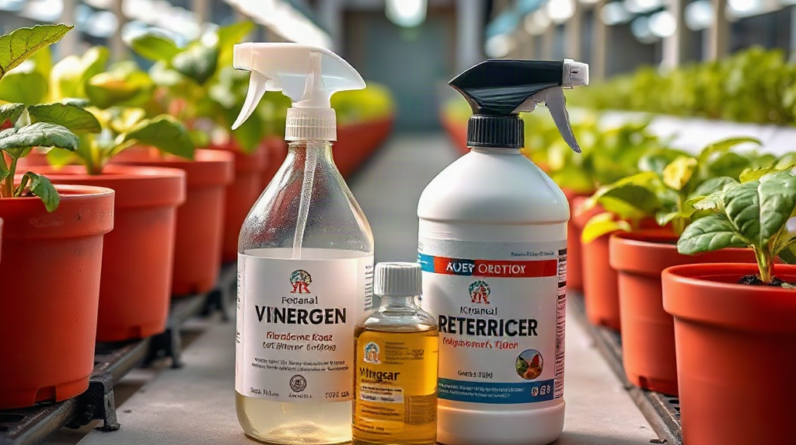
Safe cleaning products for hydroponic equipment include mild unscented detergent for routine soil removal, diluted white vinegar or citric acid for mineral deposits, and label-approved hydrogen peroxide or chlorine-based products when disinfection is necessary. Remove plants and nutrient solution before treatment, match the cleaner to the residue, and follow the product label for dilution and contact time. Pumps, tubing, reservoirs, and air stones may require different handling because porous parts trap residue and metals can corrode. Never mix cleaners, especially acids with chlorine bleach, and rinse food-contact surfaces thoroughly before refilling the system.
Match the Cleaner to the Contamination
A cleaner should be selected by what must be removed rather than by how strong the product appears. Hydroponic equipment commonly accumulates nutrient salts, hard-water scale, root fragments, algae, and microbial films. These deposits respond to different treatments. Using one aggressive chemical for every task may damage components without removing the material that protects contamination underneath.
Routine cleaning and disinfection are separate operations. Cleaning physically removes deposits with water, detergent, brushing, and flushing. Disinfection is performed afterward to reduce microorganisms on an already clean surface. If a reservoir wall still feels slimy or tubing contains root debris, disinfectant may contact the outer material but fail to reach organisms embedded beneath it. Mechanical removal therefore comes first whenever disease pressure or persistent biofilm is a concern.
For ordinary nutrient residue, warm water and a small amount of mild, unscented detergent are usually the practical starting point. Scrubbing breaks the bond between residue and smooth plastic, while detergent helps lift oily or organic material. Detergent is less suitable for porous media, air stones, or assembled irrigation lines because foam and fragrance can be difficult to flush completely. A product described as natural or biodegradable should not automatically be assumed safe to leave in a root zone.
White vinegar or a prepared citric-acid cleaner can loosen alkaline mineral scale on removable parts and reservoir surfaces. These acids are useful when chalky white deposits remain after washing, but they should not be treated as dependable broad-spectrum disinfectants. Extended acid exposure may affect metals, seals, or cement-based components. Test an inconspicuous area and consult equipment instructions before soaking pumps or fittings.
Visible algae calls for more than a chemical response. Light entering a reservoir, translucent tubing, or an uncovered opening will allow algae to return after cleaning. Likewise, recurring root slime can point to trapped organic matter, warm solution, low dissolved oxygen, or contaminated components. The practical value of Safe cleaning products for hydroponic equipment comes from pairing the correct product with correction of the condition that allowed buildup to develop.
Evaluate Common Cleaning Products
Product safety depends on concentration, intended use, material compatibility, and the ability to rinse the treated surface. Brand names alone provide little guidance because hydrogen peroxide, chlorine bleach, and commercial sanitizers are sold at widely different strengths. The label and safety data sheet should identify dilution instructions, required protective equipment, contact time, ventilation needs, and whether the product is appropriate for the surface or application.
Unscented detergent is best used for empty reservoirs, trays, buckets, and other washable surfaces. Choose a simple formula without moisturizers, heavy fragrance, or antibacterial additives that could leave unnecessary residues. Detergent is effective at soil removal but should not be counted on as the sole disinfection step after a suspected plant disease. Repeated rinsing is warranted if the surface remains slippery or produces foam.
White vinegar and citric acid are targeted descaling options. They work particularly well on crust around waterlines, emitters, and removable pump housings when the equipment manufacturer permits acid cleaning. They are weaker choices for oily residue and should not be used as proof that a disease-contaminated system has been disinfected. Never combine an acid with chlorine bleach; the reaction can release dangerous gas.
Hydrogen peroxide products can serve as oxidizing cleaners or disinfectants when their labels cover the intended use. Concentration matters greatly, so a dilution copied from an unrelated product is unsafe. Peroxide can irritate skin and eyes, may discolor materials, and loses effectiveness as it reacts with organic matter. Remove debris first, prepare only the needed amount, and avoid assuming that bubbling confirms complete disinfection.
Plain, unscented chlorine bleach is an economical disinfecting option for compatible, empty equipment when used exactly as its label directs. Formulations differ, and splashless, scented, or additive-heavy versions may not be appropriate substitutes. Chlorine can corrode metals, degrade some elastomers, irritate airways, and leave residues if rinsing is inadequate. It must never be mixed with acids, ammonia, peroxide, or another cleaner.
Commercial greenhouse sanitizers, including products based on peracetic acid or quaternary ammonium compounds, may fit larger operations, but they are not automatically safer for a home reservoir. Some are intended for environmental surfaces rather than direct food-contact or root-zone use. Application restrictions, worker protection, rinse requirements, and disposal directions should govern the decision. Isopropyl alcohol is more appropriate for wiping compatible hand tools than for filling reservoirs or soaking broad plastic surfaces.
Clean Reservoirs, Pumps, and Small Parts Safely
Equipment should be disassembled far enough to expose the surfaces that water flow normally hides. Pump covers, impellers, tubing ends, grommets, filters, and emitter bodies can retain roots or biofilm even when the reservoir looks clean. Disconnect electrical equipment before removal, and never immerse a motor, plug, controller, or connection unless its manufacturer specifically identifies that component as submersible.
Begin by removing plants and draining nutrient solution according to local disposal requirements. Do not pour concentrated nutrient solution or cleaning liquid where it can enter surface water. Collect loose roots and plant matter before washing because sending debris through a pump can lodge it deeper in emitters. A dedicated soft brush or bottle brush helps reach seams without scratching plastic; scratches create sheltered sites where deposits become harder to remove.
Wash smooth reservoir walls, lids, net pots, and trays with the least aggressive effective product. For example, a between-crop cleanup with no disease history may need warm water, mild detergent, brushing, and a complete rinse. A system that held decaying roots requires more scrutiny: remove organic matter, clean every wetted component, then apply a compatible disinfectant according to its label. Chemical strength cannot compensate for an impeller chamber that was never opened.
Flush tubing in both directions when possible. Cloudy discharge, flakes, odor, or continued foam means the line is not yet clean. Narrow tubing that cannot be inspected or brushed may cost more in time and rinse water than it does to replace, especially after severe root disease. Air stones are another difficult case because their pores retain organic matter and cleaning solution. Replacement may be the more dependable choice when an old stone remains discolored, clogged, or odorous after approved cleaning.
Keep separate brushes and containers for hydroponic maintenance rather than borrowing items used with automotive fluids, pesticides, or household bathrooms. Wear the protection specified on the cleaner label, ventilate the workspace, and measure concentrates with chemical-resistant tools reserved for that purpose. Avoid reusing food utensils for dilution.
After rinsing, inspect rather than relying on appearance alone. A successful cleaning leaves no slippery film, foam, loose particles, strong chemical odor, or obstructed flow. Reassemble the system, run clean water through all paths, and check fittings for leaks before adding nutrients or plants. Detailed instructions on Safe cleaning products for hydroponic equipment should always be reconciled with the pump, tubing, and reservoir manufacturers’ material restrictions.
Use a Dilution, Contact, and Rinse Checklist
A controlled cleaning sequence reduces the two most common errors: applying chemicals to dirty surfaces and returning plants before residues have been removed. Do not improvise concentrations from memory. Product formulas change, household and commercial strengths differ, and a recommendation for one active ingredient may be inappropriate for another formulation.
- Identify the residue and affected parts. Separate mineral scale, ordinary nutrient film, algae, and suspected disease contamination. Note plastic, metal, rubber, porous, and electrical components.
- Read the current product label. Confirm intended surfaces, dilution, contact time, ventilation, protective equipment, storage, disposal, and rinse directions.
- Remove plants, solution, and debris. Clean roots, leaves, sediment, and slime away before using a disinfectant.
- Measure rather than estimate. Add products in the sequence directed by the manufacturer and prepare them in a ventilated location.
- Maintain the stated contact conditions. Keep surfaces wet only as long as directed; longer exposure may damage seals or metals without improving the result.
- Rinse and flush completely. Pay attention to tubing, valve cavities, pump housings, and porous parts that can hold concentrated liquid.
- Inspect and test with clean water. Look for foam, odor, particles, restricted emitters, leaks, unusual pump noise, or material damage before mixing nutrients.
Never place different cleaners in the same bucket or apply one immediately after another without a thorough intermediate rinse. Chlorine products are especially hazardous when mixed with acids or ammonia, while combining peroxide with other chemicals can create unpredictable reactions. More chemistry does not mean a cleaner surface.
Material condition should affect the decision to clean or replace. Brittle tubing, cracked buckets, swollen seals, deeply scratched plastic, and permanently clogged emitters are poor candidates for repeated chemical treatment. Damage can harbor residue and eventually cause leaks. Replacing one inexpensive part may reduce both contamination risk and chemical exposure.
Record the product name, active ingredient, dilution, date, and parts treated. A simple log prevents accidental concentration changes and helps identify whether repeated failures follow a certain component. If algae returns only in one translucent line, light exclusion is more useful than stronger disinfectant. If deposits repeatedly block the same emitter, source-water minerals, filtration, or nutrient compatibility deserve attention.
Signs of failure include recurring slime soon after restart, persistent odor, falling flow, visible flakes, foaming, or stressed roots after refilling. Stop and investigate rather than adding cleaner to an occupied reservoir unless a product is expressly labeled for that use and the crop application. For most small gardens, an empty-system procedure offers better control over exposure, rinsing, and inspection.
Frequently Asked Questions
Can dish soap be used to clean a hydroponic reservoir?
A small amount of mild, unscented detergent can clean an empty reservoir, but fragranced, moisturizing, and antibacterial formulas may leave unwanted residue. Rinse until the surface is no longer slippery and the water produces no foam.
Is white vinegar enough to disinfect hydroponic equipment?
Vinegar is most useful for loosening mineral scale. It should not be assumed to provide dependable disinfection after disease contamination; use a compatible, label-approved disinfectant after physically cleaning the equipment.
Can hydrogen peroxide be added directly to a working system?
Only use a peroxide product in an occupied system if its label specifically permits that application. Strengths vary widely, and an unsuitable dose may injure roots or damage materials.
Should bleach be rinsed from hydroponic equipment?
Follow the product label, including its rinse instructions. For refillable root-zone equipment, thorough flushing helps prevent concentrated residue from remaining in tubing, pump cavities, and fittings.
How often should hydroponic equipment be cleaned?
Remove spills and blocked components promptly, clean accessible surfaces during routine maintenance, and perform a full empty-system cleaning between crops or after a contamination event. Buildup, odor, reduced flow, and algae indicate that earlier attention is needed.
Conclusion
Effective maintenance relies on matching chemistry to the deposit and treating cleaning as a separate step from disinfection. Start with physical debris removal and the mildest suitable cleaner, reserve acids for compatible mineral scale, and use oxidizers or chlorine products only under their current label directions. Pumps, tubing, emitters, seals, and air stones deserve closer inspection than open reservoir walls because hidden cavities and pores retain both biofilm and cleaning residue. Before restarting, flush every flow path with clean water and check for foam, odor, particles, leaks, and restricted output. Replace damaged or persistently contaminated parts rather than repeatedly exposing them to stronger mixtures. A written product-and-dilution log, combined with control of light leaks, debris, temperature, and flow problems, makes future cleaning safer and more predictable.
Related Content
- Hydroponic Garden With Fish: Benefits, Methods, and Best Practices
- Is Hydroponic Gardening Truly Better Than Soil?
- When Hydroponic Air Stones Need Replacement: Symptoms, Timing, and What to Check
- A Cutting-Edge Solution to Sustainable Agriculture
- Risks of Using Tap Water in Hydroponics: Understanding Contaminants and Their Impact