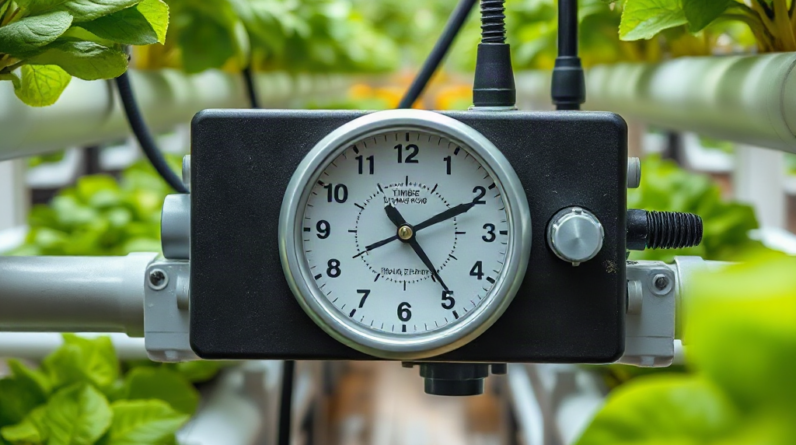
Hydroponic system timers for feeding schedules should be set according to the growing method, root-zone moisture, pump flow, and the crop’s stage rather than a universal hourly formula. Drip systems usually need short, repeated irrigations, while ebb-and-flow tables require enough runtime to flood and drain the tray completely; NFT pumps commonly run continuously. Begin with conservative cycles, observe how quickly the medium dries, and adjust one setting at a time. A reliable schedule keeps roots moist and oxygenated without leaving them saturated, producing runoff all day, or allowing channels and emitters to drain between cycles.
Match Timer Operation to the Growing Method
The correct timer pattern is determined first by how nutrient solution reaches the roots. A timer that works well for a drip-fed bucket can damage an NFT channel or leave an ebb-and-flow tray only partly flooded. Before selecting cycle lengths, identify whether the pump must maintain constant circulation, deliver a measured irrigation event, or raise the solution to a target level.
In nutrient film technique, the pump commonly runs continuously because the root mat depends on a shallow, moving film of solution. Repeatedly stopping that film can leave young roots dry, especially in warm channels or where roots have not yet reached the channel floor. Intermittent NFT operation may be possible in a carefully tested installation, but it gives the grower less protection from uneven channels, retained heat, and rapid drying. A timer should not be added merely because every other powered component has one.
Drip irrigation is different. Each event wets a medium such as coco coir, rockwool, or expanded clay, and that medium continues supplying moisture after the pump stops. Short, repeated events can maintain a useful balance between moisture and air. The same two-minute cycle, however, may barely prime long tubing in one garden while causing heavy drainage in another. Pump output, line length, emitter rate, pressure, container size, and medium retention all change the amount delivered.
Ebb-and-flow operation is governed by the tray rather than an arbitrary number of minutes. The pump must run long enough to fill the tray to the intended depth and hold it briefly if the design requires that, but it must stop before an overflow or prolonged submersion becomes routine. The drain phase also matters. Starting another flood before the tray and root zone have drained reduces the air drawn back into the medium.
Aeroponic and misting installations place tighter demands on control accuracy. Bare roots have little stored moisture, so a basic household timer with coarse 15-minute intervals is generally unsuitable. These installations may require a repeat-cycle controller capable of short on-and-off periods, plus a design that accounts for nozzle blockage and pump failure. Deep-water culture usually does not use a nutrient pump timer for feeding because roots remain in an aerated solution; its air pump is normally kept running.
The practical priority is to map the timer to the physical delivery process. The planning principles in Hydroponic system timers for feeding schedules become useful only after confirming what happens at the final emitter, tray, or channel—not merely what the timer display says.
Build a Feeding Schedule From Measured Conditions
A dependable schedule begins with measuring one complete irrigation event. Place a measuring container under a representative dripper, run the pump for a known period, and record the delivered volume. For an ebb-and-flow tray, time the interval from pump start to the required flood depth, then measure how long the tray takes to drain after shutdown. These observations turn a guessed duration into a repeatable baseline.
Next, examine the medium between events. Coco coir and rockwool retain more moisture than bare clay pebbles, but container dimensions and root density alter their behavior. A small, root-filled block can dry much faster than a larger block of the same material. Surface appearance alone is unreliable because the top may look dry while the interior remains wet. Container weight, moisture within the root zone, drainage behavior, and plant posture together provide a better reading.
Light and temperature create daily variation. Transpiration generally rises after lights come on and can fall before the dark period, so evenly spaced cycles across 24 hours may deliver too little during peak demand and too much overnight. A newly transplanted lettuce seedling under modest light may need fewer drip events than a mature fruiting plant with a dense canopy. Scheduling should therefore be reviewed as roots and foliage expand rather than treated as a permanent installation setting.
Use a controlled adjustment sequence:
- Confirm delivery. Check that the pump primes, each outlet flows, and the final container receives an adequate amount.
- Set a conservative daytime baseline. Choose a duration that wets the active root zone without producing unnecessary drainage.
- Inspect before the next event. Look for excessive saturation, premature drying, wilting, channel interruption, or standing solution.
- Change one variable. Adjust either duration or frequency, then observe the result through comparable light and temperature conditions.
- Recheck as plants mature. Larger root systems and canopies can make an earlier schedule insufficient.
Duration and frequency solve different problems. If solution never reaches all of the medium, a longer event may be appropriate. If the root zone wets fully but becomes too dry before the next event, greater frequency is usually the more relevant change. Extending every cycle can instead create excess runoff and persistent saturation.
Runoff is evidence, not an automatic target. Some drain-to-waste arrangements use controlled drainage to limit salt accumulation, while recirculating gardens return drainage to the reservoir. Large volumes of runoff at every cycle may indicate excessive duration, poor root uptake, or uneven emitters. Check electrical conductivity and pH according to the nutrient program, but do not assume timer changes can correct an improperly mixed reservoir.
Choose Timer Features That Fit the Pump and Cycle
Timer resolution must be finer than the shortest useful event. A mechanical timer divided into 15-minute segments may control lighting or a long flood cycle, but it cannot accurately deliver a two-minute drip event. A digital timer with one-minute programming suits many small drip and ebb-and-flow installations. Aeroponic misting may call for a dedicated cycle controller that repeats short intervals independently of clock time.
Programming capacity is equally relevant. A timer that allows only a few daily events may be adequate for moisture-retentive media and young plants, yet restrictive when mature plants require several daytime irrigations. Some models support clock-based events, while repeat-cycle controllers alternate an on period and an off period continuously. Clock schedules give more control over morning, midday, and nighttime delivery. Repeat cycles are simpler when the same interval is intended around the clock.
The electrical rating must match the pump load, including motor startup behavior rather than only the nominal running wattage. The timer should be grounded where applicable, kept dry, and used according to its manufacturer’s instructions. Plugs and connections belong above potential spill level with cords arranged so water cannot track into a receptacle. If a pump exceeds the controller’s rating, a properly specified relay or contactor may be needed; improvised adapters are not a safe substitute.
Power interruptions expose a less obvious difference between products. Some digital units retain their clock and program with a battery backup, whereas simple mechanical timers may resume from the wrong clock position after an outage. Test what the controller actually does when unplugged and reconnected. A feeding event that shifts into the dark period can remain unnoticed because the timer still appears to operate.
Manual override is valuable for testing lines, measuring output, and servicing trays, but it creates another failure mode. A grower may switch the pump on to flush an emitter and forget to restore automatic operation. After any maintenance, verify the displayed mode and wait for one programmed start and stop. Do not treat the illuminated display as proof that the output socket is switching correctly.
For a modest drip garden, a one-minute digital timer with enough daily programs and memory retention is often the practical middle ground. Coarse mechanical controls are better reserved for cycles that genuinely last that long. High-frequency misting needs a purpose-built controller and stronger failure safeguards. When comparing Hydroponic system timers for feeding schedules, resolution, retained programming, load rating, and override behavior matter more than an unusually large feature list.
Diagnose Scheduling Problems Without Guesswork
Timer troubleshooting should separate the programmed command from nutrient delivery. A controller can switch on at the correct moment while a blocked emitter, airlocked pump, kinked tube, low reservoir, or uneven tray prevents roots from receiving solution. Watch an entire cycle from startup through drainage and inspect the outlet farthest from the pump. This reveals faults that a quick glance at the controller cannot show.
Persistent wilting shortly before an event may indicate that intervals are too long, but it can also result from a failed dripper or poor root contact after transplanting. If every plant declines at a similar point in the cycle, review frequency and environmental demand. If only one container is affected, inspect that line and root zone before changing the schedule for the whole garden. Increasing system-wide runtime to compensate for one blocked outlet can oversaturate all functioning sites.
A constantly wet medium, slow growth, algae on exposed surfaces, or roots with declining color can point toward excessive irrigation, weak drainage, warm solution, or inadequate aeration. Reducing runtime without checking the drain path may hide rather than solve the fault. In an ebb-and-flow tray, for example, a partially blocked return fitting can leave containers submerged even though the pump shuts off on time.
Salt deposits and rising reservoir concentration need careful interpretation. Excessive evaporation, plant water uptake, inaccurate nutrient mixing, and a schedule that produces little leaching can all contribute. More frequent feeding is not automatically the answer because it may increase nutrient delivery without correcting concentration. Measure the reservoir, inspect the root zone, and determine whether the installation is recirculating or drain-to-waste before making a timer change.
A simple operating record makes gradual drift visible. Note the programmed events, measured outlet volume, reservoir level, daytime conditions, plant stage, and any adjustment. Recheck dripper output after cleaning or replacing a pump because restored flow can make the old duration excessive. Signs of a suitable schedule include consistent delivery, complete tray drainage where applicable, no repeated pre-cycle wilt, and a root zone that remains moist without being continuously waterlogged.
Failure planning deserves the same attention as normal scheduling. Keep pump intakes clear, avoid letting the reservoir fall below the intake, and inspect tubing for disconnection. Systems with exposed roots can deteriorate faster during an outage than media-based drip gardens, so alarms or backup measures have greater value there. The most reliable adjustment process is narrow and observable: identify whether the fault lies in programming, electrical switching, hydraulic delivery, drainage, or reservoir chemistry, then change only the relevant part.
Frequently Asked Questions
How often should a hydroponic feeding pump turn on?
Frequency depends on the method, medium, container size, root development, and growing conditions. Measure delivery and inspect root-zone moisture between events rather than copying a universal interval.
Should a hydroponic pump run at night?
NFT circulation and deep-water-culture aeration commonly continue overnight. Timed drip irrigation may need fewer or no nighttime events when demand falls, provided the root zone does not dry excessively.
Is a mechanical timer accurate enough for hydroponics?
It can be suitable for long flood cycles, but coarse segments cannot control brief drip or misting events precisely. Match the timer’s smallest interval to the required pump runtime.
Should feeding duration or feeding frequency be increased first?
Increase duration when an event does not wet the active root zone. Increase frequency when the zone wets properly but dries too far before the following event.
Why are plants wilting when the timer is working?
The pump may be airlocked, an emitter may be blocked, the reservoir may be low, or solution may not reach every site. Observe flow at the roots before reprogramming the controller.
Conclusion
A useful timer program comes from observing the installation rather than selecting a familiar interval. Confirm how long solution takes to reach each growing site, how completely the root zone wets, and how quickly the tray or container drains. Then choose a controller with suitable interval resolution, enough programmed events, memory retention, and an electrical rating appropriate for the pump.
Test one complete automatic cycle after programming and after every maintenance change. If plants show stress, separate schedule errors from blocked lines, poor drainage, reservoir problems, and pump faults before extending runtime. Record each adjustment and change only duration or frequency at one time. That approach produces a schedule that can evolve with plant size, light demand, and seasonal temperature instead of relying on a fixed formula that may no longer match the garden.
Related Content
- How to Manage Water Pressure in Hydroponics: Essential Techniques and Common Mistakes
- Hydroponic Vegetables Labeled Pesticide Free: What the Label Really Means
- Hydroponic Herbs for Kitchen: Essential Varieties and Growing Techniques
- Hydroponic Harvest Tools For Clean Cuts: Blade Types, Timing, And Sanitation
- Insurance and Household Safety Concerns for Hydroponic Systems: Coverage Gaps, Fire Risks, and Prevention Steps