Clay pebbles versus coco coir for hydroponic growing is primarily a choice between rapid drainage and dependable moisture retention. Clay pebbles provide high root-zone aeration, resist compaction, and suit frequent recirculating irrigation, while coco coir holds more water and buffers short gaps between feedings. Pebbles demand reliable pumps and carefully timed cycles because roots can dry quickly; coco requires drainage, calcium-aware nutrient management, and monitoring for salt accumulation. Choose clay pebbles for flood-and-drain or drip systems where irrigation is tightly controlled, and choose coco for containers where moisture stability and a more forgiving watering interval matter most.
How Water, Air, and Nutrients Behave in Each Medium
Clay pebbles and coco coir create very different root environments even when they receive the same nutrient solution. Expanded clay pebbles are hard, porous aggregates with large air spaces between particles. Water drains through those spaces quickly, leaving oxygen around the roots but relatively little stored moisture. Coco consists of processed coconut fibers and pith that hold solution within fine pores while still permitting drainage when the container structure is suitable.
That distinction controls irrigation frequency. A basket filled with clay pebbles may become noticeably drier soon after a pump stops, particularly near the top, where evaporation and warm air remove moisture fastest. Established roots in a recirculating system can perform well under frequent short irrigations because each cycle renews both water and dissolved nutrients. A pump failure, blocked emitter, or incorrectly programmed timer is less forgiving: young roots may not have enough stored moisture to bridge the interruption.
Coco provides a larger moisture reserve. Its fine structure spreads solution through the root zone by capillary movement, so a plant does not depend on every irrigation arriving at the exact minute planned. This makes coco useful for seedlings, transplants, and container crops watered through drip emitters. The tradeoff is that an oversized container, poor drainage, or excessively frequent feeding can keep the lower root zone wetter than intended. Moisture retention is useful only when enough air remains in the medium.
The media also differ in nutrient behavior. Clean clay pebbles are comparatively inert, so changes in reservoir electrical conductivity and pH reach the roots with little moderation. That gives a grower direct control but leaves less room for dosing errors. Coco interacts more strongly with dissolved ions. Properly processed coco is usually buffered before use because its exchange sites can affect calcium, magnesium, potassium, and sodium availability. Unbuffered or poorly rinsed material may produce confusing symptoms even when the reservoir formula appears correct.
Texture matters within both categories. Small or broken clay particles pack more tightly than uniform pebbles, while coarse coco chips drain differently from fine coco pith. Product labels alone therefore cannot predict root-zone behavior. Check how quickly a filled container drains, how evenly it rewets, and whether the center remains saturated. The useful comparison in Clay pebbles versus coco coir for hydroponic growing is not simply dry versus wet; it is how each specific product balances moisture, oxygen, and irrigation reliability.
Matching the Medium to the Hydroponic System
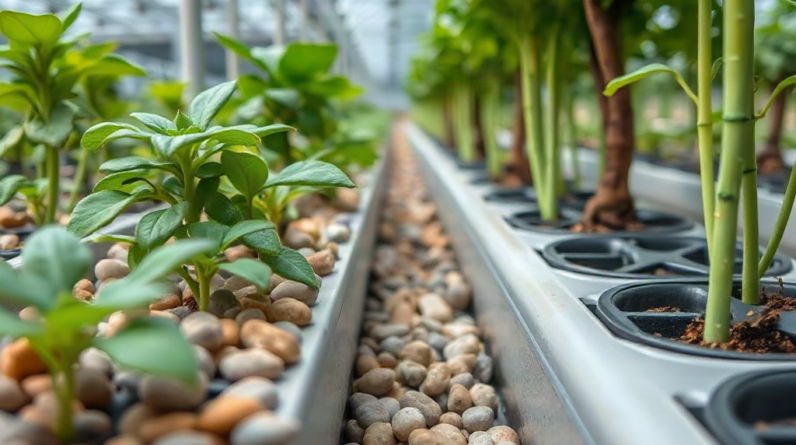
Clay pebbles fit systems that irrigate often and allow solution to drain or recirculate freely. Flood-and-drain tables are a common match because a flood cycle wets the root zone and the drain cycle pulls fresh air back through the spaces between pebbles. Pebbles also stabilize plants in net pots used above deep-water culture reservoirs, although the submerged roots obtain most of their water from the aerated solution rather than from the pebbles themselves.
Recirculating drip systems can use clay effectively when each emitter delivers evenly. Consider four mature plants supplied by separate drippers: one partially blocked line may leave its container much drier than the others before leaf symptoms become obvious. Inspecting discharge at every outlet is therefore more valuable than extending all irrigation cycles blindly. Longer cycles can waste pumping capacity and alter reservoir concentration without correcting the blocked line.
Coco is especially well suited to drain-to-waste drip irrigation in pots, slabs, or grow bags. Its moisture distribution gives roots access to water between events, while measured runoff can reveal whether salts are building up. Coco can also be used in recirculating arrangements, but fine particles and organic debris need suitable filtration. Nutrient management becomes more involved because runoff returning to the reservoir may differ from the solution delivered to the plants.
Neither medium is automatically correct for every passive design. Coco can wick nutrient solution upward, making it more suitable than large clay pebbles for some subirrigated or wick-fed containers. Clay pebbles have weak long-distance capillary action, so a high water line may wet only the bottom portion while the transplant plug remains dry. Until roots reach the moist zone, top-feeding or a carefully positioned starter plug may be necessary.
Plant support is another operational constraint. Pebbles are heavy enough to anchor a small plant, yet large top-heavy crops may still need trellising because the smooth particles shift under leverage. Coco fills the root ball more continuously and provides firmer lateral support, but it should not be compressed tightly into a pot. Compression reduces pore space and slows drainage.
Choose according to the system’s failure mode rather than its ideal operation. Where power interruptions, timer mistakes, or irregular hand-watering are plausible, coco offers a useful moisture buffer. Where drainage speed, cleanliness, and repeated flood cycles are priorities, clay is often easier to control. Mixing the two does not guarantee the best properties of both; a small amount of coco can settle between pebbles, change water retention unevenly, and complicate cleaning unless the blend has been tested in the actual container.
Preparation, Irrigation, and Nutrient Management
Correct preparation prevents many problems incorrectly blamed on the medium. Clay pebbles commonly arrive with abrasive dust and small fragments. Rinse them outdoors or where sediment will not enter household drains, continuing until the discharge is mostly clear. Soaking can wet internal pores before planting, but soaking does not sterilize used material or correct contaminants from previous crops.
Coco preparation depends on the product. Pre-rinsed, pre-buffered coco is simpler to commission than compressed, untreated material, but its condition should still be verified rather than assumed. Hydrate compressed blocks evenly, break apart dry pockets, and examine the drainage water for excessive residual salts. If the manufacturer provides preparation directions, follow its stated buffering and expansion procedure; arbitrary soaking formulas can create nutrient imbalances before roots are established.
Irrigation should be tuned from root-zone evidence rather than copied from another garden. With clay, begin by confirming that solution reaches the transplant plug and exits freely. Short, frequent cycles during the light period are often more appropriate than long, widely spaced soakings, but plant size, temperature, airflow, container depth, and emitter output all alter demand. A lightweight container, dry upper roots, and wilting before the next cycle indicate that frequency or distribution needs attention. Constantly dripping outlets and persistently flooded bases point in the opposite direction.
With coco, water thoroughly enough to wet the active root zone and observe drainage. A small transplant in a large pot consumes little solution, so repeatedly saturating the entire pot may leave it wet for too long. As the canopy and root system expand, uptake rises and more frequent fertigation becomes appropriate. Coco should not be treated like ordinary garden soil with long, severe wet-to-dry swings; extreme drying concentrates salts and makes uniform rewetting harder.
Reservoir readings and root-zone readings answer different questions. The supplied solution shows what the system delivers, while runoff or extracted root-zone solution can indicate concentration within the medium. A rising runoff EC, leaf-edge burn, or white deposits may signal inadequate drainage, excessive feed strength, or high evaporation. A reading should prompt verification of meter calibration, source water, and irrigation uniformity before nutrients are changed.
A practical startup sequence is:
- Prepare the medium: remove clay dust or hydrate and condition coco as directed.
- Test the container: run plain source water through it and confirm even wetting and unrestricted drainage.
- Verify delivery: measure each emitter rather than judging the pump by sound.
- Introduce nutrients: use a crop-appropriate formula and record input pH and EC.
- Inspect roots and runoff: adjust irrigation from moisture, drainage, plant demand, and root appearance.
The common mistake is changing nutrient strength when delivery is the actual problem. Before reformulating a reservoir, compare emitters, inspect drain holes, and check whether the medium is drying uniformly. That diagnostic order makes Clay pebbles versus coco coir for hydroponic growing an operational decision rather than a brand preference.
Cost, Reuse, and a Practical Selection Checklist
Purchase price tells only part of the cost. Clay pebbles can be washed and reused across crop cycles if roots, salts, and organic residue are removed thoroughly. The work is physical and time-consuming: roots cling to rough surfaces, small fragments accumulate, and large volumes require space for washing and drying. Reusing material without sanitation can carry algae, root debris, or plant pathogens into the next crop.
Coco is lightweight when dry and convenient in compressed blocks, but reuse is more complicated. Old roots are difficult to separate from the fiber, particle structure gradually changes, and accumulated salts must be assessed. A grower may reuse coco under controlled conditions, yet fresh material is often more predictable for seedlings or valuable plants. Disposal also deserves planning. Coco may be repurposed as a soil amendment where appropriate and free of problematic residues; clay pebbles are durable but bulky and do not decompose.
System scale changes the labor calculation. Washing a small bucket of pebbles for a home flood tray is manageable. Cleaning enough pebbles for dozens of containers may cost more time and water than expected. Coco reduces handling weight and fills containers quickly, while clay is easier to separate from net pots and mechanical components if particle size is matched to the openings.
Use the following priorities before buying either medium:
- Irrigation reliability: choose coco when the setup needs a moisture reserve; choose clay when frequent delivery is dependable.
- Drainage design: favor clay where rapid emptying is central, and coco where containers can drain completely without remaining saturated.
- Nutrient monitoring: expect direct reservoir control with clay and closer attention to buffering and root-zone salts with coco.
- Crop turnover: clay rewards growers prepared to clean and sanitize it; coco favors quick replacement but creates recurring material demand.
- Transplant method: ensure clay irrigation reaches the starter plug, or ensure a coco pot is not oversized for a small root system.
Signs of a good match appear in the root zone before harvest. Healthy new roots should be pale and actively spreading, containers should drain consistently, and plants should remain turgid between scheduled irrigations. Repeated wilting in clay, even with acceptable reservoir readings, suggests insufficient delivery or poor contact with the young root system. Slow drainage, sour odors, persistent lower-pot saturation, or steadily increasing runoff EC in coco indicate that container structure or irrigation needs correction.
Budget-focused growers should price the supporting equipment as well as the medium. Clay may require more dependable timers, pump redundancy, and extra emitters. Coco may require runoff collection, disposal capacity, and more frequent root-zone measurements. The better value is the option whose maintenance demands fit the garden’s available time, water access, and monitoring habits—not necessarily the bag with the lower shelf price.
Frequently Asked Questions
Can clay pebbles and coco coir be mixed together?
They can be mixed, but the result must be tested for drainage and moisture uniformity. Fine coco can settle between pebbles, making some areas wetter and reducing the easy cleaning that makes clay attractive.
Which medium is easier for a beginner?
Coco is often more forgiving of a delayed irrigation because it stores more solution. It still requires good drainage, suitable nutrients, and attention to salt accumulation, so it is not maintenance-free.
Do clay pebbles need to stay wet all the time?
No. Their air-filled drainage periods are useful, but roots should not dry enough to wilt between cycles. Irrigation frequency should reflect plant size, root reach, temperature, and container design.
Does coco coir require special nutrients?
A hydroponic formula suitable for coco is convenient because it accounts for the medium's ion-exchange behavior. Regardless of the label, monitor the supplied solution, runoff trend, and plant response rather than adding supplements automatically.
Can clay pebbles be reused after a crop?
Yes, if old roots and mineral deposits are removed and the material is sanitized appropriately before replanting. Discard badly fractured or contaminated pebbles rather than returning them to the system.
Conclusion
Base the choice on irrigation behavior, system design, and the amount of monitoring the garden can sustain. Clay pebbles reward dependable pumping with rapid drainage, strong aeration, and realistic reuse potential, but a missed cycle can expose roots quickly. Coco gives containers a larger moisture reserve and more even wetting, while demanding attention to drainage, conditioning, and root-zone salt trends.
Before committing an entire crop, fill one representative container, measure emitter delivery, observe drainage, and track how moisture changes through a normal light period. Match the transplant plug to the wet zone and record input and runoff readings where applicable. That small trial reveals more than a generic watering schedule and makes it easier to correct the system before roots, canopy size, and nutrient demand increase.