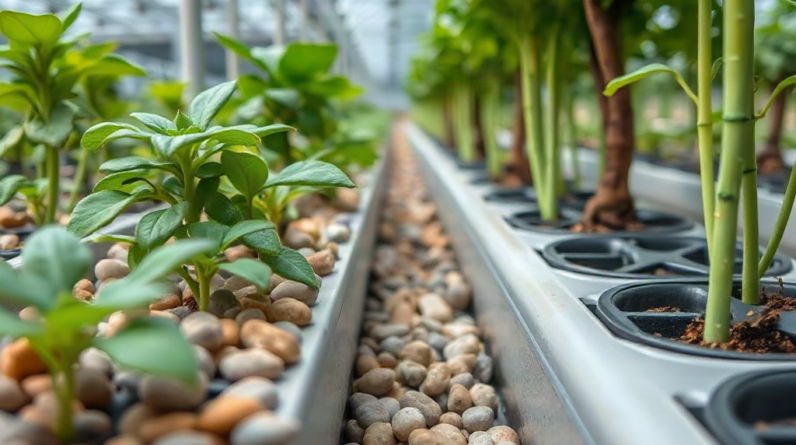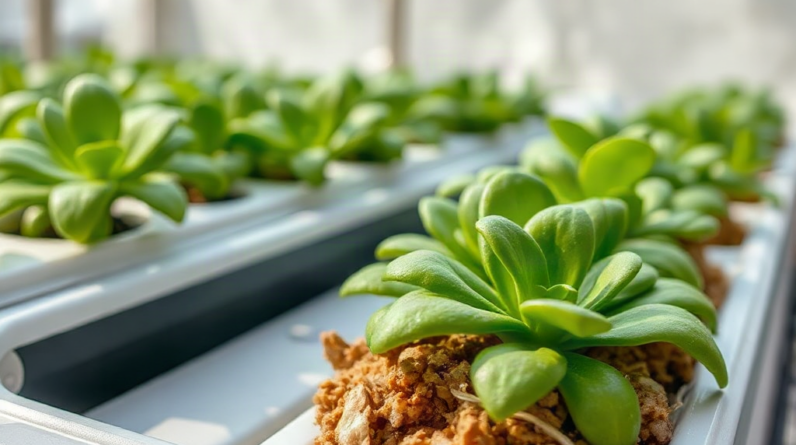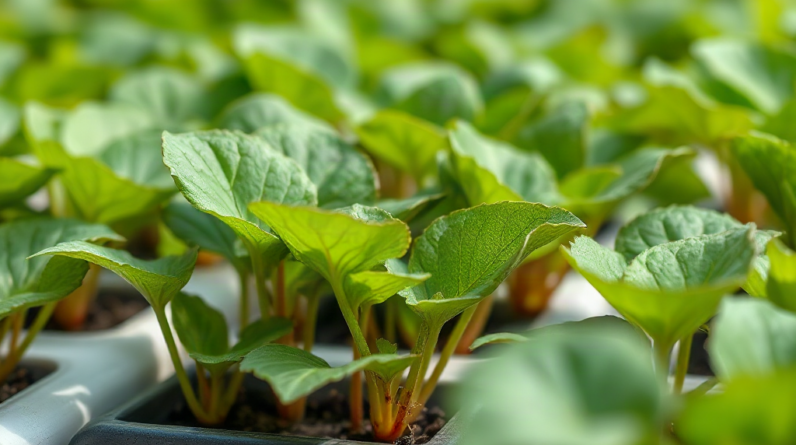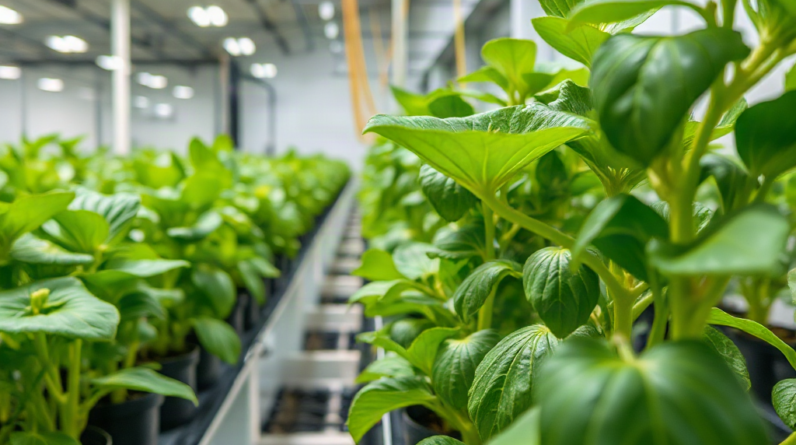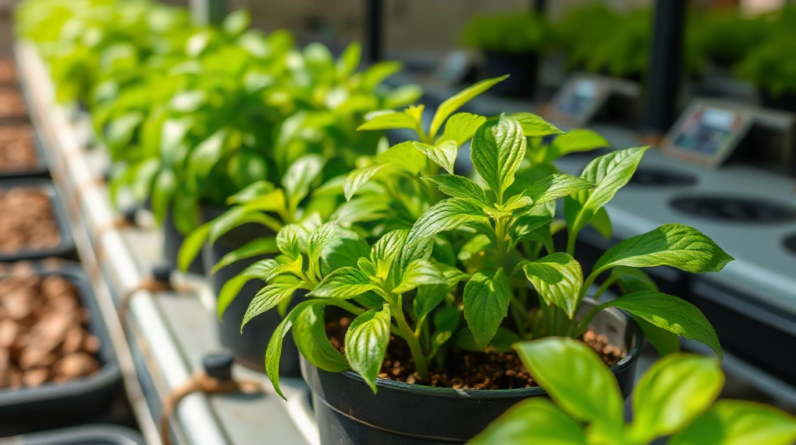
Net pot sizing for mature hydroponic crops should match the plant’s eventual root crown, stem load, growing medium, and required access for cleaning or transplanting—not merely the seedling’s current size. Two-inch pots generally suit compact greens and herbs, while three- to four-inch pots provide more support for larger lettuce, basil, strawberries, and similar plants. Fruiting crops such as tomatoes, cucumbers, eggplants, and peppers commonly need four- to six-inch pots plus separate trellising. A larger net pot improves crown stability and holds more medium, but it does not replace structural support or compensate for restricted root space beneath the lid.
What Net Pot Diameter Actually Controls
Net pot diameter primarily controls support around the plant crown and the amount of growing medium held above the reservoir or channel. It does not determine how large the entire root system can become once roots pass through the basket. A mature lettuce plant may produce a substantial root mass below a relatively small pot, while a heavy pepper plant can remain unstable in a large pot if its branches have no external support.
The useful sizing question is whether the basket can hold the crown firmly without crowding it, slipping through the opening, or forcing the stem against a hard rim. A wider basket offers a broader base and more medium around a rockwool cube, foam collar, coco plug, or bare-root transplant. That extra contact can reduce movement while a plant establishes. It also distributes leverage over a larger section of the lid when leaves, fruit, or air movement pull on the stem.
Depth matters alongside diameter. Two baskets sold under the same nominal size may have noticeably different depths and mesh patterns. A shallow basket can work well in a thin nutrient-film channel because roots reach the flowing solution quickly. A deeper basket may suit a raft, bucket lid, or media-supported system, but only if its lower portion reaches the intended moisture zone. Oversizing a deep basket in a shallow channel can obstruct flow or leave a young plug too far above the nutrient film.
Root architecture creates another constraint. Fine, branching roots from lettuce and many culinary herbs readily pass through narrow slots. Coarser roots and thick crowns need openings that do not pinch new growth. Dense root mats can eventually wrap around any basket, so moving from a three-inch pot to a six-inch pot does not solve inadequate reservoir volume, poor aeration, or roots blocking a return line. The system must still provide open water or air space beneath the lid.
A frequent mistake is selecting a basket according to the mature canopy width. Canopy diameter and basket diameter do not scale together. A sprawling cucumber might cover several square feet but can be anchored at its crown in a four- or five-inch basket when a trellis carries the vines and fruit. Conversely, a compact plant with a thick crown or large propagation block may need more basket width than its foliage suggests. Good Net pot sizing for mature hydroponic crops therefore begins at the crown and mounting point, then considers the load that must be transferred to the lid or frame.
Size Ranges for Greens, Herbs, and Fruiting Plants
Common net pot sizes provide useful starting points, but plant form and harvest age should decide the final choice. Nominal measurements are not perfectly standardized between manufacturers, so confirm the outside rim diameter, basket depth, and required cutout before drilling a permanent lid.
Two-inch baskets are usually appropriate for compact lettuce, small leafy greens, short-cycle basil, mint, and similar herbs. They use lid space efficiently and require little medium. They are especially practical in raft and channel systems where the roots quickly extend into nutrient solution. Their limitation appears when a plant develops a broad crown, a woody stem, or enough top weight to rock the basket. Closely spaced greens may also require harvesting before their crowns and root mats become entangled.
Three-inch baskets give larger lettuce heads, vigorous basil, parsley, and many strawberry plants more crown room. They can hold a larger starter plug or enough clay pebbles to stabilize a transplant without consuming as much lid area as a four-inch basket. This size often provides a sensible middle ground when plants will remain in the system beyond baby-leaf or young-herb stage. A three-inch basket still cannot carry a fruiting plant’s mature lateral load by itself.
Four-inch baskets suit crops with thicker stems, larger propagation blocks, or longer production cycles. Full-size herbs, strawberries, dwarf peppers, and compact ornamentals may benefit from the added medium and wider base. Four-inch pots are also a common minimum starting point for trellised tomatoes, cucumbers, eggplants, and peppers. For these fruiting crops, the basket stabilizes the crown during establishment; a stake, string, cage, or overhead trellis should support the mature plant.
Five- and six-inch baskets are most useful when a heavy crown, bulky media plug, long crop cycle, or bucket-style installation warrants the extra footprint. They can simplify anchoring for large tomatoes and cucumbers, but they reduce planting density and require larger lid holes. More medium also retains more moisture around the crown, which can become undesirable if the basket sits too deeply or receives constant top irrigation.
Consider two tomato installations. A compact tomato in a bucket may use a six-inch basket filled with clay pebbles because the large lid, drip ring, and broad plant base make that arrangement convenient. A greenhouse-style vine tomato may use a smaller basket or collar because an overhead support line carries nearly all mature weight. Neither choice is automatically better; the support plan changes what the basket must do.
Use these ranges as provisional categories rather than rigid crop rules. The plant variety, propagation block, planned harvest size, and training method can move the choice up or down one size. Test the actual plant holder before duplicating holes across a raft or system lid.
Match the Pot to the System and Growing Medium
The hydroponic system sets physical limits that can matter more than crop labels. Deep-water culture and raft systems generally provide generous root space below the lid, but the basket rim must sit securely without bending the raft. A large pot cut into thin foam can weaken the surrounding material, particularly when a top-heavy plant moves. Increasing basket diameter may therefore require a thicker raft, rigid collar, or independent plant support.
Nutrient-film channels favor small, shallow baskets because the channel has limited internal height. Roots must reach the nutrient film without the basket blocking flow. Putting a deep four-inch basket into a narrow channel can create a dam that traps debris and encourages roots to accumulate upstream. Larger herbs or fruiting plants can sometimes grow in channels designed for them, but simply enlarging the hole in a lettuce channel does not increase its flow capacity or structural strength.
Bucket systems usually accept larger baskets more easily. A four- to six-inch lid basket offers room for clay pebbles and a drip emitter while the bucket provides substantial root volume. Even here, large vines need a separate frame. Suspending the full weight of tomatoes or cucumbers from the basket and plastic lid can distort the opening, tilt the crown, or crack a lightweight lid.
Growing medium changes the effective support delivered by a given diameter. Clay pebbles are reusable and allow substantial air movement, but their rounded surfaces may shift around a thin stem. Coarse perlite is light and can escape through wide slots. Coco chips interlock more readily but remain wetter around the crown. A propagation cube placed in a basket should be supported without being compressed; gaps can be filled with suitable inert medium so the cube does not rotate during irrigation.
The water line or irrigation pattern must match the basket depth. During establishment, the bottom of a plug may need contact with moisture, capillary splash, or carefully directed drip irrigation until roots emerge. Permanently submerging the crown is not the goal. As roots lengthen, deep-water systems commonly maintain an air space below the basket while aerated solution supplies the roots beneath it. A pot that is too tall for the chosen water level may leave a transplant dry; one positioned too low may keep the crown saturated.
Avoid choosing a larger pot merely to hold more wet medium. Persistent moisture at the stem base can promote algae and crown deterioration, while additional medium raises cost and cleaning labor. The better adjustment may be a properly placed emitter, a different basket depth, or a supported propagation plug. When reviewing Net pot sizing for mature hydroponic crops, evaluate the complete interface among basket, lid, water level, irrigation, and support structure.
A Preplant Sizing and Support Checklist
A full-cycle mock-up is more reliable than assuming the largest available pot provides the safest choice. Assemble one basket, lid section, propagation plug, medium, and irrigation fitting before preparing the rest of the system. The test should reveal whether the rim seats flat, the plug reaches moisture, roots have a clear exit, and the lid remains stiff under sideways pressure.
- Measure the starter plug. Choose a basket that accepts the plug without crushing it or allowing it to fall through.
- Inspect the mature crown. Account for stem thickening, multiple stems, runners, or a crown that spreads near the basket rim.
- Separate anchoring from load support. Decide whether the basket carries only the crown or whether a trellis, cage, stake, or frame will carry mature foliage and fruit.
- Confirm basket depth and moisture contact. Check the startup water level or emitter position rather than relying on diameter alone.
- Verify the mounting hole. Use the manufacturer’s actual dimensions, test a scrap lid, and leave enough material between planting sites.
- Plan removal and sanitation. Allow access to lift the basket, inspect roots, clear lines, and clean the lid between crop cycles.
The mock-up should also include anticipated movement. Gently apply sideways pressure comparable to a leafy canopy shifting under fans. If the basket rocks, the rim lifts, or the lid flexes, a larger pot may help, but reinforcement or external support is often the more effective correction. If the entire lid bows, increasing basket size could make the structural problem worse by removing more material.
Signs of a suitable choice include a centered crown, a stable plug, unobstructed root emergence, and no need to keep the basket excessively wet during establishment. As the crop matures, the stem should not be abraded by the rim, and the basket should remain removable unless the production method intentionally sacrifices it at harvest. Roots surrounding the basket are normal; a distorted pot, pinched crown, blocked channel, or leaning lid indicates a mismatch.
Correct problems according to their source. Add a trellis when top weight is the issue. Adjust irrigation when the plug dries before roots reach the solution. Choose a shallower basket when channel clearance is limited. Enlarge the basket when the crown or propagation block genuinely lacks space. Reduce its size when planting density, lid strength, or unnecessary wet medium creates the larger risk.
Cutout errors are difficult to reverse, so avoid drilling every site from a catalog label. Measure the basket beneath its retaining lip and make one test opening. A hole that is slightly too large can let the pot drop or tilt, while an undersized hole may hold it above the planned water level. Applying this installation check to Net pot sizing for mature hydroponic crops prevents a small hardware decision from limiting an entire production cycle.
Frequently Asked Questions
Is a larger net pot always better for a mature plant?
No. A larger basket holds more medium and broadens crown support, but it also reduces planting density, removes more lid material, and may keep the crown wetter. External trellising is usually more effective for heavy canopies.
Can tomatoes grow in three-inch net pots?
A tomato can grow from a three-inch basket if its plug fits, roots have ample space below, and a separate trellis carries the mature plant. Four- to six-inch baskets are often more convenient for bucket installations.
What net pot size works for mature lettuce?
Two-inch pots commonly suit compact or short-cycle lettuce, while three-inch pots offer more stability for larger heads and longer growing periods. Confirm that the raft or channel spacing accommodates the mature canopy.
Should the bottom of a net pot touch the nutrient solution?
The plug needs reliable moisture until roots emerge, but the plant crown should not remain submerged. The correct position depends on basket depth, water level, capillary action, and whether startup irrigation is provided.
Can a plant be moved into a larger net pot later?
Early transfers are possible, but mature roots often weave through the basket and can be damaged during removal. Selecting the production basket before extensive root emergence is usually safer.
Conclusion
Choose net pot diameter from the mature crown, propagation plug, system geometry, and support plan rather than canopy width alone. Two- and three-inch baskets cover many greens and herbs, while four- to six-inch options provide more anchoring space for thick crowns, large plugs, and bucket-grown fruiting plants. Trellises, cages, or frames should carry substantial foliage and fruit loads instead of transferring that force to the basket and lid.
Before cutting multiple openings, test one complete planting site with the actual basket, medium, water level, and irrigation hardware. Confirm that the plug remains moist during establishment, roots can exit freely, the crown stays above persistent saturation, and the mounting surface resists sideways movement. That short trial provides a more dependable answer than a crop name or nominal pot measurement alone.