Build the Schedule Around Harvest Demand
A useful succession schedule begins with the amount of salad the household actually eats, not with the number of planting sites available. A 24-site raft filled on one day may look efficient, but it creates 24 similarly aged plants competing for attention and reaching harvest together. Filling a smaller group each week turns that single flush into a steadier supply.
Work backward from consumption. If a household uses four mature lettuce heads each week, sow enough seed to produce four usable plants plus a modest allowance for weak germination or damaged seedlings. The allowance should reflect observed performance rather than an arbitrary habit. A grower who routinely germinates nearly every pellet needs fewer extras than someone working with older seed or uneven temperatures.
Harvest style changes the calculation. Whole-head production occupies one site until the plant is removed, so each harvested head normally requires a replacement seedling. Cut-and-come-again greens remain in place through multiple harvests, reducing the number of new sites needed each week. Their output is less uniform, however, because regrowth slows as plants age and may decline sooner under heat, crowding, or root stress.
A simple starting interval is seven days for frequently used lettuce and mixed greens. A 10- to 14-day interval may suit a smaller household or a system with limited finishing space. Calendar intervals are only planning tools: temperature, cultivar, light duration, plant spacing, and harvest size all affect the true turnaround. Track the date sown, date moved into the main unit, and first harvest date for every batch.
For example, a grower with 20 finishing sites could divide them into five groups of four. Harvesting and replacing one group each week creates a five-week finishing rotation once production stabilizes. If the chosen lettuce consistently needs six weeks in the finishing area, either reduce the weekly target, add sites, harvest smaller plants, or accept that the nominal five-week rotation cannot supply four full heads indefinitely. The arithmetic exposes capacity limits before overcrowding does.
The common mistake is scheduling from optimistic maturity claims while ignoring transfer time and local conditions. Treat the first several batches as calibration. The best plan for Hydroponic gardening for salad greens succession planting is the interval that matches measured harvests to realistic kitchen demand.
Divide the Garden Into Growth Stages
Separate germination, nursery growth, and finishing whenever space permits. Seedlings need reliable moisture and gentle conditions, while mature greens need wider spacing, stronger airflow, and enough root-zone capacity to support rapid leaf production. Forcing every age group into one uniform environment usually wastes productive space or exposes young plants to conditions selected for older ones.
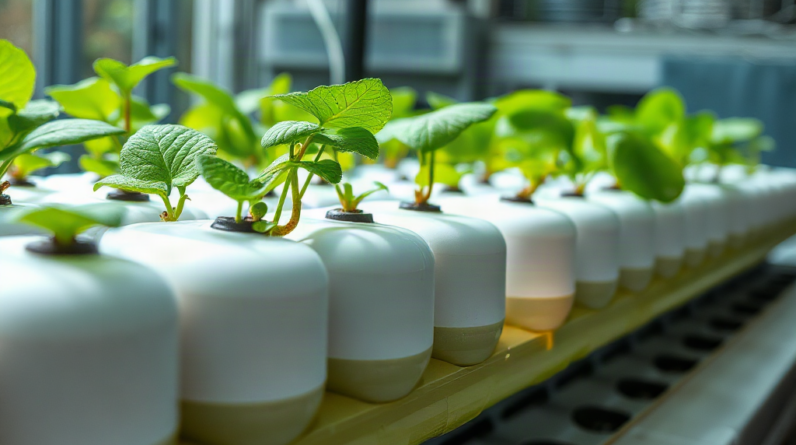
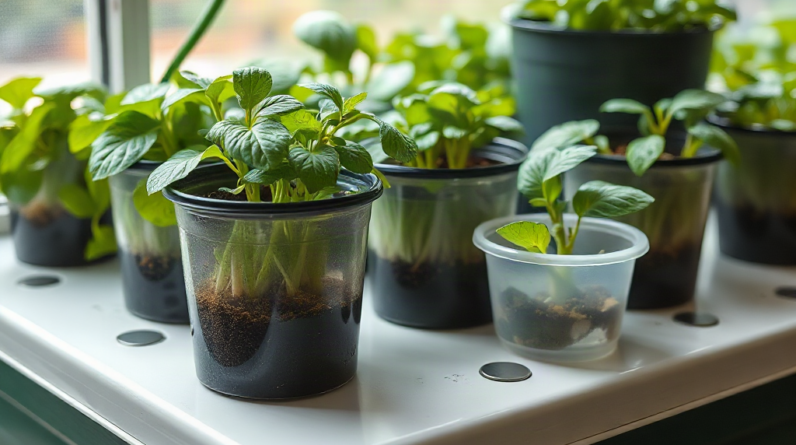
A small germination tray can hold several weekly batches because newly sown plugs occupy little room. Once roots emerge and the first true leaves develop, seedlings can move to a nursery area with closer spacing than the finishing unit. They should enter their final positions before leaves overlap heavily or roots become tangled with neighboring plugs. The exact transfer day is less useful than visible readiness: stable roots extending from the plug, upright new growth, and enough structure to handle movement without collapsing.
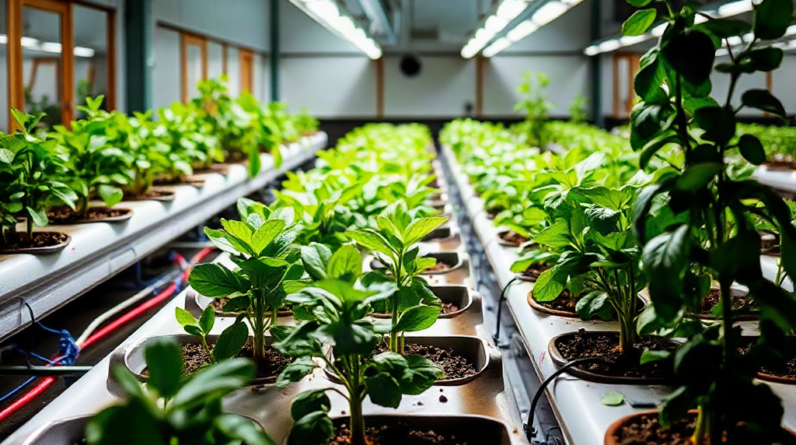
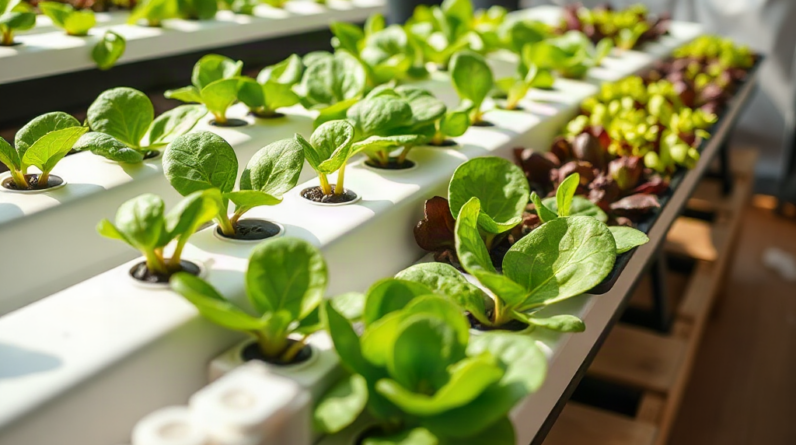
Consider a deep-water culture setup with 18 final sites. The grower might keep six seedlings in a separate nursery and sow another small batch while the nursery plants develop. When six mature plants are harvested, six established juveniles enter the raft and newly germinated plugs move into the nursery. This pipeline keeps expensive, well-lit finishing positions occupied by plants capable of using them.
A single-stage setup is simpler and can work for a small countertop garden, but it creates tradeoffs. Young plants leave unused canopy space, while mature neighbors may shade them. Roots from older plants can surround new plugs, making removal awkward. If separate equipment is impractical, group each age class together and progress from shortest to tallest along the light footprint. Avoid placing a new seedling directly between two broad, harvest-ready heads.
Before each transfer, check that roots are pale to cream-colored, new leaves are expanding, and the plug is moist without remaining saturated and airless. A stalled seedling should not be promoted merely because the calendar says a site must be filled. Holding a healthy juvenile briefly is generally less disruptive than introducing a weak plant that occupies a finishing site without building a usable canopy.
Sanitation must fit the rotation. Continuous production removes the convenient full-system shutdown between crops, so clean empty sites, collars, covers, and accessible surfaces as each batch leaves. Remove dead roots rather than allowing them to accumulate in the reservoir. Periodic deeper cleaning still requires planned downtime or a second unit; succession planting does not make residue, biofilm, or worn equipment disappear.
Match Sowing Intervals to Varieties and Harvest Style
Varieties sharing one batch should have reasonably compatible growth rates and canopy sizes. Fast baby-leaf arugula, compact butterhead lettuce, and a large romaine do not reach the same harvest stage together even when sown on the same date. Mixing them without accounting for those differences turns a neat weekly batch into several unrelated harvest windows.
For whole heads, group cultivars by observed time to the size you prefer. Compact lettuces are often easier to rotate through fixed sites because they occupy a predictable footprint. Large romaine types may need more time and spacing, reducing weekly system capacity. Mustard greens and arugula can develop quickly, but flavor and texture may become stronger as leaves age or temperatures rise. Those crops may be more practical as smaller, more frequent sowings rather than large batches held until every plant reaches the same size.
Baby-leaf production uses a different model. Seeds are sown densely in shallow channels, mats, or suitable media and harvested young. It can deliver frequent bowls of mixed leaves from little space, but dense stands demand even germination and airflow. A patchy tray cannot be repaired easily once neighboring seedlings fill the gaps, and an overly thick stand holds moisture around leaves. Whole-head culture is slower and uses more area per plant, yet each site is easier to inspect and replace.
Cut-and-come-again harvesting sits between those approaches. Remove outer leaves while preserving the growing point, and the plant can continue producing. This reduces transplant frequency, but old plants should not remain merely because they are still alive. Replace them when new leaves become progressively smaller, stems elongate, flavor declines, or the root mass takes space that a vigorous juvenile could use better.
Use one compact planning sequence:
- Choose the harvest unit: a head, a measured baby-leaf tray, or a set number of outer leaves.
- Record actual turnaround: count from sowing to the harvest size used in the kitchen.
- Calculate site occupancy: include nursery and regrowth time, not only finishing days.
- Set the next sowing date: base it on expected use and free positions.
- Review after three batches: adjust the interval rather than repeatedly changing seed quantity at random.
Do not assume every salad green belongs in the same nutrient and temperature program. Compatible crops simplify management, while a mixed planting may force compromises. If one variety repeatedly bolts, stretches, or develops poor leaf quality while the others perform well, move it to a different seasonal window or remove it from the rotation. Variety choice should support the production rhythm, not continually disrupt it.
Use Crop Records to Correct the Rotation
A succession plan becomes dependable only after actual crop records replace estimates. The most useful notes are operational: sowing date, emergence date, transfer date, harvest date, harvest amount, losses, and the reason a batch was early or late. Detailed records are valuable only if they lead to a scheduling decision.
Label each batch with a date and short cultivar code. Without labels, visually similar lettuce seedlings are easy to confuse, especially when several sowings are only a week apart. A notebook or spreadsheet can then show whether a particular cultivar consistently spends 12 days in the nursery and 30 days in finishing, or whether those stages vary enough to require spare capacity.
Read the garden as a queue. Empty final sites while healthy seedlings wait in the nursery mean transfers are late or harvesting is poorly coordinated. No available sites when seedlings are ready means the sowing rate is too high, the finishing period is longer than expected, or mature plants are being held unnecessarily. Repeated kitchen surplus means the schedule is producing more than demand, even if every plant looks excellent.
Suppose three weekly batches are ready within five days of one another. The weak response is to sow yet another identical batch because the calendar calls for it. The better response is to identify the cause. Warmer conditions may have accelerated later seedlings, an earlier batch may have stalled after transfer, or several cultivars may simply mature at different rates. Delay the next sowing, harvest selected plants smaller, and revise the recorded turnaround for the affected variety.
Useful signs of a balanced rotation include a small but steady nursery reserve, few vacant finishing positions, harvest quantities close to household use, and mature plants removed before quality declines. Warning signs include seedlings held until root-bound, frequent shading, repeated disposal of surplus leaves, and harvest gaps followed by excess.
Change one scheduling variable at a time when possible. Shortening the interval while also increasing batch size and changing cultivars makes the result hard to interpret. Readers refining Hydroponic gardening for salad greens succession planting will get clearer answers by testing one adjustment across two or three cycles before redesigning the entire rotation.
Prevent Gaps, Gluts, and Declining Quality
Production gaps and harvest gluts are usually capacity signals rather than seed problems. Gaps arise when germination fails, transfers are delayed, or finishing takes longer than the plan allows. Gluts occur when too many sites were started together, growth accelerates, or mature greens remain in the unit until the next batch catches up.
Keep a small reserve of healthy seedlings, but do not maintain a crowded backlog. One or two extra plants per batch may cover a weak seedling or damaged transplant in a modest home setup. A large surplus consumes nursery space and encourages the grower to squeeze plants into occupied channels. Extras should have a defined use, such as early harvest as baby greens, rather than becoming permanent overflow.
Environmental stress can masquerade as a scheduling error. If every batch slows at once, inspect light coverage, air and solution temperature, circulation, root condition, pH, and nutrient concentration before sowing more seed. If only the oldest plants show browned leaf margins or weak inner growth, crowding, airflow, rapid growth, or nutrient delivery may deserve attention. Scheduling cannot compensate for unhealthy roots or an unstable reservoir.
Seasonal changes require deliberate recalibration. A sowing interval that produces orderly winter harvests indoors may create overlap when warmer conditions accelerate growth. Conversely, insufficient winter light can lengthen finishing time and fill every site before the next seedlings are ready to move. Adjusting the interval by several days is often cleaner than repeatedly discarding seedlings or harvesting plants before they have useful mass.
Prioritize corrections in this order: protect plant health, restore appropriate spacing, align harvest quantity with use, and only then maximize site occupancy. A completely full unit is not automatically productive if crowded leaves stay wet, lower growth receives little light, or roots are difficult to inspect. Leaving a site empty briefly can be better than forcing in a transplant that will reduce quality across the surrounding canopy.
The misconception that succession planting creates identical weekly harvests leads to unnecessary micromanagement. Biological growth varies, and household demand varies too. The practical goal is a controlled range: enough greens approaching harvest, enough juveniles to replace them, and enough flexibility to absorb a failed plug or a faster week without collapsing the rotation.
Frequently Asked Questions
How often should salad greens be sown for a continuous harvest?
Seven-day sowings are a practical starting point for frequently eaten greens. Use 10- to 14-day intervals for lower demand, then adjust according to actual harvest dates, available sites, and surplus.
Should different lettuce varieties be planted in the same batch?
They can share a batch when their growth rate and mature size are similar. Separate fast compact types from slower or larger cultivars if they repeatedly create uneven harvests or shading.
How many extra seedlings should be started?
Start only enough extras to cover typical losses. For a small batch, one or two reserve seedlings may be adequate; excessive backups often create nursery crowding and unnecessary waste.
Can mature and young salad greens share one hydroponic unit?
Yes, but group plants by age and prevent mature leaves from shading new transplants. Separate nursery and finishing areas provide better space efficiency when production is continuous.
When should a cut-and-come-again plant be replaced?
Replace it when regrowth becomes progressively smaller, stems elongate, flavor or texture deteriorates, or its root mass occupies space more productively used by a vigorous young plant.
Conclusion
A dependable rotation comes from matching batch size to real consumption and matching sowing dates to measured crop performance. Begin with small weekly groups, label every sowing, and reserve distinct space for seedlings and finishing plants if the setup allows. Harvest style matters: whole heads require direct replacement, while repeated leaf cutting extends site occupancy but becomes less productive as plants age.
Review the rotation whenever seedlings wait too long, final positions remain empty, mature leaves crowd younger batches, or harvested greens exceed what can be used. Correct plant health and spacing before trying to increase output. For the next cycle, record one cultivar from seed to harvest, compare its weekly yield with household demand, and alter either the batch size or interval—not both—so the effect of the change remains clear.