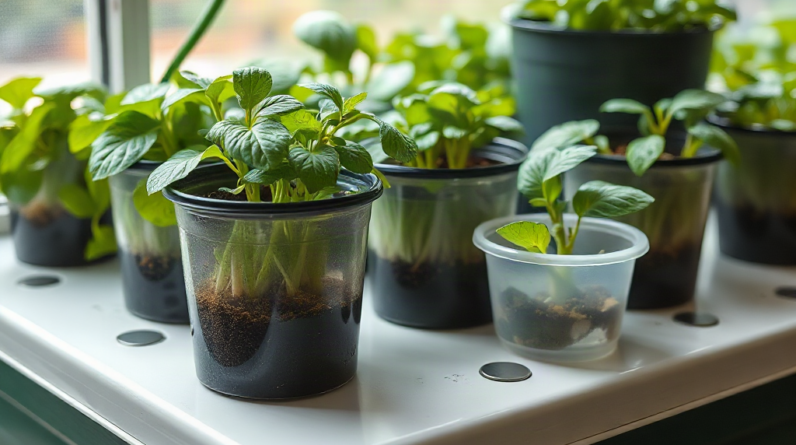
Hydroponic gardening with tap water is usually workable when precautions address disinfectants, mineral content, alkalinity, pH, and contamination before nutrients reach the reservoir. Check the utility’s water-quality report, measure source-water electrical conductivity and pH, and determine whether the supply contains chlorine or longer-lasting chloramine. Hard or alkaline water may require a nutrient formula designed for that source, partial dilution with reverse-osmosis water, or careful acid adjustment. Let mixed nutrient solution settle before making final corrections, because fertilizer changes both conductivity and pH. Track reservoir behavior over several days; rising pH, mineral deposits, leaf-edge damage, or unexplained nutrient imbalance indicate that source water needs closer management.
Identify What Is in the Tap Water
Tap water should be treated as an ingredient rather than an empty carrier. It may already contain calcium, magnesium, bicarbonates, sodium, chloride, disinfectants, and trace metals. Those components affect how much fertilizer can be added, how stable the reservoir pH remains, and whether a nutrient recipe produces the concentration its label implies.
Begin with the annual water-quality report supplied by the local utility, often called a consumer confidence report in the United States. Look for the disinfectant used, hardness or calcium and magnesium values, sodium, chloride, alkalinity, and any reported seasonal changes. A report describes water in the distribution system, not necessarily its exact condition at a particular faucet, so pair it with direct measurements. Test the untreated tap water for pH and electrical conductivity, commonly shortened to EC. Record the result before adding fertilizer.
Source pH alone does not reveal whether water is suitable. Water at pH 7.8 with low alkalinity may be easy to adjust, while water at the same pH with substantial bicarbonate alkalinity may repeatedly push a reservoir upward. EC is also incomplete because it measures dissolved ionic material without identifying it. An EC reading cannot tell whether the dissolved load is useful calcium or unwanted sodium.
A practical scenario illustrates the distinction. Two homes may receive tap water with similar EC readings, but one supply derives much of that reading from calcium and magnesium while the other contains more sodium and chloride. The first may work with a compatible fertilizer and modest adjustment. The second may consume too much of the crop’s acceptable dissolved-solids budget before nutrients are added.
Do not rely on taste, clarity, or a basic drinking-water filter as proof of hydroponic suitability. Water can meet drinking standards yet still be awkward for a small reservoir because hydroponics recirculates and concentrates dissolved minerals. Readers planning Hydroponic gardening with tap water precautions should establish a baseline whenever they move, change faucets, or notice an unexplained shift in reservoir behavior.
Handle Chlorine and Chloramine Correctly
Chlorine and chloramine require different handling, and confusing them is a common source-water mistake. Utilities use these disinfectants to control microorganisms in drinking-water networks. Their presence does not automatically make tap water unusable, but the treatment method should match the actual disinfectant.
Free chlorine is comparatively volatile. Allowing water to stand in a wide, uncovered container with circulation or aeration can reduce it, although the time required varies with concentration, temperature, surface area, and water movement. Simply filling a narrow bucket and leaving it untouched for an arbitrary number of hours is less reliable. A drinking-water report or direct chlorine test provides better evidence than odor, because a weak smell does not confirm that the concentration is negligible.
Chloramine is deliberately more persistent and does not disappear predictably through brief standing or ordinary aeration. If the utility uses chloramine, use a treatment specifically rated for chloramine or a suitable filtration method with enough contact time and maintained media. Product labels matter: a filter described only as improving taste may not provide dependable chloramine removal at normal faucet flow. Replacement schedules and actual flow rates also influence performance.
Disinfectant control deserves extra attention in systems that depend on an intentionally active root-zone microbiome or biological additives. In a conventional mineral-nutrient setup, small residual levels may not produce an obvious plant response, yet repeatedly adding freshly chlorinated water can still create avoidable variability. Conversely, removing disinfectant does not sterilize the hydroponic equipment or make poor sanitation safe. Warm reservoirs, dead roots, light leaks, and dirty tubing remain separate microbial risks.
Avoid improvised neutralization with unmeasured household chemicals. Some treatments can add sodium, sulfur compounds, or other residues, and overdosing may create a new water-quality problem. If removal is necessary, choose a product intended for potable or horticultural water, verify whether it addresses chlorine, chloramine, or both, and follow its measured dose. The sign that the approach is working is a consistent disinfectant test result without an unexplained rise in source-water EC.
Manage Hardness, Alkalinity, and Starting EC
Hard water is not automatically bad hydroponic water, but its mineral load must be counted before nutrients are mixed. Hardness mainly reflects calcium and magnesium, while alkalinity describes the water’s acid-neutralizing capacity, commonly associated with bicarbonates. They are related but not interchangeable. Hardness affects nutrient totals and scale formation; alkalinity strongly influences how much acid is needed and how readily pH rebounds.
Moderately mineralized water can contribute useful calcium and magnesium. Adding a full-strength calcium-magnesium supplement on top of such water may create excess rather than solve a deficiency. Extra calcium can compete with potassium or magnesium, and surplus dissolved salts raise EC without necessarily improving plant nutrition. White crust on emitters, reservoir walls, or air stones is another clue that minerals are precipitating as water evaporates or pH changes.
High starting EC leaves less room for a complete fertilizer. For example, if tap water already contributes a substantial portion of the intended reservoir EC, merely subtracting that number from the fertilizer target is an imperfect solution. The source-water ions may not match the nutrient proportions plants require. Reducing fertilizer enough to hit a target EC can therefore leave nitrogen, potassium, or micronutrients below the intended formula while sodium or bicarbonate occupies part of the reading.
Where hardness or alkalinity causes persistent trouble, three approaches are practical. A nutrient formula designed for hard water is the simplest when the source is consistent. Blending tap water with reverse-osmosis water lowers the mineral load while retaining some buffering capacity. Using mostly reverse-osmosis water offers greater control but adds equipment cost, wastewater, maintenance, and the need to rebuild calcium and magnesium deliberately.
Choose based on repeated behavior rather than a single high pH reading. Rapid upward pH drift after correct mixing, recurring scale, blocked drippers, unexplained leaf-edge burn, or difficulty reaching the intended nutrient EC all justify closer testing or dilution. Softened household water is usually a poor shortcut because many ion-exchange softeners replace calcium and magnesium with sodium. Use an unsoftened bypass tap when available, and confirm the source before assuming that “soft” means low in problematic salts.
Mix Nutrients and Adjust pH in the Right Order
Mixing order determines whether measurements describe the finished solution or only an intermediate stage. Fill the reservoir with prepared tap water first, add nutrients according to the manufacturer’s sequence, mix thoroughly, and then measure EC and pH. Adjusting raw tap water to the final target before adding fertilizer wastes acid or base because nutrients alter both readings.
Concentrated nutrient parts should never be combined directly with each other. Add each component separately to the full water volume and circulate before adding the next. Direct contact between concentrated calcium and phosphate or sulfate ingredients can create insoluble precipitates. The resulting cloudiness or sediment represents nutrients that may no longer be available to roots, even if the EC meter still detects dissolved ions elsewhere in the solution.
After mixing, allow the solution to circulate and reach a stable temperature before making fine pH corrections. Add small, measured amounts of a hydroponic pH adjuster, mix again, and retest. Repeatedly alternating large doses of acid and base increases dissolved salts and makes the reservoir harder to interpret. A calibrated meter is more useful than chasing an exact number with an unreliable pen.
The appropriate nutrient concentration and pH range depend on the crop, growth stage, fertilizer, and growing method. Lettuce seedlings in a small deep-water container do not have the same demand as mature fruiting tomatoes in a recirculating drip setup. Follow the nutrient maker’s crop guidance, then observe the reservoir trend. A gradual change as plants remove water and nutrients is expected; a sharp daily swing suggests excessive alkalinity, an undersized reservoir, inaccurate dosing, root problems, or meter error.
Top-offs also require judgment. Adding only tap water replaces volume but introduces another dose of source minerals each time. Over multiple top-offs, sodium, chloride, and bicarbonates can accumulate because plants may take them up more slowly than water. Periodic solution replacement limits that concentration effect. Keep a simple log of source EC, mixed EC, pH, water temperature, top-off volume, and plant appearance so Hydroponic gardening with tap water precautions become measurable operating decisions rather than guesses.
Use a 6-Point Tap Water Check
A repeatable check is more dependable than treating every reservoir problem as a nutrient deficiency. Complete the first four points before planting, then use the final two during operation. This sequence separates source-water limitations from mixing errors and later root-zone changes.
- Confirm the source. Use cold water from an unsoftened line, and avoid hot tap water that has passed through a heater or storage tank.
- Identify the disinfectant. Check the utility report or test directly so chlorine is not handled as though it were chloramine.
- Record untreated EC and pH. Measure the same faucet under similar conditions and note meaningful changes rather than relying on memory.
- Review hardness and alkalinity. Use the utility data, an appropriate test kit, or laboratory testing when persistent scale or pH rebound needs diagnosis.
- Measure after complete mixing. Add nutrients separately, circulate, allow stabilization, and only then correct pH.
- Watch the trend. Log top-offs, pH movement, EC movement, deposits, root condition, and leaf symptoms across several days.
The direction of EC change can help interpret what is happening. If water level falls while EC rises, plants may be consuming proportionally more water than nutrients, or non-nutrient salts may be accumulating. If both water level and EC fall, nutrient uptake may be outpacing replenishment. These patterns are clues rather than diagnoses because meter accuracy, temperature compensation, and crop stage affect the readings.
Plant symptoms should be checked against the reservoir record. Pale leaves do not prove that the tap water lacks nutrients, and brown leaf edges do not prove that chlorine is responsible. Inspect root color and odor, verify the meter with calibration solution, confirm solution temperature, and review recent dosing. Changing several variables at once—filtering the water, adding supplements, raising nutrient strength, and adjusting pH—makes the actual cause nearly impossible to identify.
The check has succeeded when source readings remain predictable, the mixed solution reaches its intended range without excessive correction, and pH drift is manageable between routine inspections. Failure signs include increasing scale, recurring precipitation, a rising baseline EC after each top-off, or corrections that become larger over time. At that point, test more specifically, blend with lower-mineral water, change the nutrient formulation, or replace the solution rather than continuing to add corrective products.
Frequently Asked Questions
Can tap water be used directly in a hydroponic reservoir?
Often yes, but first check its disinfectant, EC, hardness, and alkalinity. Water with low mineral content and manageable disinfectant levels may need little preparation, while chloraminated or highly alkaline water may require treatment or dilution.
Does leaving tap water out overnight remove chlorine?
Standing can reduce free chlorine, especially with aeration and a broad exposed surface, but it is not a dependable method for chloramine. Confirm which disinfectant the utility uses before choosing a treatment.
Should tap water pH be adjusted before adding nutrients?
Usually no. Add and mix nutrients first because they change pH, then allow the solution to stabilize and make small final corrections.
Is hard tap water better because it contains calcium and magnesium?
Not necessarily. Some hardness can contribute useful minerals, but excessive hardness or alkalinity can raise starting EC, cause scale, promote precipitation, and create persistent pH drift.
When should reverse-osmosis water replace tap water?
Consider reverse-osmosis water or a tap-water blend when sodium, chloride, hardness, alkalinity, or starting EC repeatedly prevents stable nutrient management. Account for filter maintenance, wastewater, and the need to restore appropriate minerals.
Conclusion
Successful tap-water use depends less on chasing a perfect source and more on knowing what the source contributes. Start with the utility report and direct EC and pH measurements, distinguish chlorine from chloramine, and evaluate hardness and alkalinity separately. Mix fertilizer before making final pH adjustments, avoid softened water unless its chemistry is known, and record how the reservoir changes after top-offs.
If pH rebounds rapidly, scale returns, or baseline EC climbs, adding more supplements is rarely the best first response. Verify the meter, inspect the roots, review the source-water data, and change one variable at a time. A hard-water nutrient formula, partial reverse-osmosis blend, or scheduled solution replacement may be enough. The most useful next step is to establish a written baseline from one faucet and compare every later reservoir against it.