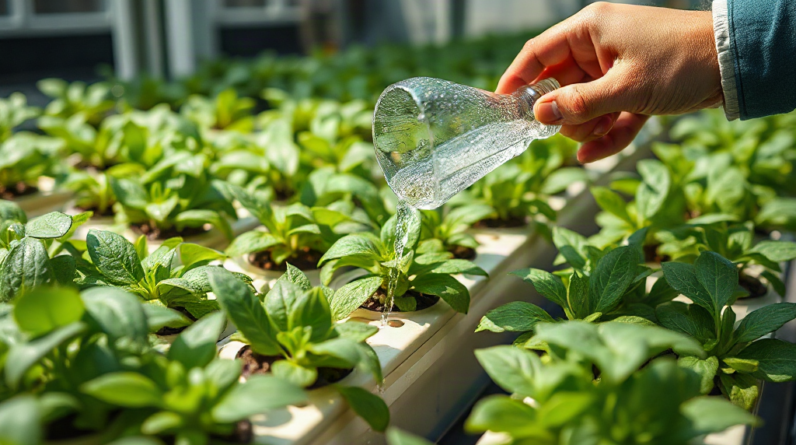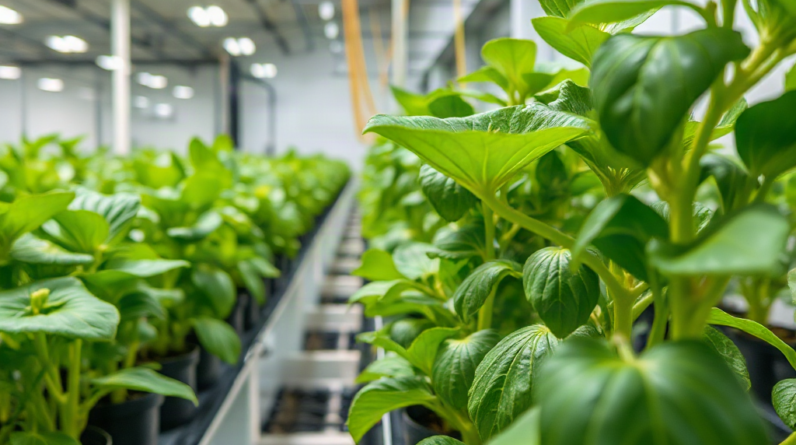
Correct magnesium deficiency on older hydroponic leaves by first confirming interveinal chlorosis, checking root-zone pH and EC, and then making a measured magnesium sulfate adjustment rather than blindly increasing the entire nutrient formula. Magnesium is mobile within plants, so shortages usually appear first as yellowing between green veins on mature foliage while newer growth remains comparatively healthy. Correct pH-related lockout, excessive potassium or calcium, and reservoir imbalance before adding more magnesium. After correction, judge success mainly by healthy new growth and halted symptom progression because damaged older leaves may remain mottled or discolored.
Confirm That Older Leaves Show a Magnesium Problem
Magnesium deficiency has a recognizable location and pattern: symptoms generally begin on older leaves because the plant can move magnesium from mature tissue toward developing shoots. The tissue between the veins becomes pale green or yellow while the veins remain greener. As the shortage progresses, mottling may become more pronounced, leaf margins may develop rusty or brown areas, and affected leaves can eventually become brittle.
Leaf position matters as much as color. Uniform yellowing across an entire older leaf may point more strongly toward nitrogen shortage, while iron-related chlorosis usually appears first on young leaves. Potassium problems commonly produce marginal scorching or spotting rather than a clean interveinal pattern. Disease, root injury, intense light, and normal aging can further complicate identification, so color alone should not trigger a magnesium addition.
Consider a mature hydroponic tomato with pale lower leaves but a green canopy. If the lower leaves show yellow tissue bounded by distinctly green veins, magnesium deserves attention. If those same leaves are uniformly yellow and the entire plant is losing vigor, the nutrient balance may involve nitrogen or a broader root-zone problem. On lettuce, natural shading and senescence of the lowest leaves can look less patterned and should not automatically be treated as a mineral shortage.
Inspect several plants rather than the most damaged specimen. A reservoir-wide imbalance tends to create a similar progression across plants sharing the solution. Symptoms limited to one plant may instead reflect a pinched root mass, blocked emitter, crown damage, or uneven access to the solution. Record which leaves are affected, photograph their pattern, and inspect roots for discoloration, odor, or tissue breakdown.
A sound diagnosis therefore combines three observations: older-leaf interveinal chlorosis, a consistent pattern among plants using the same reservoir, and root-zone measurements that could explain reduced magnesium supply or uptake. The related topic page on Magnesium deficiency correction on older hydroponic leaves can be used alongside a crop-specific nutrient schedule, but the schedule should never replace direct measurements. Treating a visual symptom without checking the reservoir risks adding magnesium to a solution that already contains enough.
Check pH, EC, and Competing Nutrients Before Dosing
A plant can display magnesium deficiency even when magnesium is present in the reservoir. Uptake depends on root health, solution pH, total salt concentration, water chemistry, and the relative abundance of other positively charged nutrients. Adding magnesium before examining those conditions can raise EC without resolving the actual restriction.
Measure pH with a calibrated meter and compare the result with the range recommended for the crop and nutrient product. Many hydroponic crops are managed in a mildly acidic root zone, often around pH 5.5 to 6.5, although the appropriate operating band varies by crop, growth stage, substrate, and system. A persistent reading outside the intended band can reduce nutrient availability. Avoid chasing a single reading with repeated acid or base additions; confirm the measurement, examine the trend, and adjust gradually.
EC provides a different piece of the diagnosis. A low EC combined with falling reservoir strength may indicate that the crop has consumed nutrients faster than the solution was replenished. A high or rising EC can indicate concentration from water loss, inaccurate mixing, salt accumulation, or unbalanced top-offs. In the latter situation, adding Epsom salt increases the dissolved-ion load and may aggravate root stress. Replacing part or all of the solution with a correctly mixed formula is often cleaner than layering another amendment onto an uncertain reservoir.
Calcium, potassium, and magnesium also interact through competition at the root surface. A grower who repeatedly adds a calcium supplement, for example, may create a solution whose ratios differ substantially from the base formula. High potassium can likewise make magnesium uptake more difficult even if a laboratory analysis would show magnesium in the water. The answer is not to remove calcium or potassium indiscriminately; plants need all three. Instead, return to the manufacturer’s complete formula and account for every additive already used.
Source water changes the calculation. Hard water may contribute calcium and magnesium, while reverse-osmosis water contributes very little mineral content and may require a formula designed for low-alkalinity water. Compare the water report, nutrient label, and mixing history before deciding that extra magnesium is missing. For a practical reservoir review, use this compact priority order:
- Verify the meters: Calibrate pH and EC instruments and retest a fresh sample.
- Inspect roots and delivery: Confirm oxygenation, circulation, temperature stability, and unobstructed flow.
- Review every input: Include base nutrients, calcium supplements, pH adjusters, and previous magnesium additions.
- Correct the solution first: Restore the crop’s intended pH and EC before considering a separate dose.
This sequence separates a true supply shortage from lockout, concentration, and root damage. It also prevents a common failure mode: treating leaf color repeatedly while the underlying reservoir drifts farther from a balanced composition.
Apply Magnesium Sulfate Without Overcorrecting
Magnesium sulfate, commonly sold as plain Epsom salt, supplies magnesium and sulfur without adding calcium or nitrogen. It is useful when the diagnosis and mixing records indicate a genuine magnesium gap, but it should be treated as a measured nutrient input rather than a harmless household remedy. The required amount depends on the existing formula, source water, reservoir volume, crop, and product purity.
Start with the nutrient manufacturer’s crop-specific guidance whenever it gives a magnesium correction rate. If the label does not address supplemental magnesium, calculate the elemental magnesium contribution instead of relying on a spoon-per-gallon recipe copied from an unrelated system. Product composition can differ, kitchen spoons are imprecise, and a rate suitable for a large fruiting crop may be excessive for seedlings or leafy greens. A gram scale and known reservoir volume produce a more defensible adjustment.
Dissolve the measured magnesium sulfate completely in a separate container of water before adding it to the reservoir. Add the diluted solution slowly where circulation is strong, allow the system to mix, and then recheck EC. Do not combine concentrated magnesium sulfate directly with concentrated stock nutrients. Concentrates can react or precipitate before dilution, leaving nutrients unavailable and creating sediment in tanks or lines.
A conservative correction is usually preferable to a large one-time dose. If the reservoir’s history is unreliable, replacing it with freshly mixed complete nutrients may be safer than supplementing. For example, a deep-water culture grower who has repeatedly topped up with nutrient concentrate may not know the remaining calcium, potassium, or magnesium levels. Resetting the reservoir restores known proportions; adding Epsom salt only adds another unknown.
Foliar magnesium sprays are sometimes used for a rapid response, but they are not a substitute for correcting the root-zone imbalance. Concentrated sprays can mark leaves, interact with pesticide residues, or create moisture conditions that favor foliar disease. Uptake also varies with leaf surface, environment, and crop. Root-zone correction is the more durable approach when the reservoir itself is deficient. If a foliar product is used, follow its label, test a small area, and avoid spraying under intense light.
More magnesium is not inherently better. Excess supplementation can raise EC, distort nutrient ratios, and conceal a failing base-nutrient program. Keep a dated record of the product, mass added, reservoir volume, pH, EC, and plant response. That record turns Magnesium deficiency correction on older hydroponic leaves from guesswork into a controlled adjustment that can be evaluated and, if necessary, reversed through dilution or solution replacement.
Track New Growth and Prevent the Deficiency From Returning
Successful correction is shown first by stable symptoms and healthy developing foliage, not by old leaves turning perfectly green. Chlorophyll loss and tissue damage on mature leaves may be only partly reversible. Expecting every affected leaf to recover often leads growers to add another dose too soon, creating an excess while the plant is already responding.
Mark or photograph the boundary between affected and healthy foliage on the day of correction. Over the following several days, watch whether interveinal yellowing continues to climb into newer leaves. Also track pH and EC at the same time each day, because rapidly changing water levels can make isolated readings misleading. Healthy new leaves, resumed growth, and no spread into the middle canopy are more useful signals than cosmetic improvement in the oldest tissue.
Failure has several recognizable forms. Continued symptom progression despite an appropriate magnesium addition suggests that the diagnosis may be wrong, the pH remains unsuitable, roots are impaired, or competition from other nutrients persists. A sharp EC increase, leaf-edge burn, or slowed water uptake after dosing suggests that the correction was too strong for current conditions. Dilution or a freshly mixed reservoir may then be more appropriate than another additive.
Do not remove every affected leaf immediately. Older leaves that still contain green tissue can continue contributing photosynthesis, and removing too much foliage at once reduces the plant’s working leaf area. Remove a leaf when it is mostly dead, diseased, shading critical growth, or no longer functional. Use clean tools and avoid aggressive pruning while the crop is recovering from root-zone stress.
Prevention depends on repeatable reservoir management. Mix complete nutrients in the prescribed order, measure accurately, and avoid making routine additions merely because a previous crop once needed them. Account for source-water minerals and select a base formula appropriate for hard water or reverse-osmosis water. Periodic solution replacement is especially useful in recirculating systems where plants remove ions at different rates and top-offs gradually alter the original balance.
Crop stage also matters. Fruiting plants can have different nutrient demand than seedlings, while rapid vegetative growth may expose a marginal supply sooner than slow growth. Adjust the complete feeding program as the crop changes rather than treating each recurrence as an isolated Epsom salt problem. Consistent records of water use, EC, pH, formula strength, and visible symptoms make recurring patterns easier to identify. If the same deficiency returns after every correction, examine the base formula, water profile, and nutrient ratios instead of increasing the supplemental dose indefinitely.
Frequently Asked Questions
Will magnesium-deficient older leaves become green again?
Mild chlorosis may improve, but heavily mottled or necrotic tissue often remains damaged. Judge the correction by symptom stabilization and healthy new foliage rather than complete restoration of old leaves.
Is Epsom salt safe for every hydroponic system?
Plain magnesium sulfate can be used in hydroponics, but only after accounting for the base formula, source water, reservoir volume, and EC. Unmeasured additions can create excess salts or nutrient imbalance.
How quickly should plants respond to added magnesium?
Progression may begin to stabilize within several days under healthy root conditions, but visible timing varies by crop and severity. Continued deterioration warrants a fresh review of pH, roots, and diagnosis.
Can incorrect pH cause magnesium symptoms?
Yes. An unsuitable or unstable root-zone pH can restrict uptake even when the solution contains magnesium. Confirm meter calibration and correct the solution gradually before adding more mineral salts.
Should damaged lower leaves be removed?
Keep leaves that retain useful green tissue unless they are diseased or obstructive. Remove mostly dead leaves with clean tools, avoiding heavy defoliation while the plant is recovering.
Conclusion
Older-leaf interveinal chlorosis is a useful clue, but it becomes actionable only when it agrees with reservoir measurements, root condition, and the crop’s feeding history. Verify pH and EC, review calcium and potassium inputs, and decide whether a clean reservoir change is more reliable than another amendment. When supplemental magnesium is justified, weigh and pre-dissolve magnesium sulfate, add it conservatively, and document the resulting EC.
Monitor the boundary between damaged and healthy foliage instead of repeatedly dosing for cosmetic repair. Stable older-leaf symptoms and normal new growth indicate better progress than waiting for severely yellow tissue to regain color. If the pattern keeps returning, investigate source water and the complete nutrient program; repeated Epsom salt additions are not a durable substitute for balanced reservoir management.