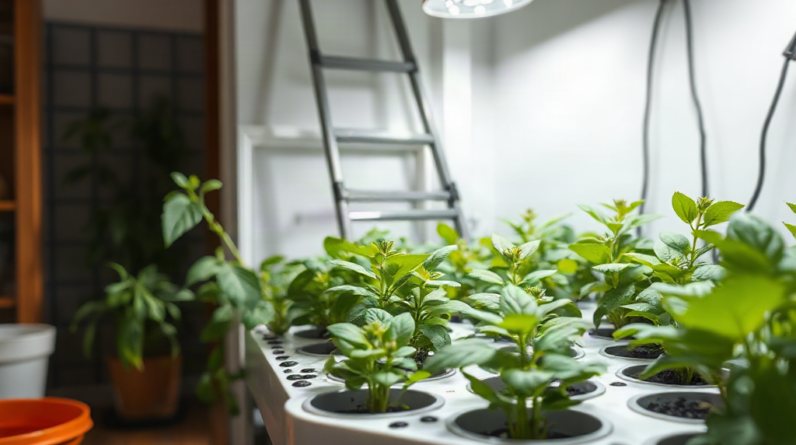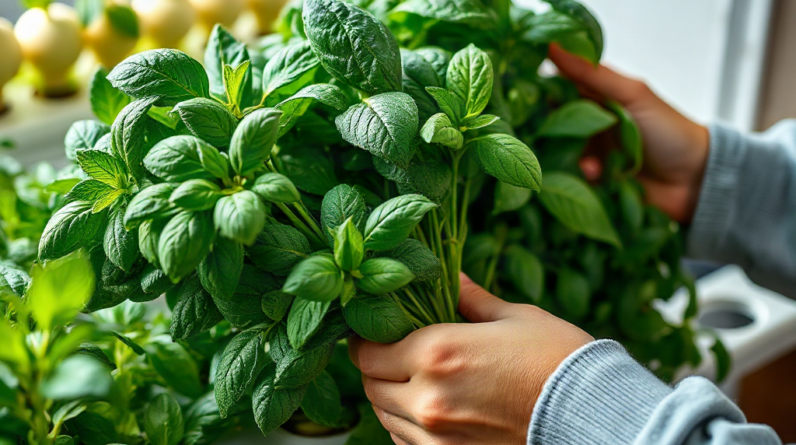
Harvesting hydroponic herbs without stopping growth depends on taking small, well-timed cuts above active leaf nodes while leaving enough foliage for photosynthesis. Cut basil, mint, oregano, and similar herbs with clean scissors, remove no more than about one-third of the plant at once, and avoid stripping the lowest healthy leaves. Harvest just above a node so two side shoots can develop, then keep light, airflow, root-zone conditions, and nutrient strength stable while the plant recovers. Frequent light harvests usually outperform one severe cut, but weak, flowering, crowded, or diseased plants may need pruning or renewal before they can produce another useful flush.
How Regrowth Depends on the Cut
Hydroponic herbs regrow from active growth points, usually called nodes, where leaves and side shoots meet the stem. A cut made just above a healthy node redirects the plant toward the buds below it. A cut made through a bare section may leave a stub that produces little useful growth, while a cut that removes every leaf reduces the plant’s ability to make energy during recovery.
Leaf removal is therefore a balance rather than a race to collect the largest handful. Basil, mint, lemon balm, and oregano can often tolerate repeated tip harvests because their stems branch readily. Parsley and cilantro behave differently: harvesting individual outer stems preserves the central crown, whereas cutting the whole plant low can shorten its productive life. The plant’s architecture matters as much as the quantity removed.
A practical limit is to take roughly one-quarter to one-third of a vigorous plant in a session. Smaller harvests every few days are generally less disruptive than a single heavy pruning event. This approach also gives the grower a chance to notice whether new shoots are enlarging, whether leaves are paling, or whether roots and stems show stress before making another cut.
Do not treat every plant as harvest-ready simply because it has reached a convenient height. Thin stems, stretched spacing, pale new leaves, or a small root system indicate that the plant is using its resources to recover or adapt. In that situation, a light tip pinch may be reasonable, but a large harvest can delay development. The useful comparison is not “more leaves today” versus “fewer leaves today”; it is a modest harvest now versus a weakened plant that needs much longer to rebuild.
For a more detailed look at Harvesting hydroponic herbs without stopping growth, watch the nodes first and the overall height second. The best cut leaves a compact plant with several healthy leaves still exposed to the light.
Timing and Technique for Common Herbs
The best harvest timing is usually just before the plant begins to flower, when leaves are well developed but stems have not become excessively woody. Basil is especially responsive when its growing tips are pinched above a pair of leaves. Each remaining node may then produce two branches, creating a fuller canopy. If flower buds appear, remove them promptly when the goal is tender foliage, because flowering changes the plant’s growth priority and can alter flavor.
Mint should be cut in the same general way, but its vigorous runners can quickly shade neighboring plants. Take upright stems above a leaf pair and thin crowded sections rather than repeatedly shortening every stem to the same height. Oregano and thyme benefit from selective tip harvesting; avoid cutting deeply into old, leafless wood because replacement shoots may be slow or absent. Chives can be cut several centimeters above the base, leaving enough green tissue for continued photosynthesis.
Parsley rewards a different method. Remove the oldest outer stalks individually at the base, while leaving the central emerging leaves untouched. Cilantro is less dependable as a long-term cut-and-regrow crop because it tends to bolt as it matures. A light outer-stem harvest can extend useful production, but it cannot permanently prevent flowering. Growers wanting continuous cilantro often sow new plants in succession rather than forcing one aging plant to recover.
Use sharp, clean scissors or snips and make a clean cut rather than crushing the stem. Harvest when the foliage is dry, preferably during the cooler part of the light cycle or shortly after it begins, so freshly cut tissue is not immediately exposed to intense heat and rapid water loss. Remove damaged or diseased leaves separately and do not place them with marketable material.
A common misconception is that pinching the tallest point anywhere on the stem always creates a productive plant. It only works well when viable nodes remain below the cut. Compare a basil tip with two strong leaf pairs below it to a long, bare mint stem: the first is suitable for shaping, while the second may need a higher cut or replacement. The same principle applies whether the garden uses deep water culture, nutrient film technique, or a small recirculating drip system.
Keeping Plants Productive After Harvest
Harvesting does not create new growth by itself; it exposes the plant’s ability to replace what was removed. Light must reach the remaining leaves, roots must receive adequate oxygen, and the nutrient solution must remain within the range appropriate for the crop and growth stage. Increasing nutrient concentration immediately after a harvest is usually a weak response to slow regrowth. If the plant is short on light or oxygen, stronger feed can add stress instead of supplying a solution.
Check the environment before changing several variables. New shoots that are green and expanding suggest that the plant is recovering normally. Persistent wilting, brown roots, curling leaves, or a sour reservoir odor point to a root-zone or sanitation problem that should be addressed before another substantial harvest. In a warm indoor area, airflow becomes particularly valuable because dense herb canopies retain moisture around cut sites and make leaves stay wet longer.
Spacing is a production decision, not merely an appearance issue. A basil plant with broad leaves pressed against its neighbor may technically be growing, yet shaded lower nodes will contribute little to future harvests. Removing one congested stem can produce more usable foliage than taking a handful from every plant. For mint, regular thinning is often preferable to letting runners fill the channel and then cutting the entire mass back.
Reservoir stability also affects the interval between harvests. Keep the solution level, temperature, aeration, and feeding schedule consistent rather than making a large correction because the canopy looks temporarily smaller. Top up according to the garden’s established practice, inspect the roots, and verify readings with calibrated instruments when available. A plant that repeatedly stalls after cutting may be underlit, root-stressed, overgrown, or simply at the end of its natural productive cycle.
Choose recovery time according to plant condition, not a rigid calendar. A vigorous basil plant may show useful side shoots within days, while woody thyme or a stressed parsley plant may need considerably longer. The tradeoff is clear: harvesting too soon keeps the basket full briefly but can produce smaller, weaker regrowth. Waiting for visible new leaves protects the plant’s reserve and makes the next cut more worthwhile.
Readers comparing techniques can use Harvesting hydroponic herbs without stopping growth as a simple operating principle: preserve active leaves, maintain root conditions, and change one environmental variable at a time.
Mistakes That Cause Slow or Uneven Regrowth
The most damaging mistake is removing too much at once. A plant may look large enough to withstand a severe cut, but its root capacity, light exposure, and previous stress determine how quickly it can replace leaves. Cutting a mature basil down to a few bare stems is not equivalent to pinching several tips. The former can force a long recovery and may expose weak tissue to drying; the latter keeps the plant photosynthetically active.
Another failure is harvesting at one height without considering the canopy. Uniform cuts can leave inner shoots shaded and outer shoots overexposed. Vary the cuts enough to maintain access to light and keep the plant balanced. Do not remove all lower leaves simply because they are older; healthy lower leaves still contribute energy unless they are yellowing, damaged, or blocking essential airflow.
Rough handling creates avoidable damage. Pulling stems, using dull blades, or harvesting with contaminated tools can crush tissue and spread problems between plants. Clean the cutting tool when moving from a questionable plant to a healthy one, and discard material with clear signs of disease rather than trying to mix it into a fresh harvest.
Flowering creates a separate judgment call. Removing flower buds can preserve leafy basil or mint growth for a while, but it does not reverse an aging plant indefinitely. Cilantro that has committed to bolting will often be better replaced through succession planting. Similarly, a woody herb with poor lower growth may be more efficiently renewed from a healthy cutting than repeatedly pruned in the hope of restoring juvenile stems.
Use these signs to decide whether to harvest, wait, or renew:
- Harvest lightly: new leaves are expanding, stems are firm, and the plant has several healthy nodes.
- Wait and inspect: leaves are pale, growth is stretched, or the root zone has inconsistent moisture or oxygen.
- Renew or separate: the plant is woody, repeatedly flowering, diseased, or too crowded to maintain a useful canopy.
These choices prevent the common assumption that every herb is a permanent crop. Continuous harvest works best when the grower combines pruning with replacement plants and accepts that some species have a shorter productive window.
A Repeatable Harvesting Routine
A dependable routine begins with inspection, not cutting. Look at the roots, newest leaves, stem firmness, and spacing. Then select the healthiest shoots and decide whether the goal is a meal-sized harvest, canopy shaping, or removal of flower buds. This small pause prevents a visually large plant from being treated as a fully recovered plant.
Make clean cuts above active nodes, leave enough foliage on every remaining section, and collect only what can be used promptly. If several plants are available, rotate them instead of taking a large share from one specimen. Rotation smooths supply and reduces the chance that a single stressed plant becomes the main source of herbs.
Record the date, herb, approximate amount removed, and appearance of regrowth. A simple note such as “basil: two tips removed; side shoots visible after several days” is more useful than a fixed promise about harvest frequency. Over a few cycles, the record reveals which plants tolerate heavier cuts and which require more recovery time.
After harvesting, return attention to the growing conditions rather than trying to force a response. Confirm that the light reaches the remaining leaves, that air moves through the canopy, and that the reservoir has not drifted from the garden’s normal readings. If regrowth stalls, investigate those conditions before pruning again. For a broader maintenance reference, Harvesting hydroponic herbs without stopping growth should be treated as a cycle of observation, selective cutting, and recovery.
The most efficient setup for steady household use may include plants at different ages: a newly rooted plant, a mature plant being harvested, and another approaching renewal. That arrangement is more reliable than demanding unlimited production from one plant and allows declining herbs to be replaced before the supply disappears.
Frequently Asked Questions
How much of a hydroponic herb should be harvested at once?
Take about one-quarter to one-third of a vigorous plant, leaving several healthy leaves and active nodes. Reduce the amount when the plant is young, pale, stretched, flowering, or recovering from root stress.
Where should basil be cut for continued growth?
Cut just above a pair of healthy leaves or side buds. The remaining node can produce two branches, while cutting through a bare stem may leave a slow or unproductive section.
Can cilantro be harvested continuously in a hydroponic garden?
Cilantro can provide repeated light harvests while it remains vegetative, but it commonly bolts with age. Succession planting is usually more dependable than trying to keep one mature plant productive indefinitely.
Should nutrient strength be increased after harvesting?
Not automatically. First check light, root oxygen, reservoir stability, and plant health. Extra nutrient concentration will not correct inadequate light or damaged roots and may add stress.
Why is new growth slow after a large cut?
Removing too many leaves reduces energy production, and the plant may also be dealing with weak roots, low light, heat, crowding, or flowering. Wait for recovery and correct the limiting condition before making another heavy cut.
Further Reading
Authoritative Sources
- Growing Herbs
extension.umn.eduUniversity Extension guidance on herb growth, harvesting, and maintaining productive plants
- Herbs
extension.illinois.eduPractical education on herb cultivation and crop-specific care from the University of Illinois Extension
Conclusion
Continuous herb harvest comes from preserving the plant’s ability to rebuild, not from cutting as much as possible. Select healthy stems, cut above active nodes, retain enough leaves for photosynthesis, and rotate harvests among plants when a steady supply matters. Basil and mint often respond well to repeated tip cuts, while parsley, cilantro, thyme, and other herbs require more crop-specific handling. Watch new growth, roots, light access, and canopy airflow before changing the nutrient solution. When a plant becomes woody, repeatedly bolts, or stalls despite sound conditions, renewal is more practical than increasingly severe pruning. A small harvest record and a few staggered plants can turn irregular growth into a predictable household supply.
Related Content
- 10 Effective hydroponic root growth tips (2025 Guide) to Boost Your Plants
- Mixed Herb Container Planning for Hydroponic Gardens: Compatible Pairings and Spacing
- Hydroponics: A Gateway to Organic Produce
- Consequences of Underfeeding Hydroponic Plants: Signs, Risks, and Recovery Strategies
- A Comprehensive Guide to Selecting Hydroponic Lighting